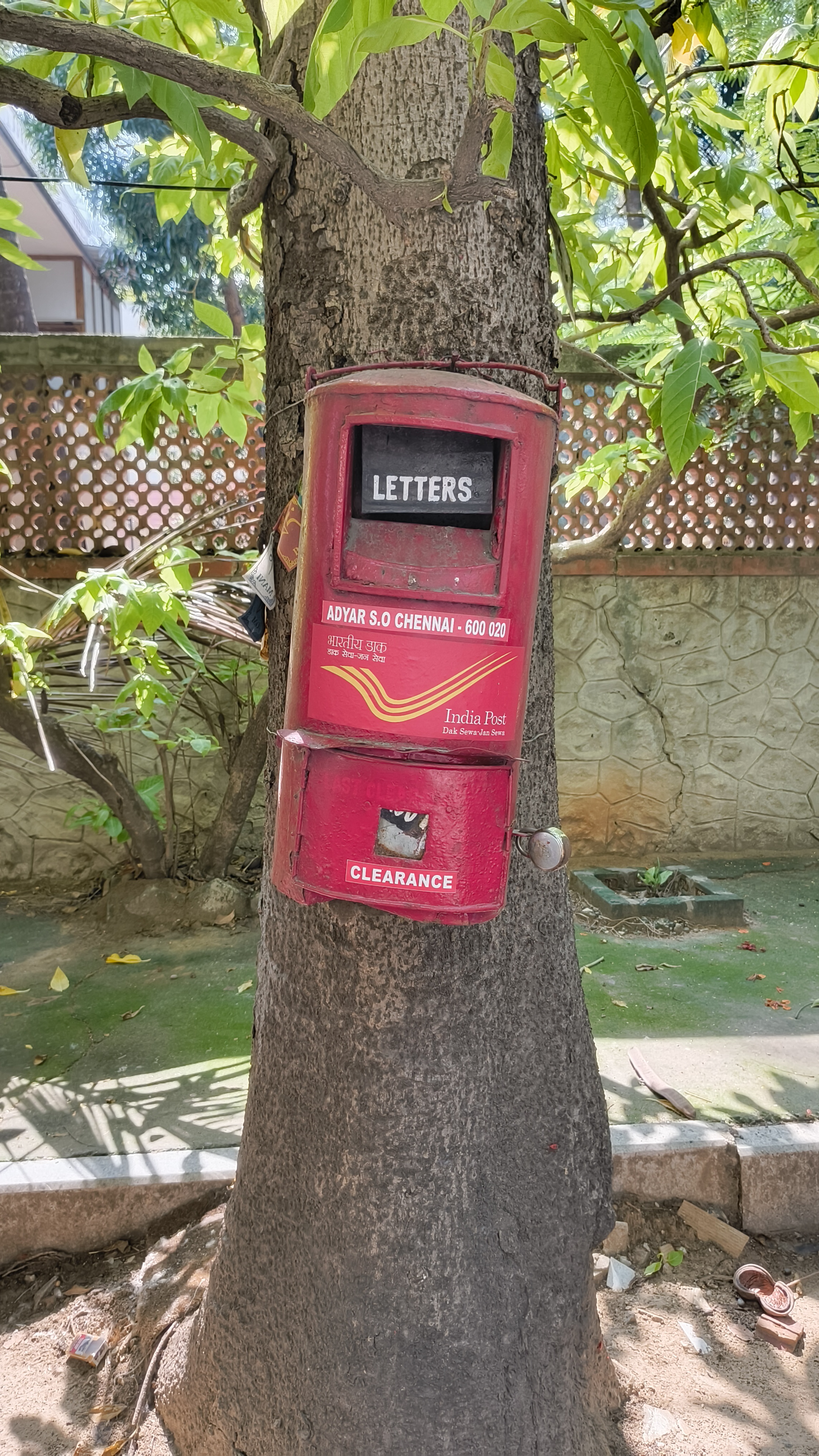
Today I met a friend for lunch. While returning home I spotted something that used to be very common during my childhood days but rare to find these days. Worse even when they are present hardly anyone pays attention to them. I spotted a post-box tied to a tree.
Post boxes were the routers of the pre-internet age. The post-box and the postal system were integral part of the childhood days of my generation. There was a time when the sight of the postman opening the gates of their house would make the kids jump in joy. Among the several well-known brands in India, India Post was one. Almost everyone could instantly recognize the deep red and bright yellow colours of India Post.
Before our household got a landline telephone, the only way to receive any message from relatives who lived in another town was through a post card or inland letter. One of the simple joys of my childhood days were those occasions when my dad or mom would allow me to drop a post-card or letter into a post-box. Receiving greeting cards for festivals or birthday cards made those occasions even more special. The most recent birthday card that I sent was the one that my kids sent my nephew a few months ago.
Post-stamps were one of the most cherished collectibles of my childhood days. The post-stamps that were collected were mostly the old post-stamps with seal that were carefully removed from the letter that the household received. Kids in those days were practitioners of Zen and the Art of Retrieving Postal-Stamps. To remove a stamp from a letter completely in tact was a fine art form – it tested patience, perseverance and skill. And if the letter would have a unique stamp and not one of the usual ones, my joy would be boundless.
Post-cards had a special place during my childhood days. During my schooldays around April just before our annual exams started, each of us had to submit a self-addressed post-card to our respective class teacher. The school will use the post-card to inform each student and his/ her family if the student has been promoted or not. So, towards the end of summer vacation, we would all be eagerly waiting to hear these words: “Sir, Post.” The last post-card that I have managed to retain/ save is the one that my college friend, Prabhu wrote me while I was pursuing masters in Delhi.
When I was doing masters (2002 – 2004), mobile phones started gaining traction. Then came smartphones and social media. With their rise the habit of sending letters, post-cards and greeting cards began to wane. Then came WhatsApp as the primary mode of communication. Now messages are hardly two sentences long. Most responses are just emojis or internet slang like LOL, ROFL, etc.
What happened to the custom/habit of sending greeting cards for festivals? In the world of WhatsApp each one of us is like a hippie scavenging for valuables in a dustbin. We forward a greeting message from school group to college group, forward greeting message from office group to family group and so on. The habit of coming up with an original, thoughtful greetings message has been degraded by mass-ritual of ‘Forwarding.’
In the 80s and 90s the process of wishing family members and friends living in another town for Deepavali or Pongal would start at least two weeks in advance. With pocket-money being limited, we had to short-list the people to whom we would send greeting cards. Then we had to go to a nearby bookshop or stationery-shop and buy greeting cards with messages that most resonate with us. Then we will write a personalized message as well in each card. For cards that were meant for grandparents every grandchild will write a line or two. Then with the right post-stamp affixed, we will post the cards a few days before the festival to avoid the cards getting delivered after the festival. Even after all these, we can only know whether the card got delivered and in time for the festival only when we meet the addressee in person the next time. That was an era in which the virtue of patience as embedded in everyday life by default.
With smartphones and digital platforms, our conversations are near instantaneous. With GenAI tools and native AI capabilities of digital platforms we don’t even have to bother our neurons to come up with anything original. The art of thoughtful conversation is fast vanishing. Sometimes one has to wonder net-net whether we have gained or lost by embracing free and instant digital communication. We are digitally connected but emotionally detached. Most people message us because the platform is free and most importantly the effort involved is minimal – just a couple of swipes of the thumb or index finger across a glass surface. We are always online but always distracted as well. Today every act is convenient, but nothing is conscious and thoughtful anymore. In the age of GenAI, most of our messages are statistically predicted digital vomit devoid of emotion & life.
The digital world has made communication easier and convenient but has reduced our treasured moments into trivial ones. As communication has become digital, not only are post-boxes becoming fossilized, but connections are also becoming superficial. There is no more eagerness to send a message to family or friend as I know that I can reach them any time with a couple of taps and swipes on my smartphone. There is no more anticipation for responses too as most responses are some variants of the digital platform’s auto suggestions. In our pursuit of convenience at industrial scale, we have turned our unique human experiences pedestrian and lifeless. In the short run these digital platforms offer us convenience but in the long-run they eviscerate our experience of being human – a devil’s bargain.


