
Sleeptime




Today I met a friend for lunch. While returning home I spotted something that used to be very common during my childhood days but rare to find these days. Worse even when they are present hardly anyone pays attention to them. I spotted a post-box tied to a tree.
Post boxes were the routers of the pre-internet age. The post-box and the postal system were integral part of the childhood days of my generation. There was a time when the sight of the postman opening the gates of their house would make the kids jump in joy. Among the several well-known brands in India, India Post was one. Almost everyone could instantly recognize the deep red and bright yellow colours of India Post.
Before our household got a landline telephone, the only way to receive any message from relatives who lived in another town was through a post card or inland letter. One of the simple joys of my childhood days were those occasions when my dad or mom would allow me to drop a post-card or letter into a post-box. Receiving greeting cards for festivals or birthday cards made those occasions even more special. The most recent birthday card that I sent was the one that my kids sent my nephew a few months ago.
Post-stamps were one of the most cherished collectibles of my childhood days. The post-stamps that were collected were mostly the old post-stamps with seal that were carefully removed from the letter that the household received. Kids in those days were practitioners of Zen and the Art of Retrieving Postal-Stamps. To remove a stamp from a letter completely in tact was a fine art form – it tested patience, perseverance and skill. And if the letter would have a unique stamp and not one of the usual ones, my joy would be boundless.
Post-cards had a special place during my childhood days. During my schooldays around April just before our annual exams started, each of us had to submit a self-addressed post-card to our respective class teacher. The school will use the post-card to inform each student and his/ her family if the student has been promoted or not. So, towards the end of summer vacation, we would all be eagerly waiting to hear these words: “Sir, Post.” The last post-card that I have managed to retain/ save is the one that my college friend, Prabhu wrote me while I was pursuing masters in Delhi.
When I was doing masters (2002 – 2004), mobile phones started gaining traction. Then came smartphones and social media. With their rise the habit of sending letters, post-cards and greeting cards began to wane. Then came WhatsApp as the primary mode of communication. Now messages are hardly two sentences long. Most responses are just emojis or internet slang like LOL, ROFL, etc.
What happened to the custom/habit of sending greeting cards for festivals? In the world of WhatsApp each one of us is like a hippie scavenging for valuables in a dustbin. We forward a greeting message from school group to college group, forward greeting message from office group to family group and so on. The habit of coming up with an original, thoughtful greetings message has been degraded by mass-ritual of ‘Forwarding.’
In the 80s and 90s the process of wishing family members and friends living in another town for Deepavali or Pongal would start at least two weeks in advance. With pocket-money being limited, we had to short-list the people to whom we would send greeting cards. Then we had to go to a nearby bookshop or stationery-shop and buy greeting cards with messages that most resonate with us. Then we will write a personalized message as well in each card. For cards that were meant for grandparents every grandchild will write a line or two. Then with the right post-stamp affixed, we will post the cards a few days before the festival to avoid the cards getting delivered after the festival. Even after all these, we can only know whether the card got delivered and in time for the festival only when we meet the addressee in person the next time. That was an era in which the virtue of patience as embedded in everyday life by default.
With smartphones and digital platforms, our conversations are near instantaneous. With GenAI tools and native AI capabilities of digital platforms we don’t even have to bother our neurons to come up with anything original. The art of thoughtful conversation is fast vanishing. Sometimes one has to wonder net-net whether we have gained or lost by embracing free and instant digital communication. We are digitally connected but emotionally detached. Most people message us because the platform is free and most importantly the effort involved is minimal – just a couple of swipes of the thumb or index finger across a glass surface. We are always online but always distracted as well. Today every act is convenient, but nothing is conscious and thoughtful anymore. In the age of GenAI, most of our messages are statistically predicted digital vomit devoid of emotion & life.
The digital world has made communication easier and convenient but has reduced our treasured moments into trivial ones. As communication has become digital, not only are post-boxes becoming fossilized, but connections are also becoming superficial. There is no more eagerness to send a message to family or friend as I know that I can reach them any time with a couple of taps and swipes on my smartphone. There is no more anticipation for responses too as most responses are some variants of the digital platform’s auto suggestions. In our pursuit of convenience at industrial scale, we have turned our unique human experiences pedestrian and lifeless. In the short run these digital platforms offer us convenience but in the long-run they eviscerate our experience of being human – a devil’s bargain.
“Are you a new student?” he asked.
“Yes,” I replied.
“Which section?”
“I don’t know.”
“What’s your name?”
“Yogesh. And what’s your name?”
“Vinci Raj. N.C. Vinci Raj.”
“Can you repeat the name once again?”
“Vinci Raj. N.C. Vinci Raj.”
I had a hard time getting the name. For a moment I thought it was Linci Raj. But one of the other boys called him as, “Vinci.” So, it’s Vinci Rraj. Very different name compared to the Raja, Ram, Ramesh, etc. that were very common in those days.
This was my interaction on the first day at my new school standing in the assembly area in June 1994. My family had recently relocated back to Chennai. And I had joined Boston Matriculation School in Nandanam, Chennai or Madras as it was called then.
The ground where we had assembled was rectangular in shape with two buildings on either side (I would get to know in a few minutes that the one on the left is primary block and the one on the right is secondary block). The ground was covered in sand, resembled a football field but neither had the length or breadth to be a proper football field.
One the far side, there was a room (P T Room) and there was a shed for school bus adjoining the room. Beyond them there was garden spanning the entire breadth covering the ground and both the buildings. The grass in the garden was patchy, almost like hair on a bald guy’s head. But there were a number of coconut trees and a few neem trees providing ample shade. On the far side of the garden, there was a huge compound wall protecting the ground and the school from the Adyar River.
Smack in the middle of the ground floor of the secondary block I was able to see a mike. A bunch of students with a Shruthi box and a couple of teachers had gathered around the mike. The entire school assembled in the ground standing as per classes facing the mike.
“Is he a new student?” one of the boys asked Vinci Raj pointing to me.
“Yes. His name is Yogesh,” He replied.
The voice of the PT master started the prayer session in earnest. In this school they didn’t call it prayer session, it was called Bhajan session. After a few announcements, the P T master handed over the mike to the principal. After a few instructions, the principal handed over the mike to students standing with the Shruthi box.
They started singing and everyone started singing along with them. Probably, I was the only one who was not singing. The Bhajans were sung in three languages – Tamil, Sanskrit and English. The English songs were sung by an Anglo-Indian teacher. I would take me a few weeks to learn those songs.
Post the assembly, the students had to go to their classes. It was the first day of school. But the students were walking towards their classes with the same enthusiasm of Goat that were being taken on a Bakrid procession. It took forever for the turn of 9th standard students to march towards our classrooms.
We marched or rather strolled to reach the 2nd floor. I was surprised when all of us were made to sit outside our classrooms. Mrs. Chithra, one of the senior-most teachers was in charge of allocating sections. When it was my turn, she asked for my admission card.
“What’s your second language?” she asked as she was looking at my admission card.
‘Tamil Miss,” I replied.
She turned to the teacher standing next to her and said, “Let’s put him in 9B. There are already too many students in 9A.” The teacher noted down my name on the students list that she was holding. Within a few minutes the students allocation process was over. There were a couple of others who joined the school that year like me.
Once the process was over, the teachers asked us to go to our respective classes. Without much commotion the students were entering the classrooms. I was the last to enter. I looked around as I entered the room.
In a room full of strangers, I could recognize one person. Vinci Raj, N.C. Vinci Raj.
Note: True to the name that he shares with Leonardo Da Vinci, Vinci Raj went on to embrace his artistic side. He is creative director, has made a number of short films and has even given a TEDx talk. He has won a number of awards for his creations. You can check his portfolio here.
This is the fourth post in the series, ‘From Chennai to Madras Down the Memory Lane’
1st post in the series: A Friend’s House
2nd post in the series: Sharing Slivers of Joy
3rd post in the series: The Audience Laughed when Jacked Died of Hypothermia

I was in high school when the movie Titanic was released. A bunch of us in school decided to go and watch the movie as the movie had a sensational hit across the world and Kate Winslet became a sensational hit amongst us.
In those pre-internet days, to reserve a movie ticket one had to go in-person to the theatre a few days before the day of the show, wait in queue and book the ticket. Then the person has to come back on the day of the movie show and watch the movie. So, two trips to make sure that you get to watch the movie.
My friend Venkat, his brother, a classmate of ours and I went to went to Devi Theatre complex on Mount Road to watch the movie. Since the movie had been theatre for a few weeks by then, we thought we should be able to get the tickets at the counter itself if we go a couple of hours prior to the show.
Turned out that our collective instinct was wrong. We saw houseful board at the counter when we reached the theatre. But we managed to buy tickets from one of the guys who was selling the tickets with a markup. Only two of tickets were for seats adjacent to each other. The other two were scattered in random corners in the theatre. Too bad. But in those days, it was considered better than going home without watching the movie.
Devi Complex had four theatres: Devi, Devi Bala, Devi Kala and Devi Paradise. We got tickets for the Titanic movie at Devi, the biggest and grandest of the four theatres. Incidentally the movie Titanic ran for 365 days in Devi theatre.
Devi theatre was one of India’s first theatres to install Dolby audio. In those days Devi Complex competed with Satyam Cinemas for the best multiplex in Chennai. Alas, Satyam won the battle in subsequent years because of tasty popcorn!
Devi theatre is a large movie hall by today’s multiplex movie hall standards. All the movie classes in the theatre were in the same level. It was one large movie hall – end to end.
We settled down in our seats right on time for the movie to start. The grandeur of the onscreen Titanic ship mesmerized me. The beauty and charm of Kate Winslet as Rose eclipsed even the grandeur of the Titanic. And Leonardo Di Caprio as Jack unnecessarily tagged along with Rose throughout the movie.
The plot moved seamlessly towards the tragedy of the sinking of the Titanic due to the collision with an iceberg. Everyone in the theatre was hooked to the screen. Then the heart wrenching scene slowly unfolded. To save Rose from drowning, Jack decides to stay in the cold Atlantic waters. As a result, Jack dies of Hypothermia. Rose if heartbroken on realizing that Jack is dead.
You could sense the collective sadness in the movie hall. At this very juncture, I heard the voice of my classmate saying, ‘Jack Illana Yenna Ma, Naan Iruken Unaku.’ (Translation: What if Jack is no more; I am there for you). A tsunami of laughter swept through the entire movie hall! Even after the laughter died down, the humor vibe still lingered in the air.
And so, an off-the-cuff remark by a mischievous teenager evoked an anti-climatic response from the audience for the most iconic scene from a movie that went on to win 11 Oscars and made more than $1 Billion in box-office collections. In that moment, my classmate became the David who vanquished James Cameroon, the Goliath with a verbal pebble.

This is the third post in the series, ‘From Chennai to Madras Down the Memory Lane’
1st post in the series: A Friend’s House
2nd post in the series: Sharing Slivers of Joy
4th post in the series: First Interaction in New School
“You can say hi. I am not going to grab your cream bun and run away,” my classmate from French class uttered these words as she was walking past our group on Chamiers Road.
No sooner than she finished this sentence, all my friends started laughing boisterously. As if taking their cue, the guy who was manning the bakery counter also started laughing out loudly.
I did not know how to react. There was no place for me to hide. The only thought that came to my mind was, “Three of her Computer Science classmates are also here. Why on earth did she target me?”
Every group of friends would have a place where they would assemble after school, college, gym session, etc. to chit chat, make fun of each other and simply while away time.
For my group at Boston Matriculation School, it was a bakery on Chamiers Road just beside the bus stand, at a couple of minutes walking distance from our school. There was also a pharmacy adjacent to the bakery.
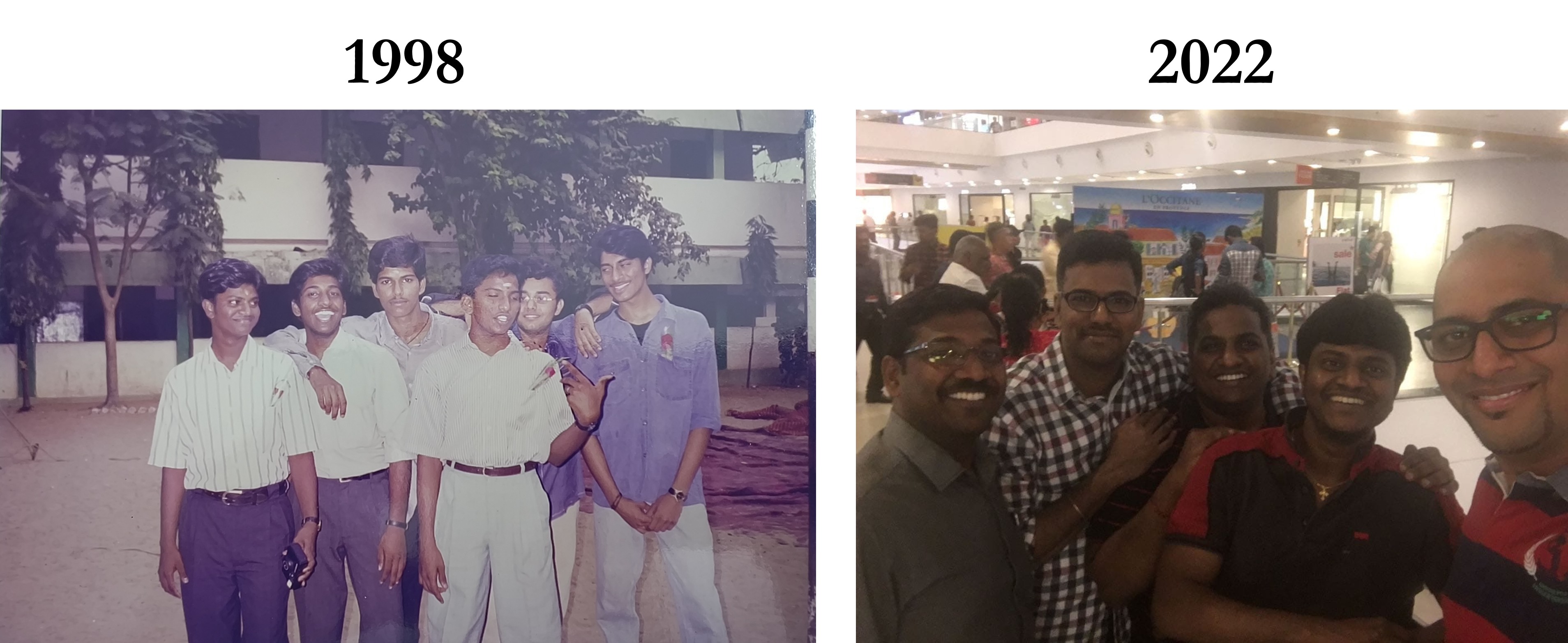
My friends Pramod, Vishnu & Nambi from Computer Science group as well as Venkat, Palani and myself from Biology group would assemble at the bakery after school with amazing regularity. There were days in which a couple of other batchmates would also join us. Since we went there so often the person manning the counter at bakery, who was in his mid-twenties, also became a part of our gang.
We would turn any conversation into an opportunity to laugh at each other. We would tease each other, pass comments about the incidents from the day and so on.
Those were the days of limited means. We would pool the money that we had and buy one or two cream buns depending upon the group size on that particular day. The guy in the bakery would usually cut a cream bun into three pieces. But, for us he would accommodate as many pieces necessary so that all of us would get a piece each.
On most of the days each of us would get a piece of cream bun hardly the size of a thumb. But that did not stop us from having a good time. Going to the bakery after school became a ritual for us. The day would be incomplete without going to that bakery and teasing each other.
Apart from cutting the cream bun into ever smaller pieces, the other skill the bakery guy had was to add fuel to the fire for whatever conversation that we were having. Mostly he would hang around us with an innocent look on his face; it would look like he was attending to other customers and was hardly paying any attention to our conversations.
But he had an amazing knack for eavesdropping and even more amazing knack for timing. He would join our conversations at any crucial juncture and pass a comment, hardly a sentence or two, or a question. And that would make the bad situation worse for whoever was the butt of the joke at that moment. With his mission accomplished he would laugh out louder than any of us and then go back to attending the bakery.
Even though all of us used to talk with girls in our batch, those conversations would begin and end inside our school campus. That being the 90s, people would roll their eyes or even offer a look of contempt if they spot a boy and girl having conversation. People had a very severe hangover of Tamil cinemas and had erected an invisible social wall between boys and girls.
On that particular day, we were at the bakery. We were facing the road while eating and chatting. We spotted our classmate walking towards us. Wanting to avoid any awkward question or comment from our baker friend we decided to avoid any conversation with her and turned towards the bakery counter in unison. But I guess I was a little slow in turning and that probably would have made it very obvious to her that I was trying to avoid looking at her. So, she shot back with her critical observation/ comment. Thankfully that episode ended with just laughter and no follow-up questions from our baker friend.
During our entire 11th & 12th standards we regularly assembled at the bakery after school. Strangely today, I neither remember the name of the bakery or the name of the person who used to be an extended part of our gang. We hardly saw him after completing our school. The bakery closed down a few months after we left school and the pharmacy closed down a couple of years later.
Today the bus stand still exists almost at the same spot where it used to be. The place where the bakery stood and where we used to stand and chat still remains dilapidated nearly 25 years later. It’s so strange to think that the place which used to be our chit-chat spot for more than two years has vanished without a trace. All I am left with are the memories of the good times that we, a bunch of carefree teens had there.

This is the second post in the series, ‘From Chennai to Madras Down the Memory Lane’
1st post in the series: A Friend’s House
3rd post in the series: The Audience Laughed when Jacked Died of Hypothermia
4th post in the series: First Interaction in New School
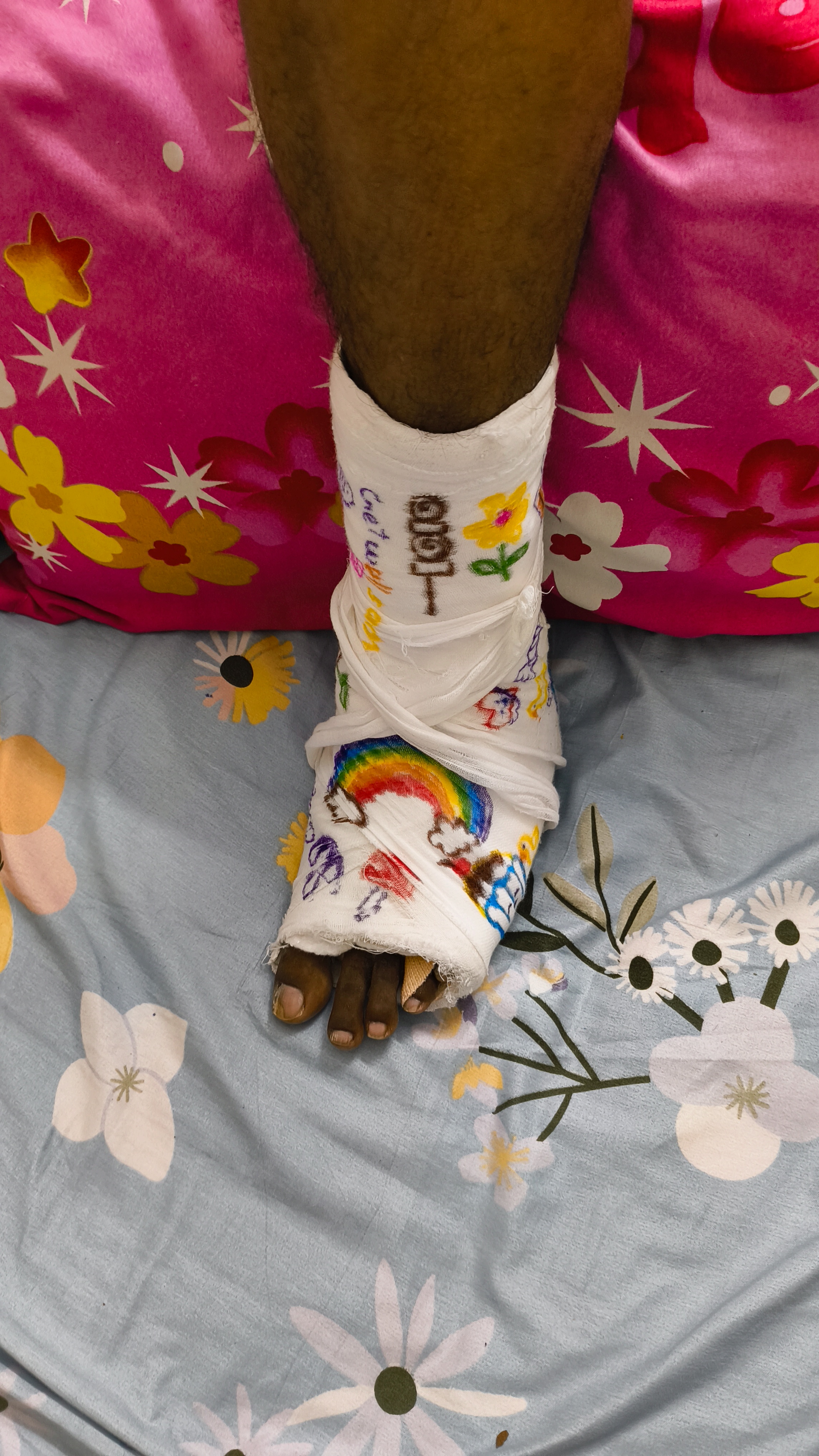
The first day my son saw me with the cast on my leg, he asked me if he could draw on it. I said he can do it later. I was not sure if I was going to have the cast, so I did not allow him to draw.
But on the evening of the penultimate day on which I was supposed to have the cast removed, I asked my son, “Do you want to draw on my cast?”
“Yes,” he ran out of the room as he was replying. He came back with his sketch pen set, sat near my leg, and started drawing on the cast. The first one he drew was a skull similar to the ones we see in danger symbols.
I looked at him. “Dei, I have a fracture, and you are drawing a skull on the cast.”
In response he looked at me with the most mischievous smile that an eight-year-old could come up with.
He continued to draw—a crescent, a star, a candy, and a two-tiered birthday cake with a candle on top of it. Then he looked at me and said, “I am done.”
“Go and call your sister.”
When she came in, I asked her, “Do you want to draw?”
With a smile she started drawing cute Japanese doodles. In between she asked if I had a wish list. I asked her to bring the book ‘How to Draw Almost Every Day’ from the bookshelf.
I flipped through the book and pointed to doodles one after another. She drew for about an hour. I ended up with 24 doodles on my cast. I even published a blog post with a photo of my cast with the doodles as well as a haiku about it.
When I was listening to my wife convey the doctor’s message about a week ago, it was a hopeless situation. If anyone had told me that day that I would manage to retain the cast for the entire duration of eight days, I would have mocked them. But I did manage to retain the cast for the eight days that the doctor had advised.
This stage is only the first and most important phase in the six-plus weeks required for recovery. There are still so many ifs and buts. But I am hopeful of the best outcome.
So, what are the lessons that I learned from my inner battle?
This essay is part 5 of the 5-part personal essay series – Agonizing over a cast
Part 1: https://yogesvr.xyz/2025/10/05/agonizing-over-a-cast-the-crybaby/
Part 2: https://yogesvr.xyz/2025/10/21/agonizing-over-a-cast-the-bad-news/
Part 3: https://yogesvr.xyz/2025/10/22/agonizing-over-a-cast-conjuring-up-scenarios/
Part 4: https://yogesvr.xyz/2025/10/23/agonizing-over-a-cast-the-zen-master-in-the-house/
There is an episode in Hindu mythology in which God Murugan, being a cosmic child, would teach Pranava Mandhiram to his dad, God Shiva—one of the trinity of gods in Hinduism. Because he taught his dad, God Murugan got the title of ‘Thanthaiku Mandhiram Sonnavan’ (translation: The one who taught the sacred hymn to his dad).
With every passing hour of my battle with the itching sensations, I had a profound sense of respect for my son, similar to the reverence that a disciple would have for a Zen master. Maybe kids have an inherent optimism and chirpiness that guard them against such adversaries. That’s something that could not be matched by worn-out souls of forty-somethings. Nonetheless, I decided to use my son’s resolve as an inspiration. If he can manage to have a cast for seven weeks, I can at least try and manage for a week.
Somewhere in between all my ruminations, an insight hit me—I am facing my own version of the Marshmallow Test with a twist. Do I want to endure a lesser pain (cast) in the short term, or do I want to endure more severe pain (two possible surgeries and casts) in the long run?
I first heard about the Marshmallow Test in the TED talk ‘The Discipline of Finishing’ by Conor Neill. ‘The Marshmallow Study,’ or ‘The Marshmallow Test,’ is one of the most famous psychological studies of the second half of the twentieth century. This study was carried out between the late 1960s and early 1970s at Stanford University and was headed by a distinguished professor by the name of Walter Mischel. The key finding of the study is that the ability to delay gratification (self-discipline) in kids, more than intelligence, is a much better predictor of future success.
Once I realized that my situation was a version of the Marshmallow Test, which pain I needed to endure became clear to me. It’s relatively easy to have a moment of realization but very difficult to consistently act based on that insight. The short-term pains, like the real or imagined itching sensation on my left leg, are very concrete. They are effective in drawing our attention towards them. In contrast, long-term pains or gains are very vague, like a daydream. So, I used a combination of insights to come up with my coping mechanism.
In his TED talk, Conor Neil spoke about endurance high-performance athletes. They only worry about the immediate challenge in front of them—sometimes just about one step at a time. I decided not to think about the remaining five days before my next visit to the doctor. I decided not to think about an entire day, not an hour, not even a minute ahead. I decided that I will focus on what I will do when the itching sensation hits.
One of the key insights from the Marshmallow Test is that distraction is an effective strategy when faced with an immediate temptation. Kids who were able to succeed in the Marshmallow Test were able to come up with multiple ways to distract themselves from looking at the short-term temptation or prize in front of them. Whenever the itching sensation hit, I tried to distract my mind. I was mostly successful. We usually consider distraction to be a bane. But, without the ability to get distracted from adversities and bad luck, we would be constantly ruminating about them and pretty soon end up as a nervous wreck.
The human mind is very resilient and tends to cope very well with adversities. After a couple of days, there were only fewer instances of itching sensations and the urge to scratch. I also noticed that mostly the itching sensation subsided after a few seconds even if I didn’t scratch.
In addition, the grip of the cast also loosened in a couple of days. This reduced the episodes of itching sensations further. In fact, the grip loosened so much that I had to see the doctor a couple of days ahead of schedule, as I was worried that the cast was no more effective. The doctor mentioned that it was normal for the cast to become loose with each passing day. He tightened the cast by tying a gauze cloth around it. I felt uncomfortable for the rest of the day but was pretty much unbothered from the next day. I am reminded about a comment by one of my professors during MBA days: “The mind is like a parachute. It works only when it is open.” Once I decided that I wanted to have the cast for the entire duration that the doctor prescribed it, I was able to come up with coping mechanisms against the discomfort of the cast. I did not stand in the way of my well-being.
This essay is part 4 of the 5-part personal essay series – Agonizing over a cast
Part 1: https://yogesvr.xyz/2025/10/05/agonizing-over-a-cast-the-crybaby/
Part 2: https://yogesvr.xyz/2025/10/21/agonizing-over-a-cast-the-bad-news/
Part 3: https://yogesvr.xyz/2025/10/22/agonizing-over-a-cast-conjuring-up-scenarios/
Part 5: https://yogesvr.xyz/2025/10/24/agonizing-over-a-cast-painting-our-own-rainbow/
Everything made Art.
The musings and ramblings of a young poet.
Rhymes and Reasons for Every Season
words. hearts. humanity.
The Life & Ramblings Of A Zillennial
welcome to my paradoxes
where wellness meets authenticity.
Here's To Express.. :)
THIS SITE IS ABOUT ME, MY CREATIVITY, MY IMAGINATION AND MY FEELINGS.
Hi! my name is Sebastian (You can call me Seb!) ...welcome to my Blog. I'm a photographer from Worcester, Worcestershire, England. Thanks for dropping by! I hope you enjoy my work.
Open Your Mind
Epic fantasy & military sci-fi author.
An Independent Nondiscriminatory Platform With No Religious, Political, Financial, or Social Affiliations - FOUNDED 2014
Living slowly, adventuring often ✨️
Connecting Inner voice to External World
Gray clouds trail across the sky. In the pale winter sun a flock of geese (Ben Grafström--Akita, Japan)
Tip Shack generates inspiring, positive, informative, entertaining and useful tips & guide, covering fast and fun gastronomy, movies, entertainment, sports, beauty, news, relationships and technology.
Climbing, Outdoors, Life!
Challenging and Supporting People to do the Most Important Work of their Lives
Seeing Systemic Change Before Pathways Harden
The daily reads and writes
rays on life...


