My Thoughts on the ongoing Pro-Jallikattu Protests

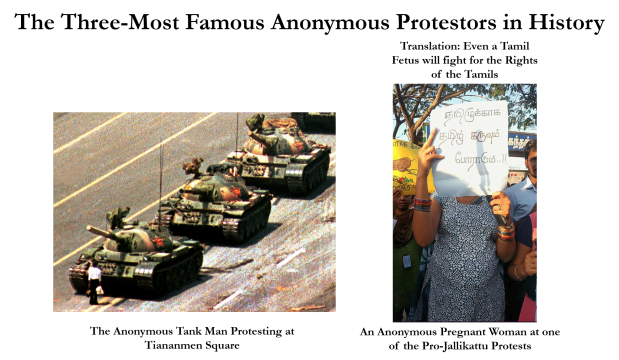
Three Famous Protestors.png


My thoughts on the ongoing protests to lift the ban on Jallikattu:

  1. In India thousands of people die in road and train accidents every year. Would the court ask for stringent implementation of regulations and better regulations or would it ban road and train transport altogether?
  2. India is the largest exporter of beef, 7th largest exporter of goat and sheep meat and the 2nd largest producer of footwear and leather garments in the world. Shouldn’t the animal right activists first target these industries before targeting an ancient sport? Isn’t killing animals, de-skinning them and cutting them to pieces more cruel than bull-taming?
  3. Under UNESCO’s Convention for the Safeguarding of the Intangible Cultural Heritage, article 13 specifically calls for national governments to a) adopt a general policy aimed at promoting the function of the intangible cultural heritage in society, and at integrating the safeguarding of such heritage into planning programs and b) designate or establish one or more competent bodies for the safeguarding of the intangible cultural heritage present in its territory. ‘Social practices, rituals and festive events’ is one of the domains under ICH. Shouldn’t India (and its highest court) as a member of the UN protect Jallikattu, a festive event, rather than ban it?
  4. In its observation in January 2016, the Supreme Court observed, ‘in this modern world of computers, it is better to play Jallikattu on computer.’ Shouldn’t the judges of the Supreme Court be value-neutral? Why mock at a tradition?
  5. The Youth of Tamil Nadu protesting peacefully across the state are not questioning the authority of the Supreme Court, but questioning the logic of putting the values of one group (the animal right activists) above the values of another group (people who want to ensure in the continuity of their tradition). People who think that Tamil Youths’ stand is wrong should bear in mind that they are following in the footsteps of Mahatma Gandhi and Jayaprakash Narayan.
  6. Human Beings are like Trees; just like trees we need strong roots (nationality, religion, language and culture, etc.) and strong branches and leaves (education, experience and appreciation of diversity, etc.). In the end the choice between where to strike a balance between tradition and modernity is each individual’s right and no one has to the right to infringe on it. PETA is at best a Ponzi scheme of the Animal Rights World and no true animal lover should believe in them.
  7. People still don’t get the fact that India is not a Homogenous Nation but a mosaic of cultures and nation of immense diversity. In the way the former British colonies came together to form a new country, India is similar to USA. In terms of a huge population of people, India is similar to China. In terms of the sheer diversity of languages, ethnic groups, religions and group identities, India is similar to the European Union. In terms of the way politicians and rich people embrace each other, India is similar to dictator ruled countries. In short India is a first of its kind POLITICAL and SOCIAL EXPERIEMENT in history. Any individual or institution that is going to treat India as a homogenous nation/ entity and enact/ implement laws based on this assumption is going to create more frictions like the Jallikattu-ban issue. Any such attempt is an attempt to trample the dreams of the founding fathers of this nation, an assault on the foundation of our constitution and an assault on the very idea of INDIA itself.


#Jallikattu #Jallikattuprotest #AmendPCA

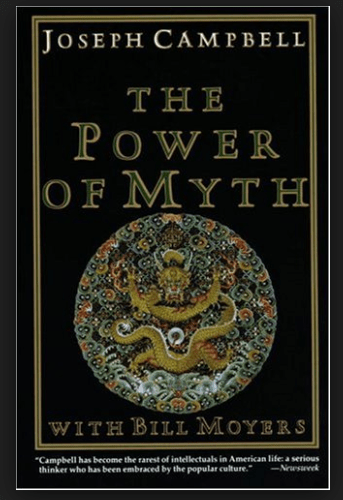
The Power of Myth by Joseph Campbell

The Power of Myth

Yesterday I finished reading ‘The Power of Myth’ based on a televised conversation between Comparative Mythologist, Joseph Campbell and TV anchor, Bill Moyers. The book set in the conversational style and makes for an easy read.

The sentence ‘Myths are clues to spiritual potentialities of the human life’ appear in the opening chapter as well as the closing chapter of the book. And that’s one of the key messages that this conveys. The other key theme discussed in this book is the similarity or proximities between myths from different cultures, places and times. The close association, as per Campbell, is due to ‘certain powers in the psyche that are common to all mankind.’ As per Campbell, ‘Every mythology has to do with the wisdom of life as related to a specific culture at a specific time. It integrates the individual into his society and the society into the field of nature.’

Some of the countless nuggets of wisdom from the book:

  • Every religion is true in one way or another. It is true when understood metaphorically. But when it gets stuck to its own metaphors, interpreting them as facts, then you are in trouble.
  • If you think that the metaphor is itself the reference, it would be like going to a restaurant, asking for the menu, seeing beefsteak written there, and starting to eat the menu.


  • Compassion is the fundamental religious experience, and, unless that is there, you have nothing. (A very important observation given the current series of religion based hate crimes).
  • You get a totally different civilization and a totally different way of living according to whether your myth presents nature as fallen or whether nature is in itself a manifestation of divinity, and the spirit is the revelation of the divinity that is inherent in nature.
  • Life is pain, but compassion is what gives it the possibility of continuing.
  • It’s characteristic of democracy that majority rule is understood as being effective not only in politics but also in thinking. In thinking, of course, the majority is always wrong.
  • Giving birth is definitely a heroic deed, in that it is giving over of oneself to the life of another.
  • Making money gets more advertisement. So the thing that happens and happens and happens, no matter how heroic it may be, is not news. Motherhood has lost its novelty, you might say.
  • Our life evokes our character. You find out more about yourself as you go on. That’s why it’s good to be able to put yourself in situations that will evoke your higher nature rather than your lower.
  • Mythology is not a lie, mythology is poetry, it is metaphorical.
  • The myth is the public dream and the dream is the private myth (just brilliant).
  • A legendary hero is usually the founder of something – the founder of a new age, the founder of a new religion, the founder of a new city, the founder of a new way of life.
  • In order to found something new, one has to leave the old and go in quest of the seed idea, a germinal idea that will have the potentiality of bringing forth that new thing.


  • You must have a room, or a certain hour or so a day, where you don’t know what was in the newspapers that morning……. This is a place where you can simply experience and bring forth what you are and what you might be. This is the place of creative incubation.
  • The earth does not belong to man, man belongs to the earth. All things are connected like the blood that unites us all. Man did not weave the web of life, he is merely a strand in it. Whatever he does to the web, he does to himself. (People carrying out the destruction of the ecology in pursuit of a fat bank account, please take a note.)
  • People say that what we’re all seeking is a meaning for life. I think that what we’re seeking is an experience of being alive, so that our life experiences on the purely physical plane will have resonances within our own innermost reality, so that we actually feel the rapture of being alive.
  • What we’re learning in our schools is not wisdom of life. We’re learning technologies, we’re getting information. There’s a curious reluctance on the part of faculties to indicate the life values of their subjects.

When I was watching the movie Troy, based on Greek epic Iliad, I was struck while watching the scene in which Achilles is killed by an arrow piercing his heel which is similar to a scene from Hindu epic Mahabharata, in which Krishna is killed by an arrow piercing his foot. After reading this book, I now realize that there are countless similarities between mythologies from different parts of the world.

There is one striking conversation in the second chapter in which Moyers reads verses from the creation story in Genesis and Campbell gives equivalent verses from other cultures ranging from the Pima Indians in Arizona, the Hindu Upanishads from India and the Bassari People of West Africa.

There is another conversation in the book about a story from Persia that Satan was condemned to hell because he loved God so much. I remember the The parallel episode to this from Hindu stories where the gate keepers of Vaikuntam, the heavenly abode of God Vishnu, are cursed by a group of saints. On the intervention of God Vishnu they are given an option between staying away from Vishnu for six births if they praise Vishnu in each birth or staying away from Vishnu for three births if they denounce him in each birth. Not able to bear the thought of being away Vishnu for six births, they accept to denounce him and are born as Asoora (Demon-like) kings in their next three births.

Reading ‘The Power of Myth’ is the best way to realize that humanity as whole shares the same roots, shares the same resources, shares the same fears and ultimately shares the same fate on this earth. As they say: ‘God is Love and Love is God.’ Love life and let all life forms live and flourish on this beautiful planet. May the power of sanity be with us and lead us to embrace the God within each one of us.