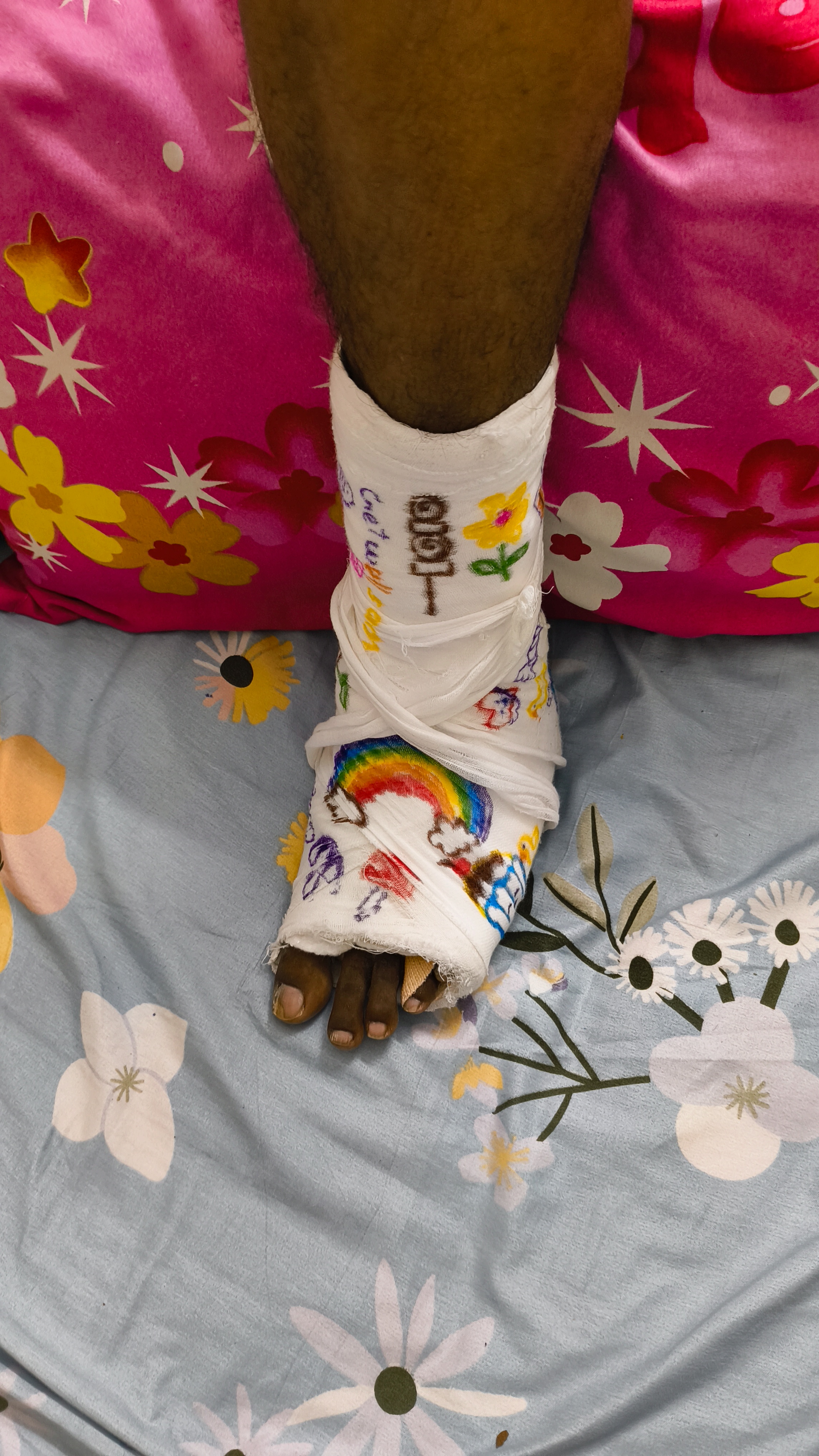
The first day my son saw me with the cast on my leg, he asked me if he could draw on it. I said he can do it later. I was not sure if I was going to have the cast, so I did not allow him to draw.
But on the evening of the penultimate day on which I was supposed to have the cast removed, I asked my son, “Do you want to draw on my cast?”
“Yes,” he ran out of the room as he was replying. He came back with his sketch pen set, sat near my leg, and started drawing on the cast. The first one he drew was a skull similar to the ones we see in danger symbols.
I looked at him. “Dei, I have a fracture, and you are drawing a skull on the cast.”
In response he looked at me with the most mischievous smile that an eight-year-old could come up with.
He continued to draw—a crescent, a star, a candy, and a two-tiered birthday cake with a candle on top of it. Then he looked at me and said, “I am done.”
“Go and call your sister.”
When she came in, I asked her, “Do you want to draw?”
With a smile she started drawing cute Japanese doodles. In between she asked if I had a wish list. I asked her to bring the book ‘How to Draw Almost Every Day’ from the bookshelf.
I flipped through the book and pointed to doodles one after another. She drew for about an hour. I ended up with 24 doodles on my cast. I even published a blog post with a photo of my cast with the doodles as well as a haiku about it.
When I was listening to my wife convey the doctor’s message about a week ago, it was a hopeless situation. If anyone had told me that day that I would manage to retain the cast for the entire duration of eight days, I would have mocked them. But I did manage to retain the cast for the eight days that the doctor had advised.
This stage is only the first and most important phase in the six-plus weeks required for recovery. There are still so many ifs and buts. But I am hopeful of the best outcome.
So, what are the lessons that I learned from my inner battle?
- Our long-term mental resolve is much better than what we assume it to be in the immediate aftermath of an adversity.
- The mind is like a parachute. If we want to make a situation work, we will be able to gather the resolve to make it work.
- More than the physical ailment, it is the lack of control over one’s own situation that hurts the most. So, always focus on what is under our control and take solace from it.
- Seek out inspiration from a source appropriate for the situation, even if it is someone much younger than you.
- Do not let a good crisis go to waste. Use it as an opportunity for self-discovery. You will be in for a surprise.
- Lean into your bonds. Laugh or smile at whatever sliver of the situation that deserves a laugh or smile.
- Tap into the collective wisdom of humanity for help.
- I heard about the story about God Murugan and the Tamil sayings from my grandmother when I was a toddler nearly forty years ago.
- I heard the “mind is like a parachute” quote from my B-school professor nearly twenty years ago.
- Nearly ten years ago I came to know about a) the Marshmallow Test conducted on American children by b) an Austrian-born psychologist from c) an Irish professor working in a B-school in Spain, d) from his talk at TED Talks, a forum started by an American and a Britisher via e) YouTube, a technology platform started by an American, a German, and a Taiwanese.
This essay is part 5 of the 5-part personal essay series – Agonizing over a cast
Part 1: https://yogesvr.xyz/2025/10/05/agonizing-over-a-cast-the-crybaby/
Part 2: https://yogesvr.xyz/2025/10/21/agonizing-over-a-cast-the-bad-news/
Part 3: https://yogesvr.xyz/2025/10/22/agonizing-over-a-cast-conjuring-up-scenarios/
Part 4: https://yogesvr.xyz/2025/10/23/agonizing-over-a-cast-the-zen-master-in-the-house/









 Yogi's Blogosmos