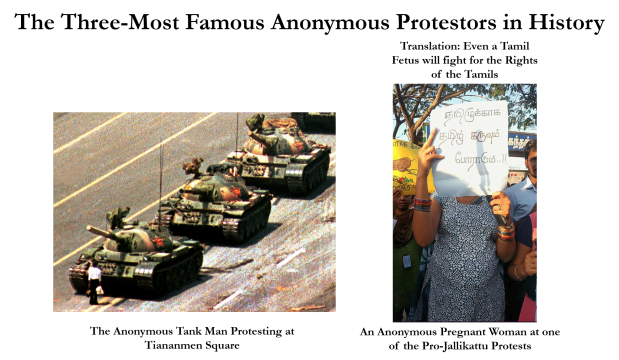
My Thoughts on the ongoing Pro-Jallikattu Protests

Three Famous Protestors.png


My thoughts on the ongoing protests to lift the ban on Jallikattu:

  1. In India thousands of people die in road and train accidents every year. Would the court ask for stringent implementation of regulations and better regulations or would it ban road and train transport altogether?
  2. India is the largest exporter of beef, 7th largest exporter of goat and sheep meat and the 2nd largest producer of footwear and leather garments in the world. Shouldn’t the animal right activists first target these industries before targeting an ancient sport? Isn’t killing animals, de-skinning them and cutting them to pieces more cruel than bull-taming?
  3. Under UNESCO’s Convention for the Safeguarding of the Intangible Cultural Heritage, article 13 specifically calls for national governments to a) adopt a general policy aimed at promoting the function of the intangible cultural heritage in society, and at integrating the safeguarding of such heritage into planning programs and b) designate or establish one or more competent bodies for the safeguarding of the intangible cultural heritage present in its territory. ‘Social practices, rituals and festive events’ is one of the domains under ICH. Shouldn’t India (and its highest court) as a member of the UN protect Jallikattu, a festive event, rather than ban it?
  4. In its observation in January 2016, the Supreme Court observed, ‘in this modern world of computers, it is better to play Jallikattu on computer.’ Shouldn’t the judges of the Supreme Court be value-neutral? Why mock at a tradition?
  5. The Youth of Tamil Nadu protesting peacefully across the state are not questioning the authority of the Supreme Court, but questioning the logic of putting the values of one group (the animal right activists) above the values of another group (people who want to ensure in the continuity of their tradition). People who think that Tamil Youths’ stand is wrong should bear in mind that they are following in the footsteps of Mahatma Gandhi and Jayaprakash Narayan.
  6. Human Beings are like Trees; just like trees we need strong roots (nationality, religion, language and culture, etc.) and strong branches and leaves (education, experience and appreciation of diversity, etc.). In the end the choice between where to strike a balance between tradition and modernity is each individual’s right and no one has to the right to infringe on it. PETA is at best a Ponzi scheme of the Animal Rights World and no true animal lover should believe in them.
  7. People still don’t get the fact that India is not a Homogenous Nation but a mosaic of cultures and nation of immense diversity. In the way the former British colonies came together to form a new country, India is similar to USA. In terms of a huge population of people, India is similar to China. In terms of the sheer diversity of languages, ethnic groups, religions and group identities, India is similar to the European Union. In terms of the way politicians and rich people embrace each other, India is similar to dictator ruled countries. In short India is a first of its kind POLITICAL and SOCIAL EXPERIEMENT in history. Any individual or institution that is going to treat India as a homogenous nation/ entity and enact/ implement laws based on this assumption is going to create more frictions like the Jallikattu-ban issue. Any such attempt is an attempt to trample the dreams of the founding fathers of this nation, an assault on the foundation of our constitution and an assault on the very idea of INDIA itself.


#Jallikattu #Jallikattuprotest #AmendPCA

Mirror mirror on the wall who is the most ritualistic of them all?

Question Mark

It has become fashionable these days to question anything and everything related to beliefs and sentiments of Indians, especially anybody of knowledge or way of living handed to us by our earlier generation. Sadly it’s the Indians who indulge in this activity more than westerners. ‘In this age’…. Wow, I like the phrase, it makes me feel like mortality has been conquered, Planets unknown until recently have been colonized, India has become the richest and the most equitable country in the universe, Elephants and Apes are signing in Opera Houses, Humans have stopped unleashing hell on each other in the name of ideology and men have started giving birth to babies. None of the above have become true and the fact is that this age is not much different from the by-gone ones.

It seems to me that to some us anything that our elders taught us is ritualistic, burdensome and not relevant anymore. Going to a place of worship on an auspicious day…. That’s too ritualistic. Touching the feet of our elders… that is so uncool. Living in harmony with nature…that’s not relevant to this age. We are quick and proud to declare that each one of these is just a solace to fight our fears and insecurities. We are one hundred percent sure that our ancestors were delusional crackpots who made our life miserable by making us dance to the tunes of meaningless rituals. ‘To Hell with the Rituals.’

Well, let’s look at some of the super-cool episodes from the rational life and ultra-modern age of ours. When a bunch of friends want to meet, the place that we choose is most often a bar and we can’t discuss about the happenings in our life without gulping a few glasses of alcohol. Does this not sound like a ritual? When a bunch of youngsters want to travel bike from one place to another, they have to ride without wearing helmets, have to over speed on the roads and honk horns like hell. Does this not sound like a ritual? Any new movie has to be watched on the day of its release and we have to perform abhishekam to the hero’s cutout wasting either our or our parent’s hard earned money. Does this not sound like a ritual?  Smoking has become so integral to the act of colleagues taking a break from work for a chat, that the session is popularly called as ‘Sutta Socializing Session.’ If this is not a ritual what else would you call as a ritual?

Oh let’s not forget our trips to malls and shopping therapies every single weekend. How about evening after evening spent watching IPL, ISL and Pro Kabbaddi matches? How about a ‘Facebook Like’ for every random post by our friends and ‘Updates on Twitter’ for every trivial action of ours? How about compulsory selfies at get-togethers? What about the mother of all modern day rituals – Valentine’s Day Celebration? Isn’t showering lover or spouse with cards, gifts, flowers and lavish dinners at upscale restaurants on one particular day every year a ritual?

The fact is Beer Bash, Valentine’s Day Celebration and Over Speeding on Roads are as much ritualistic as visiting a place of worship or fasting for religious reasons. The last two are rituals that have been handed down to us and the first three are the ones that we ourselves have added to the list. Nothing more and nothing less. The reasons attributed to each one of them may vary. The demographics of the population indulging in each of these activities may vary as well. Value systems, aside each of these rituals is a method to the madness for traversing through the chaos called Life. The Indian way of life is very flexible. After all we are not a nation that restrict our political sphere to only two political parties. We have hundreds of languages and multiple religions. We have as much choice possible in most issues that are important to us. What matters is that each one of us rationally chooses a way of life that is meaningful and provides satisfaction to us. What is even more important is not to mock, ridicule or look down upon the way of life that is suitable to another person. Let’s make ‘Mutual Respect to Each Other,’ the foundation for our ‘Indian Way of Living.’

Note: This post is written for IndiSpire – Edition 115: ‘We Indians give too much importance to rituals…visiting a temple on a particular day, fasting for religious reasons…are these relevant in this age? Or they are just a solace to fight our fears and insecurities? #rituals

ABCs of the pursuit of everlasting Happiness

The Pursuit of Everlasting Happiness is like…..

Ascent of an imaginary summit

Bathing with nothing but air

Carving a sculpture without tools

Dive in to a bottomless ocean

Eating with a hungry ghost

Flight to an unreachable horizon

Gathering sand grains on the seashore

Hoping onto an endless rollercoaster

Influencing a million people with silence

Journey through emotional cliffs and valleys

Knitting the world with a stream of words

Lecturing a bunch of puppies

Measuring a shape shifting monster

Never ending marathon

Oscillating between darkness and light

Pursuit of an oasis of quicksand

Quarrelling with oneself

Racing back in time

Star gazing on a cloudy night

Taming a wild beast

Unleashing nothing

Valuing the invaluable

Wedding with a quirky stranger

X-ray of skeleton less body

Yawning while underwater

Zooming into a black hole

Education System

Education System in India a mass stereotype transportation system (MSTS). All through the school years you are made to believe that getting on to the ‘Professional Education’ Express is your life’s only mission. When you do discover that ‘‘Professional Education’ Express is actually a ‘Professional Education Passenger Train’ that carries millions to unsure destination, you are made to take the ‘Masters Express is awesome’ bait. And so on and on it goes every year for every individual entering India’s Education System. At the end of these ‘Rides of Illusion,’ you are left with the realization that you had boarded the wrong trains and have reached the wrong destination and detours are going to be costly and enervating.

Regarding grades: well I would like to brush it all aside as a hyperbole, but it does what it is supposed to do. However the fact that the focus of education system is not a balanced one, some of the people who are well suited for real life might not get high grades. Examples: The first guy to open his own firm (a successful one) from my school batch consistently finished in the bottom third of the class in 10th and 12th; the first guy to become an AVP from my college batch was not in the Toppers list; the first guy to become an AVP from my MBA batch was one of the last few to get placed on placement day. Agreed this is only the professional side of the story, but you get the gist of my message. I can still quote examples of people who are successful in all walks of their life but their grading during school or college would not have served as a leading indicator for their current success.

Note: This post has been written for Indiblogger’s Indispire edition 109: ‘Education system of India is more focused on bookish knowledge rather than practical knowledge. Still students are judged on basis of their report card. Give your opinions on this subject.’


A Time of Need and a Time for Greed

The world has enough for everyone’s need, but not enough for everyone’s greed.’ – Mahatma Gandhi

Neither a man nor a crowd nor a nation can be trusted to act humanely or to think sanely under the influence of a great fear.’ – Bertrand Russell, Unpopular Essays

As the rains receded on December 3rd, I and my brother in law ventured out to buy essential household items. It was around 11.30 AM and we had to go from one shop to another as there was stock out situation for some of the essential items. I had walk the entire Kottur area in search of Milk and Candles. Not a single candle was available in any of the stores. A solitary vendor was selling milk outside a big vegetable store in Kottur market. But instead of the usual Rs. 40 per liter he was charging Rs. 100 per liter, a full 150% mark-up to the usual price. Most people were buying multiple packets of milk from him and yet after walking a few feet from the shop complained that it was wrong on the part of the vendor to hike the price in that hour of distress.

After an extended period of incessant rains, the prices of some of the vegetables had reached the stratosphere. On this particular day these darlings of every household’s kitchen were not even available at even these extremely inflated prices. Bread and Rice were running out of stock too. A couple of days later as I was standing in line to buy milk at another milk depot, a woman was hoarding about hundreds of packets of milk in her tricycle. When one of the customers asked why the woman was siphoning off milk meant to be distributed through regular channel, she hurled abuses at the customer. The irony was that within a few minutes she was selling the same milk packets in a nearby street with a fat markup.

Though most of us complain about the greediness of opportunistic vendors, we are opportunistic and greedy too. A case in point was a trip a petrol pump on the same day. My brother in law’s two wheeler was almost at the verge of running out of petrol. By this time most petrol pumps were closing down as they had no more petrol or diesel to sell. The unending lines of people outside petrol pumps rivaled the queues outside places of worship on auspicious days. I went along with my nephew to one of the petrol pumps near Royapettah. Among the crowd to my disappointment and chagrin, there were a bunch of guys who had come with multiple 30 to 40 liter cans. Why would anybody need so much petrol or diesel? Clearly they were greedy arbitrageur who was planning to sell the fuel at much higher prices in suburban localities. Even people who were buying for their own use too were buying more than necessary.

Around the same time, another irrational phenomenon was unfolding across the city. There was a run on the banks, no actually there was a run on ATMs. With most of the bank branches in Chennai on leave due to rains, the cash balance in ATMs was already low. The situation was made even worse by a lot of anxious people (foreseeing more rain and bank holiday) each withdrawing up to their daily permissible limit. The anxious withdrawal pattern resulted in most ATMs going out of cash by afternoon that day and as result the entire city was indulging a real life treasure-hunt, running from one ATM to another. Only after bank branches opened the following day and some of the banks started operating mobile ATMs the situation limped back to normalcy.

While it is understandable that there were long queues at grocery stores, milk vending booths, ATMs and petrol pumps to everyone’s surprise there was queue in wine shops too. And contrary to ATMs and petrol pumps that ran out of stock, these wine shops were fully stocked and was buzzing with so much activity and life that one could have easily mistaken them for an ant colony or a beehive. It is billion dollar puzzle that how in a democratic country there is stock out for essential commodities but wine shops are fully stocked.

No amount of technology can serve as replacement for irrationality of human beings. No amount of rules and processes can check human greed. As I think back on the events that unfolded during the recent rainy spell, I get reminded of a dialogue from a recent movie: ‘By eating even a single mouthful of food after our hunger has been quenched, we are ensuring that another person remains hungry.’ This principle is very apt in situations of natural or man-made calamities like the recent rainy spell.

The Essentials in Life

What would I consider as luxury? What would I celebrate? What would I classify as a moment of great joy? What would call as a divine blessing? Today, my answers to these questions are completely different from the ones that I had in my mind until a few days ago.

A twenty four hour period of continuous and very heavy rains between December 1 and 2, created an urban deluge that started submerging one locality after another in Chennai. All my family had were just the essentials, the bare minimum to carry on with our day to day activities. And yet, this bare minimum seemed at that moment and even now like ultimate luxuries for which I am very grateful to God.

I do not remember previous instance when there was no power in my house for two days at a stretch. Yet I was grateful that the rain water had collected only in my street and did not enter my apartment complex. The excess water let out from one of Chennai’s reservoirs was causing havoc at localities barely a couple of kilometers from my house. Army and NDRF were using boats and every other possible means to evacuate people from these areas. Though there was no power in my street and the mosquitoes were troubling us, we were safe and had the luxury of a good night’s sleep.

There was no power, no TV, no internet and slowly the mobile battery too ran out. The waterlogging in my street made it nearly impossible to go outside. As a result I spent most of the two days playing and interacting with my daughter. In those two days I should have played and interacted with my daughter more than I would have done in an average fortnight. And my interaction level with my wife, parents and neighbors increased significantly during those two days.

In that time of despair, a bunch of kids in my apartment complex found reason to play and rejoice. When the rain stopped on the third morning and the common area in my apartment complex was dry enough, I and my daughter walked from one gate to another. I also saw my neighbors either interacting with or playing with their kids.

In a city where the weather is hot and humid for most of the year, I wouldn’t have ever dreamed of a day when I would rejoice at the sight of the sun. And yet when the rains stopped and the sun appeared only for a brief period, I expressed my joy by shouting like a child. Thankfully from that moment, though the sun has been playing hide and seek the rains have stopped.

By the third evening, with the power still not back, we left to my eldest sister’s house in another locality. It was still raining at the time of dinner and we were all sick and tired of seeing more than a month of rain breaking one record after another as well exposing the limits of our city’s infrastructure. Though the environment was pale and gloomy, my daughter on seeing her aunts, uncles, grandparents and cousin having dinner with her described, ‘I am very happy. We are all having dinner together.’ I guess she was absolutely right. What mattered was that we were all together and we were safe. Everything else that we counted as the necessities of modern life seemed superficial and redundant. I thank God for providing me this moment/ opportunity to reflect on what is important in life. I hope and pray that the people whose life had been thrown out of gear and traumatized by this monstrous downpour find the courage and help needed to reconstruct their life.

Rains in Chennai

I do not remember the last time when I saw so many helicopters fly. The incessant rains in December first week left my hometown Chennai as battered like a war-torn city. Unable to cope with unfolding disaster, the state government asked for center’s help which soon dispatched the army, navy, air force, the coast guards to join the NDRF which was already assisting the state government with rescue and relief operations.

Someone photographing the earth from several kilometers high in the sky would have been baffled at the sudden appearance of numerous islands in India’s South East. The railway tracks in the city, the major roads leading to and from the city, the roads linking different localities within the city were all under water. With the airport runway too submerged the geographic isolation of the city was complete. This is probably the first time in several years that train service from the three major railway stations in the city were stopped completely. And for the first time in several years that the airport operation in Chennai came to a grinding halt. And so many people in and around Chennai became aware of the names of all the rivers, canals and lakes in and around the city for the first time in their lives.

The photos that were being relayed across the globe of the devastation would have made everyone question, ‘Is this India’s fourth largest metropolitan city?’, ‘Is this the city whose name used to synonymous with South India until a few years ago?’, ‘Is this the same city that was so strategic to the British in India that it became the only Indian city that was bombed by the Germans in World War I?’ Every locality in the city was affected by the rains. Electricity and Telecommunication were completely cut-off. Instead of resembling a major metropolis, Chennai resembled a series of islands in distress and people were just castaway in their own homes.

The rainfall received in the month of November is the highest in nearly a hundred years. The rainfall received on December 1, is the second highest rainfall in day in the past one hundred years. In addition to Chennai, four other northern districts (Kancheepuram, Thiruvallur, Cuddalore and Villupuram) and the Union Territory of Pondicherry had to bear the brunt of the cloud’s fury. The endless streams of clouds resembled the unstoppable army of Anubis from ‘The Mummy II’: These streams of cloud unleased hell on Tamil Nadu’s northern districts and crippled normal life.

Nature became a neutralizing agent that made the young and the old, the rich and the poor, the well-connected and the not-so well-connected all equal in that moment of misery. While we cannot do much about the vagaries of nature, one should not forget the fact much of Chennai’s present problem is actually man-made. The steady disappearance of lakes and ground level tanks, the encroachment of canals and rivers, reckless urbanization, greed of the residents for cheaper real estate, toothless civil administration that that did not stand firm in instances where it should have been are all the pieces in the not-so difficult to understand puzzle that shamefully managed to convert the fourth largest city in India into a ‘DISASTER ZONE.’

Voting is both a right and a responsibility

With great power comes great responsibility.’ – Uncle Ben in Spiderman

Caveat Emptor (Let the buyer beware)’ – Ancient Maxim

For every public role that a man or woman would play there is a qualification. If we want to be doctor we have to undergo schooling, then enroll in medical school as an MBBS student. All along the away at every important milestone we have to appear for qualifying examination and then clear it to move to the next level and receive the qualification/ degree. The same applies for other professions like Engineer, Auditor or Lawyer, etc.

However for one of the most important public roles, that of being a CITIZEN of the country, there is no training or qualifying exam in our country. As a democracy, everyone above the age of 18 years has the right to vote. The problem is that people are willing to treat their power to VOTE as a RIGHT and an ENTITLEMENT but forget that the power to vote is equally a RESPONSIBILITY too. Are we exercising that responsibility well? Are electing the right candidates to represent us? Definitely not. We pass on the blame for all of our nation’s maladies on to our politicians but we are part of the problem too. In fact the problems starts with us. Our political class is nothing but symptoms of deep rooted problems in our society.

Every one of us dreams of India becoming a great nation; but we are personally not willing to incur the small but numerous everyday costs that would collectively enable this dream to become a reality. Some of the guidelines to be followed in choosing our representatives include (but not limited to):

  1. We need to make informed choices and choose our representatives based on weighing the pros and cons of his governance record
  2. We should never choose a candidate because he represents the party we support (if the candidate does not merit being elected)
  3. We should not blindly support a party because historically our family elders have voted for that party
  4. We should not cast our vote for someone just because he or she is related to the leader whom we like

We blame that there are not many good candidates contesting in elections. But can we tell the difference between a good candidate and bad candidate? Do we know what information to use to arrive at that decision? Do we know where to look for that information? Do we understand the consequences of sending the wrong candidates to represent us? When the government doles out freebies, what are the other important projects that are being shelved? Where is the government borrowing from and who will pay the principal and interest for these borrowings? What would ensure in long term social progression? Where does India as a whole and individual states within India stand on each and every one of the parameters of Human Development Index? What’s the progress been over the years on these parameters? The answer to all these questions would be an EMPHATIC NO.

The only way to ensure this situation changes for the better is to have systematic qualification exam for voters or voters who are due to be eligible to vote. Going forward, the Election Commission of India, instead of adding anyone above the age of 18 (based on the proof of Indian Citizenship) to the voters’ list, should also conduct a qualification exam to assess if they are aware of the rights and responsibilities of a voting citizen. People who do not clear the exam should be denied a voter’s ID card and a place in the voter’s list. Since the cut-off age for being eligible to vote in India is 18 years, the age around which most kids finish their higher secondary schooling, we can have a subject for 11th and 12th standards across all school boards that deal with various aspects of the rights and responsibilities of a voting citizen. The curriculum for this subject should be handled by a constitutional body like the Election Commission of India. For people who are not fortunate enough to be part of the schooling system, the Election Commission of India should have an independent certification process.

The topics to be covered should include (but not limited to): a brief overview the constitution of India, the electoral process, the powers of the Supreme Court of India, Lok Adalat system, The Right to Information Act, sources to look for unbiased information on the back ground information of contesting candidates, etc. In addition, we should it make it mandatory for people to read the following books or similar books that deal with topics covered in these books:

  1. Manufacturing Consent: The Political Economy of the Mass Media by Noam Chomsky and Edward Herman
  2. Basic Economics: A Citizen’s Guide to the Economy by Thomas Sowell
  3. Games Indians Play by V. Raghunathan (this book provides the Indian Context very well)
  4. Predictably Irrational: The Hidden Forces that Shape Our Decisions by Dan Ariely

Note: The above list is only indicative and not an exhaustive one. There can be other relevant topics and books as well. Also there might be books that deal with the Indian context better.

People might question why limit this exercise only to new voters. The costs, logistics and politics of doing this for existing voters are enormous to overcome. Over four or five iterations of this exercise, we will have significant number of voters who would have come through this filtering process. If you don’t believe, keep in mind that the number of first time voters in the 2014 National Elections was around 12 crores!!! In four iterations, at an average of 10 crore new voters per iteration, we can bring in 40 crore voters through this process, a voting block significant enough make a positive change. It is well known in social sciences circle that the minority influence can in fact bring about social change, so making a start which is directionally correct is more important. Also starting with the younger population provides the added advantage that the young are not as much influenced by the social prejudices prevalent in our society and will be more open to change. We can also hope that the awareness created by the process of implementing this new system would have a positive influence on existing voters as well. We should also create incentives for voters to put into use, the knowledge obtained through this system.

There will always be loopholes and we might not be able to create a completely foolproof system. However at this point in time we need to only worry about whether we are moving in the right direction. We should bear in mind that social as well as political change is a slow and evolutionary process and we should be patient enough to give this new system the right amount of time to flourish. Some people might ask why not a qualification system for contesting candidates as well. It is a much more difficult idea to implement. Also as more and more candidates with cleaner and better governance records get elected, political parties themselves will see the merit in fielding right candidates. After all, aren’t Indian political parties’ masters at playing vote bank politics?

Print Books vs. E-Books – Part 3

This is a follow up post to my previous post: Print Books VS. E-Books and Print Books VS E-Books – Part 2.

Amazon might promote Kindle E-Reader as device ‘for the love of reading.’ But we would get locked into Amazon’s system if we buy the Kindle E-reader. A friend of mine reads using his smart phone through Kindle e-Reading app as well as Flipkart’s e-reading app. He says he does comparison shopping and buys from the vendor who offers a book at the lowest price.

Reading only using e-reader also makes it difficult to come across interesting books other than what Amazon’s or other such vendors’s recommendation algorithm would suggest. In one particular instance, I was watching Barry Shwartz’s TED video on my laptop and then decided to buy his book, ‘The Paradox of Choice’. Using only the e-reader would rule out possibilities like these.

While most of the time we come across opinions that portray Social Media as unnecessary distraction, they can be useful too. Most non-fiction authors take between one year and three years to publish a new book. Following them on Social Media sites like Twitter would help us to find out about any follow up research or development after a book (on a particular topic) got published. Professors/Authors like Steven Pinker, Richard Thaler, Dan Ariely and Nassim Nicholas Taleb post about interesting ongoing academic research from their respective Twitter handles quiet often. Some of these ongoing research might act as supplement to the book that we might be reading. As is always the case with any social media we have to have the discipline to selectively browse and read, otherwise we will be wasting our time. This is where a general purpose device like a smartphone or a tablet might come in handy rather than a dedicated e-reader.

Having access social media tools like Facebook, Twitter and WhatsApp will also help us to share with our friends and acquaintances about what book we are reading. Rather than a way of just bragging, we can use these tools to share quotes, anecdotes, statistics, etc. from the book that we are reading. About a few days ago I was reading an article by James Altucher on Pope Francis. I found a quote by Pope Francis about the media very interesting and I shared it via my Twitter handle. What’s the fun of any activity including reading if we cannot assimilate (good) aspects of it into our personality and bring it to the fore in our social interactions? Reading from sources like blogs, forums and websites will also not be possible with a dedicated e-reader.

Having a general purpose device like a smartphone or tablet can be useful in other situations as well. On a couple of occasions, I have taken snaps at the most unlikeliest of places and times using my smartphone and used these snaps later to write blog posts (Examples: Urban Nomads, Free Bird Peeking at Caged Birds and Cloud – awkward wingman). There was another occasion when I was waiting in the reception of a dental clinic while my wife was getting her dental procedure done, I opened the Kindle e-reading app and read a book.

With passage time displays in smartphones and tablets might improve to negate some of the advantage enjoyed by e-readers. There might be some new development such as in spectacles and contact lens that can eliminate or at least drastically reduce the eye strain developed due to reading on smartphone or tablet displays.

Amazon markets its Kindle e-reader with the tagline: “For the love of reading.” In a way, we can assume, any e-reader carries a hidden tagline: ‘For the confinement of reading from e-books alone.”   While there is no doubt that e-books are superior to printed books on a number of utility factors, a dedicated e-reader is not absolutely necessary to enjoy these benefits. Ultimately buying and owning a dedicated e-reader is more a matter of affordability and preference than any technological requirement to enjoy e-books. A general purpose device like a smartphone or a tablet would allow us to read from a myriad sources in addition to e-books. We can actually use a smartphone or a tablet as a device to fulfil and enhance our ‘love for reading’ provided we only have the discipline to do so.

Print Books vs. E-Books – Part 2

This is a follow up post to my previous post: Print Books VS. E-Books.

A friend of mine introduced me to the idea of general reading during my MBA days. I wish I had picked up this wonderful habit much earlier. I generally used to read non-fiction books in paperback format. One of the problems I have encountered every now and then is that after starting a book and getting the basic message of the book, if the writing style is not to my liking, I tend to discontinue reading further. I also tend to get very restless in reading books that run beyond 300 to 350 pages. I have accumulated so many books over the course of the last ten years that managing them has become a problem (at least the ones that I have not finished reading and don’t foresee reading either). The problem is compounded by the fact that I have lived in four different cities over the course of the last ten years or so and moving and maintaining these books has been a problem.

So the last few books that I have bought have all been in e-book format. I do not own a Kindle e-book reader. I have been thinking about buying one for a long time now. Instead I have continued to read these e-books using the Kindle app in my smartphone or my laptop. The kind of money that I will have to shell out on a Kindle e-reader would transform my book reading experience from simple pleasure to a guilty pleasure. Let’s dig a little deeper in to this.

Amazon has been promoting Kindle e-readers in a big way in India these days. They have stepped up the print and television ads in the last few months. They are also sponsoring a short story writing contest in tie-up with The Times of India. The cheapest Kindle e-reader is INR 5,999, the Kindle Paperwhite is priced at INR 10,999 and the Kindle Voyage is priced at INR 16,499. Most of Amazon’s ads feature the Kindle Paperwhite and to enjoy most of the benefits that are being advertised, one would have to have at least the Kindle Paperwhite. Let’s take the case of Kindle Paperwhite for the sake of this post.

Amazon India sells E-books at a discount compared to paperback versions. The discount is not substantial but let’s assume that the average money saved by buying an e-book is INR 100. If I buy a Kindle Paperwhite, I would have to read at least 110 books to start accumulating actual savings in money when compared to buying all these books in paperback format. On an average I read about one book a month. At that rate it will take me 9 years to realize the above said savings. I am not sure if the e-reader will function fully well till that period (accounting for durability of the product as well as my own handling of it). Amazon itself gives only one year warranty for the product. It’s safe to say that like most gadgets these days it will reach end of life between third and fifth year.

We might argue, the cost benefit analysis is not the right way to look at the Kindle e-reader; it enhances the reading experience. But only as long as I am fine with reading books and/or magazines in black and white. Kindle e-reader is Henry Ford’s equivalent of a gadget: ‘We can read whatever we want to read on the Kindle e-reader as long as its BLACK and White.’ I went to Croma Retail store a couple of days back to check out the Kindle Paperwhite. The children’s magazine (cartoon) that was loaded in the demo version was in black and white. That same magazine (in colorful form) is available for INR 25 in print edition. I am not sure if I or my daughter would ever be interested in reading a cartoon strip in black and white. I can safely say never. If I have to pay INR 10,999 and still make a compromise with my reading experience (on some of the stuff that I would read) then I might as well make a compromise with my reading experience without spending INR 10,999 (by reading on the app on my mobile and laptop). As of now the only person in my circle who owns a Kindle e-reader (basic version) did not actually buy it; his friends gifted it to him!