
Haiku: Web
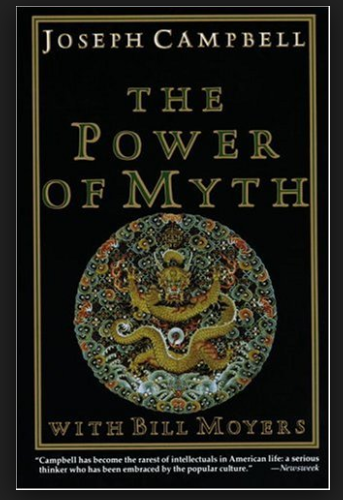
Yesterday I finished reading ‘The Power of Myth’ based on a televised conversation between Comparative Mythologist, Joseph Campbell and TV anchor, Bill Moyers. The book set in the conversational style and makes for an easy read.
The sentence ‘Myths are clues to spiritual potentialities of the human life’ appear in the opening chapter as well as the closing chapter of the book. And that’s one of the key messages that this conveys. The other key theme discussed in this book is the similarity or proximities between myths from different cultures, places and times. The close association, as per Campbell, is due to ‘certain powers in the psyche that are common to all mankind.’ As per Campbell, ‘Every mythology has to do with the wisdom of life as related to a specific culture at a specific time. It integrates the individual into his society and the society into the field of nature.’
Some of the countless nuggets of wisdom from the book:
When I was watching the movie Troy, based on Greek epic Iliad, I was struck while watching the scene in which Achilles is killed by an arrow piercing his heel which is similar to a scene from Hindu epic Mahabharata, in which Krishna is killed by an arrow piercing his foot. After reading this book, I now realize that there are countless similarities between mythologies from different parts of the world.
There is one striking conversation in the second chapter in which Moyers reads verses from the creation story in Genesis and Campbell gives equivalent verses from other cultures ranging from the Pima Indians in Arizona, the Hindu Upanishads from India and the Bassari People of West Africa.
There is another conversation in the book about a story from Persia that Satan was condemned to hell because he loved God so much. I remember the The parallel episode to this from Hindu stories where the gate keepers of Vaikuntam, the heavenly abode of God Vishnu, are cursed by a group of saints. On the intervention of God Vishnu they are given an option between staying away from Vishnu for six births if they praise Vishnu in each birth or staying away from Vishnu for three births if they denounce him in each birth. Not able to bear the thought of being away Vishnu for six births, they accept to denounce him and are born as Asoora (Demon-like) kings in their next three births.
Reading ‘The Power of Myth’ is the best way to realize that humanity as whole shares the same roots, shares the same resources, shares the same fears and ultimately shares the same fate on this earth. As they say: ‘God is Love and Love is God.’ Love life and let all life forms live and flourish on this beautiful planet. May the power of sanity be with us and lead us to embrace the God within each one of us.


Which is the closest country to Australia? If you answered New Zealand, you are wrong. If you answered Indonesia, you are wrong again. Papua New Guinea is the closest country to Australia. Papua New Guinea (PNG), is an independent country that occupies the eastern half of the island of New Guinea and its offshore islands in Melanesia, a region of the southwestern Pacific Ocean north of Australia. Its capital, located along its southeastern coast, is Port Moresby. The western half of New Guinea forms the Indonesian provinces of Papua and West Papua. Papua New Guinea achieved its independence in 1975 following almost 60 years of Australian administration. PNG is a member of the Commonwealth of Nations and Queen Elizabeth II is the head of state. The country has a population of about 8 Million people, has a per capita GDP of $2,283 and is classified as a developing nation by the IMF.
Some interesting facts about PNG:
If you are interested in visiting PNG the following links might be useful to you:
http://wikitravel.org/en/Papua_New_Guinea
https://www.lonelyplanet.com/papua-new-guinea
http://www.papuanewguinea.travel/birdwatching
http://www.tropicalbirding.com/australasia-tours/new-guinea/papua-new-guinea/
http://world.new7wonders.com/?n7wn-finalist=great-barrier-reef-australia-papua-new-guinea
I will leave you with a couple of videos, one of PNG and one on Birds of Paradise.
Sources:
Article:
https://en.wikipedia.org/wiki/Papua_New_Guinea
http://www.traveller.com.au/have-you-visited-australias-closest-neighbour-papua-new-guinea-ghfi04
http://www.10-facts-about.com/papua-new-guinea/id/898
http://www.factsking.com/countries/papua-new-guinea/
https://papuanewguineacasestudy.wikispaces.com/Learn+More+about+Papua+New+Guinea,+Fun+Facts!
http://travelpost.noble-caledonia.co.uk/articles/papua-new-guinea-interesting-facts-travel-tips
https://en.wikipedia.org/wiki/Bird-of-paradise
Photos:
http://missionpng.com/PNGScene.htm
http://www.globaldivingadventures.com/expedition-papua-new-guinea/
Note: This post has been written for IndiSpire Edition 116: ‘Choose a country you don’t know much about. Now read up/ research about it. And tell us something interesting about it. Can be anything – history, politics, music or whatever tickles your fancy. #DiscoverACountry’
We went from Ramanadhapuram to Rameswaram by Car. Google maps was fairly accurate in showing even small waterbodies. All along the way we saw different kinds of birds lazing around in water bodies. The real treat to the eyes started around the area where the Indian mainland protrudes into the sea like a thin strand of hair. Suddenly from nowhere the sea appears barely a few feet from the road on either side. As we started driving up the Indira Gandhi Bridge, the view was breathtaking.
We stopped at a spot on the bridge where most other vehicles had been parked. Somehow the temptation of selfies had not eluded even the Sabarimala Pilgrims who were present in droves everywhere; selfies were in full swing. It was very windy. On one side we could see the Pambhan Bridge and the railway line. The sea was at its pristine beauty; I guess that’s how the seawater is supposed to look. Compared with this standard, the sea water in Chennai is basically nothing but drainage water.
On the other side of the bridge we could see a fishing hamlet and numerous fishing boats indulging in their everyday odyssey. The view on this side was equally beautiful. Sadly, we were short of time and had to head towards the temple. I think one at least needs an hour to admire the beauty on either side of the bridge.
Once at temple we were running to take a holy dip/ bath from one well to another just like migrant animals running from one waterhole to another. Though it was around closing time, luckily we got to see all the deities. As I was about to leave the temple, I noticed the Nandhi near the Flag-mast; my God, it was one giant Nandhi.
Post lunch we started on our onward journey. As we were already running way behind schedule we could not visit Danushkodi or even take another pit stop at Indira Gandhi Bridge.


I and my family went on a quick pilgrimage trip to Rameswaram and nearby temples. Our first stop was Thirupullani. From there we went to Sethukarai where we had to do a poojai. The view from Sethukarai beach was amazing. We had reached there by around 7 AM, the sun was still hidden behind a thick patch of clouds. As a result the sky resembled a cake made of blue and orange layers with the dark cloud serving as the icing.
The color of the sea made me wonder if it was some kind of magic potion with swirls of emerald green, turquoise and aquamarine. The nomadic fishing boats with wind sails and the rising sun as the backdrop would be any photographers dream come true. Alas I did not have even a point and shoot camera and was shooting with my mobile camera.
The sight at the shore was an eyesore. Clothes strewn all over the shore was strangulating the beauty of the beach. With not much of a tide in the water, kids were having time of their life playing in the water. The multiple fishing boats somehow added to the beauty of the sea. It was surreal to see the sea change to multiple shades as the sun kept ascending.


I am writing this post for the ‘Be Inspired by the Neighbors’ exercise. Yesterday I read a post by Marilyn Armstrong on her blog Serendipity. The blog poat had a bunch of photos posted with explanation. Marilyn had created this blog post to take part in Cee’s Which Way Photo Challenge: 2015 Week #2. The title of the blog post was: FOLLOWING THE BIRDS – CEE’S WHICH WAY PHOTO CHALLENGE. Marilyn had posted a bunch of photos of wild birds swimming on water bodies.
My comment to Marilyn was: ‘Excellent post. The photos look fantastic. Were they all taken on the same day? Which camera did you use? A thing of beauty is a joy forever. Your photos have beauty written all over them. Keep up the good work.’ Marilyn was kind enough to respond quickly: ‘Thank you! They were taken on a bunch of different days over a period of 3 years, though all in the Blackstone Valley. The two signed by my husband were taken on his Panasonic Lumix XZ 60. Mine were all taken on Olympus Pen PM-2 or an Olympus Pen EP3. Some are quite recent, just last month. Others date back to spring 2012, though many were taken at the same locations in different months and years.’
To begin with, I like photography. For a couple of years I even had a DSLR camera and used to take a lot of snaps. But I found the experience of using a DSLR camera to be cumbersome and I am very lazy as well. So I have become a dormant photographer or photographer in hibernation these days! Nevertheless, I admire good photography and that’s the reason in addition to liking Marilyn’s post, I also left a compliment on her blog.
They say, ‘a picture is worth a thousand words.’ But these seven words have survived hundreds of years, a period over which the picture which inspired these words was lost for eternity. Human words are too weak an instrument to describe something that human mind enjoys through the eyes. However, this exercise is about writing and therefore I embark (despite my limited command over English) on the herculean task of describing Marilyn’s photos. I have subscribed to Marilyn’s blog for the past couple of months but I do not know whether she is a professional photographer or an amateur photographer or just a casual photographer.
These photos of birds swimming in water bodies without any care in the world is an awesome sight even at a casual glance. And that’s the reason I was drawn to this post. These bunch of photos captured the grace of God’s creation in its pristine form. Though these are still photographs they ooze with life. I am not sure whom to praise for the joy/ ecstasy that I attained in seeing these beautiful photographs: should I praise Marilyn’s keen sense of timing and her skill? Should I praise those birds who were just following their natural instincts? Should I praise some unknown cosmic power that made Marilyn’s skill, a piece of technology (camera) and a bunch of nature’s beautiful creations cross each other’s’ path? Or should I praise the creators of the WordPress platform that enables digital imprints of such serendipitous acts to be enjoyed by people who are live in remote corners of this globe?
Most people will think of motion pictures (videos) as a technological progression to still photography. But still photography, since it is a snapshot at one particular point in time, introduces an element of suspense (what happened next?). Still photography is more like an abstract philosophy open to multiple interpretations. Still photography helps us to achieve a power that God did not bestow upon us: ‘an ability to freeze time. An ability to look at any event is isolation to its preceding or succeeding events.’
Since these snaps were taken by Marilyn and her husband at different points in time over a period of two to three years, they display multiple gradients of multiple factors: different birds, different seasons, may be different water bodies too, different light settings etc. We all find it very difficult to follow any abstract concepts. But while looking at these bunch of photos by Marilyn and her husband, the abstract concept, ‘beauty in nature’s creations’ penetrates deep into our eyes, seeps deep into our hearts and gets sculpted into our minds for eternity. Try however hard, we will lose the battle to dislike these photos.
J. Krishnamurti writing in his book, ‘Meditations’ says: ‘A meditative mind is silent. ….. It is the silence when thought – with all its images, its words and perceptions – has entirely ceased.’ These bunch of photos take us into a meditative state, a state of trance where nothing seems to exist: not you, not Marilyn, not even those birds. The only thing that exists is the beauty of nature.
Everything made Art.
The goal of this blog is to create a list of super facts. Important facts that are true with very high certainty and yet surprising, misunderstood, or disputed by many. This blog aims to be challenging, educational, and fun, without it being clickbait. I determine veracity using evidence, data from reputable sources and longstanding scientific consensus. Prepare to be challenged (I am). Intentionally seek the truth not confirmation of your belief.
The musings and ramblings of a young poet.
Rhymes and Reasons for Every Season
words. hearts. humidity.
The Life & Ramblings Of A Zillennial
welcome to my paradoxes
where wellness meets authenticity.
Just Inked Thoughts- Poems, Quotes, and Reflections
Here's To Express.. :)
THIS SITE IS ABOUT ME, MY CREATIVITY, MY IMAGINATION AND MY FEELINGS.
Hi! my name is Sebastian (You can call me Seb!) ...welcome to my Blog. I'm a photographer from Worcester, Worcestershire, England. Thanks for dropping by! I hope you enjoy my work.
Open Your Mind
Epic fantasy & military sci-fi author.
An Independent Nondiscriminatory Platform With No Religious, Political, Financial, or Social Affiliations - FOUNDED 2014
Living slowly, adventuring often ✨️
Connecting Inner voice to External World
Gray clouds trail across the sky. In the pale winter sun a flock of geese (Ben Grafström--Akita, Japan)
This is Your Quest - Your Mission to Find Happiness
Tip Shack generates inspiring, positive, informative, entertaining and useful tips & guide, covering fast and fun gastronomy, movies, entertainment, sports, beauty, news, relationships and technology.
Climbing, Outdoors, Life!
Challenging and Supporting People to do the Most Important Work of their Lives
A Journey Through the Looking Glass - Views Expressed Are My Own




 Yogi's Blogosmos