A Bird Sings….
Once the lock-down was enforced in India, I and my wife struggled to find useful ways to keep my eight years old daughter engaged. Her school shut-down for the academic year and all of her after school classes were also closed. On top of that she could not meet any of her school friends in per either. We wanted to limit passive screen time (TV & Mobile). I tried to look on the web for resources that I can use to keep my daughter actively engaged. I had compiled a list of resources that I shared with my friends friends and acquaintances on WhatsApp. Thought I will share the list on a blog post. I have added the Origami as well as miniature crafts resources that I came across in the last week. Hope you find them useful.
Academic:
Khan Academy is offering free resources for learning.
Scholastic learn at Home website
Twig Education website
Google Education Resources
Stories/ Reading:
Amazon Audible has made its story collection available for free.
Compendium of Resources:
Boston Globe has published a list of resources to keep kids engaged
Simple Most has published a list of resources
USA Today has published a list of resources
Beyond the Chalkboard website
Drawing/ Doodling:
Skillshare resources on Doodling
Open Culture resources on drawing lessons for kids
Thrive Art School YouTube Channel for art lessons
ThoughtCo resources on drawing lessons
IQDoodle website courses on doodling (paid service)
KlineCreative free online drawing classes
LUNCH DOODLES with Mo Willems YouTube Channel
The Visual Alphabet – Free 5 Day How to Doodle Course by IQDoodle on YouTube
PicCandle Doodle Tutorials on YouTube
Doodles by Sarah YouTube Channel
Origami YouTube Channels:
Miniature Crafts YouTube Channel:
Programming for Kids:
List of 7 programing tools on Lifewire
CS First with Google
Scratch coding for kids by MIT
Tynker coding for kids
Snap coding for kids by Berkeley
Blocky coding for kids by Google
Got an extended weekend due to Friday being May Day. Woke up early on both Friday and Saturday (just 6.30 AM, pretty early by my standards for a weekend) to order groceries and vegetables on Food Delivery Apps. I was not successful in ordering on Friday but was able to order on Saturday. Somehow I have not been sleeping at the usual hour and I have been staying awake till 2 AM on both Friday & Saturday morning. So the combined effect was that, during the first part of the day I was feeling extremely sleepy and moving around my house like a Zombie.
For about an hour on Friday evening and about an hour on Saturday evening, I played cricket with my daughter & son. I also played cricket with my son for about an hour at around Noon on Saturday as well. We used my son’s plastic cricket bat and a bunch of plastic balls. I was the bowler to both of them as they took turns as batters. It was fun play time for the three of us.
One of the things that I have realized is that the only Truest Measure of Love is Time and not money. And you get to see that and feel that when you have very young kids. I have heard Conor Neill ask in one of his YouTube videos, ‘How does a child spell love?’ And went on to spell the answer as: ‘T-I-M-E.’ I got to experience this fact so dramatically a couple of days ago. On that day, I was going for my evening walk trying to catch up on my step count for the day (more on this in a later post). As I was going from one room to another, my son was frequently crisscrossing my path and making it difficult for me to walk fast. So I told him, “Let’s go for a walk,” and held his hand. At this very moment I saw his face lit up with a smile that was better than the sight of a million flowers blooming at the same time. As we were walking from one room to another and taking left or right turns, he was visibly excited and was laughing out loud. During that indoor walk session, I realized that parents spending time with kids means a lot for them, even if that time is spent on simple activities. In fact every activity and every moment that parents spend with kids is absolutely special for them.
On Friday night, post dinner as I was sitting with my son in our room not knowing how to keep him engaged, I made paper boat and paper gliders for him. As I finished making the glider my daughter walked into our room. She too wanted to make paper boat. I gave her a sheet of paper from one of her old homework notebooks. As she was making the paper boat I thought this could be a good way to pass time. So I went to YouTube and typed ‘simple Origami for kids.’ I got a string of results from which I chose the video about making a paper shirt. We did not have colorful Origami papers so we decided to use papers from my daughter’s old homework notes. After finishing the paper shirt, my daughter chose the video about how to make princess dress. The instructions in both the videos were easy to follow and we ended up with final products that looked like something shown in the videos. It’s a big surprise to me that even I was able to get it right!!!
On Saturday night, we decided to do a couple of Origami stuff once again. My daughter chose both the videos. The first one was on how to make sun glasses which was very easy. The second one was on how to make sword. This one was more complex than the other three stuff that we did. We kept missing the folds here and there and had to watch sections of the video multiple times to get the sword design right. But finally we managed to get both the swords right. Overall the time and effort was well spent. Not only did my daughter like it, even I found the time spent on doing the simple paper craft very refreshing.
Just before the lock-down I had gone to Odyssey to buy some craft-work DIY kits for my daughter. I had picked up an Origami kit in my hand initially, but decided to a buy the Quilling Jewellery kit and Amar Chitra Katha Mahabaratha book-set for her. The Origami kit would have come in very handy yesterday and the day before it. But it’s OK as long as we get any paper. For sometime now, my daughter has been pleading to open the Quilling kit and make the rings. But, I have asked my daughter to make the rings the week before her school reopens so that she can gift those rings to her school friends. Instead she has been keeping herself busy reading or drawing.
Checked on Amazon for Origami kits but they are still delivering only essential stuff. Till we are able to get Origami kits from some shop or Amazon, guess we will have to use papers from daughter’s old homework notes.

I live on the third floor of our building. Most of the houses in the neighborhood are either G+1 floor or G+2 floors. As a result, I can get visibility of far more buildings and terraces than if I were living on the first floor. One the results of the COVID19 lockdown is that the terraces of the buildings in my neighborhood have become relaxation/ socialization spots for people in the evenings. I live in a densely crowded part of the city and going for a walk on the streets is not advisable. Since its peak summer here and staying indoors for an extended period of time is extremely suffocating, a stroll in the terrace is a welcome break or rather an unusual luxury during these extraordinary times.
The terrace of the apartment complex immediately behind my house gets converted into a cricket field @ 5.20 pm almost everyday. A guy in his fifties comes to play with his two sons, one probably in his late teens and another in his preteens. They look like Tamilians but the boys talk only in Hindi. As is usually the case with boys of this age and age gap, they keep quarreling a lot about a potential catch, wrong delivery, bad shot and on and on. The dad is an extreme contrast to his sons, he rarely speaks and the look on his face resembles that of a Zen monk. After the match and on days when his sons don’t come to play cricket he goes for a brisk walk on the terrace. I think the elder son goes for cricket coaching and I have seen him do exercises (similar to the ones done perform cricket coaching sessions) on the terrace.
I have seen a couple of ladies go for walking or do warm-up exercises in the evening. But they never interact and one of them is always wearing a earphone connected to her mobile. Around 8 to 8.30 PM a couple of college guys come to the terrace to talk on mobiles. Sometimes they also do group study on the terrace. The terrace of the building beyond this one gets converted into a playground for less than 10 year olds. They are mostly accompanied by their grand parents. Sometimes I see these kids lean on the parapet wall and talk to kids in the next terrace or kids standing in their balconies in the next building.
On the terrace of the house immediately to the left of my house an elderly man and an elderly lady (most likely a couple) go for a walk in the evenings. The lady goes for a very brisk walk while chatting on mobile phone; Abishek Bachan would be proud that she is following his maxim: Walk & Talk. The guy generally strolls slowly with the look of reluctance in his face. The house and the apartments next to this building also have someone or the other in walk & talk mode. The family in the house immediately in front of my house never venture to their terrace or their balconies in the evenings. However one of the persons who lives in the house aging about sixty comes to his balcony in the mornings and chants come mantra while holding a little bit of water on his right palm.
On the terrace diagonally in front of my house, there is a very small roof garden with flowering plants. Every evening a guy in his forties or a lady in her sixties are either watering the plant or doing some sort of attending to the plants. There is a railway line of Elevated Metro Train Service very near my house. In normal days you could see and hear the sound of the trains. With the lockdown in place, the trains have gone silent. Despite all these people that I have described doing some activity or the other, a vast majority of the people still do not venture out to the terraces. Not sure, what do they do keep themselves occupied and remain sane.
There are a bunch of trees near my house, a rarity in my city these days. As a result I get to see a bunch of birds every time I step into my house terrace. Ever since shifting to this house I have made it a point to feed the crows that live in the nearby trees. Since the lock-down feeding the crows has become a ritual. I feed them twice a day, once around 10.30 AM and once around 4 PM. It’s a fascinating sight to see the crows flying towards my house as I start placing food on the parapet wall of our terrace.
As the days have passed I have noticed a few smaller things that I have not paid much attention to in the past. The crows do seem to have their favorite foods: Chapathis are their favorite, bread comes next and they like savories like Ompodi & Mixture. The have a particular liking for Medu Vadai. They are ok with biscuits, water melon & musk melon but do not seem to like bananas. They don’t like Sundal either. Crows also exhibit different personality traits: some of them descend down on the wall pick up their share of food and fly back to the trees, some sit on the wall and eat uneasily, while others rather than eating, shout on top of their voice to broadcast to others that food is available.
I get to see other birds too. There are a bunch of pigeons that live in the neighborhood. My immediate next house neighbor places water in mud plates on his terrace for the pigeons, so they have kind of made his terrace their home. Two of the pigeons come to eat if I place scraps of fruits for the crows. Ditto for a couple of squirrels. The pigeons and squirrels come to eat only after most of the crows have left. A couple of times I have seen a solitary Myna too eating on our terrace. However all these creatures make a quick exit if I even get near the door of our terrace.
There are about 4 parrots living in a hole on the side walls of apartments two building from my house. I can see them only in the morning around 8 AM but they seem to vanish from sight after that. In the evening they will be flying at high-speed from one tree to another. Guess they have the same attitude of adolescent guys indulging in bike racing in East-coast Road. I have never seen these parrots coming to eat at my house or drink at my neighbors house. May be once of the days, I need to wake up at daybreak and see what these parrots are up to.
I also get to see cranes flying in the sky; guess they are moving towards Foreshore Estate where there is creek / backwaters. I get to see eagles gliding high in the sky over a nearby hotel, the most that I have seen is six of them. I guess a crows have made nest on the terrace of the hotel. From time to time, I see a couple of crows trying to chase a solitary eagle; it’s like watching fighter planes indulging in dogfight. Most of the times, the crows seem to be successful; happy ending… for the crows and hungry tummy for the eagles.
Around 6 PM, the villains of the current season, Bats start making their appearance in the sky. It’s quite a scary sight to see a constant stream of bats flying from south-east to the north-west direction. I guess they are coming from somewhere near Foreshore Estate where there are a couple of water-bodies and a lot of trees, but I am not sure. Once the bats start gracing the sky with their appearance, I shut the terrace door and get back into the house. The sun by this time would be beating a hasty retreat and in no time mosquitoes would be busy making everybody’s life uncomfortable.
It’s my deepest wish or daydream that on one of the days when I open my terrace door to feed the crows there should be bunch of Scarlet Macaw Parrots or a couple of Indian Peafowls sitting on my terrace’s parapet wall.
It’s been a long time since I wrote something or blogged. Have been thinking seriously about starting to write on a regular basis. COVID19 has turned our life upside down. The only way to maintain sanity is to focus on the positives in life and stay away from the negatives. As a result I have drastically cut down on daily news intake and cut down completely on arguing online (on WhatsApp) with friends & acquaintances. It been nearly two months since I started working from home. With the the lock-down and curfews, its become very difficult to go out and meet friends & family members too. While it did not strike me until this point, that blogging about useful activities that I and family members indulge in would be a good way to start writing once again.
My eight year old daughter is having her summer holidays, without her usual summer classes, etc. She has not been able to step outside to play, go and meet her friends on their birthdays, visit malls & play areas; needless to say it’s been a very boring summer vacation for her. As a result, like most parents, I and my wife have been trying to keep her occupied with some usual activity or the other. My year old son is still using the entire day for playing and throwing things around as he like. One of the things that my daughter likes is drawing. She used to go for drawing classes for the past three years or so. My wife also draws from time to time. Since I am working from home, I have made it a point to encourage them to draw/ paint as much as possible. Just before the lock-down started I went to Odyssey and bought some drawing & painting related stuff. In hindsight it turned out to be a very good decision.
I keep finding instructional videos for painting for my wife & daughter. A friend who knows about my wife’s interest in painting sent an Instagram link about Live painting instruction sessions conducted by Hindustan Trading Company @ 5 PM everyday during this lock-down. So, I created an Instagram account. Yesterday my wife and daughter attended the live art sessions for the first time. Due to bandwidth issues, the video kept pausing quite a number of times. So, they decided to follow instructions from the recording of an earlier session about making bookmarks. I have posted the pictures of the bookmarks that they made. I read a lot of books, so they made the book marks as a gift for me. It was about an hour and half well spent for my daughter and wife.
Around the time of First Gulf War, on Fridays I used to stay awake at night longer than usual to view my favorite program, ‘World This Week,’ the international news show by NDTV. The topics covered, the visuals and the presentation were completely different from what Doordarshan’s other news programs had to offer. In those days Doordarshan was the only TV Channel available. On Friday evenings when ‘Oliyum Oliyum’ (a program from DD Chennai featuring Tamil Movie songs) was telecast the streets used to be empty. In those days I, like a lot of boys of my age used to bunk school to watch Indian Cricket Team Play, on TV.
Cut to today, January 14, 2018, the day of Pongal, the most auspicious and important of Tamil Festivals. All Tamil Satellite and Free-to-Air TV channels are drowning viewers in Pongal Special Programs (read movies and programs featuring Movie Actors and Technicians). As I write this post Indian Cricket Team is playing against South Africa in their second Test Match somewhere in South Africa; India is actually batting. Countless news channels are blaring about the day’s happenings. Yet instead of getting glued to one of the three TV sets at home, I am sitting and writing this blog post about a book that talks about the ill-effects of Television. From yearning for more TV content to TV addiction to weaning myself of TV, my world has come full circle.
From being deprived of TV channels and TV content to literally drowning in TV programs, India has come a long way. All this started with liberalization in the early nineties. Today my DTH subscription offers me hundreds of channels from all corners of the world. For each category there are a dozen channels. I could have a dozen clones of myself but still may not be able to cover all the TV programs in my favorite channels in a single day.
I always used to think of TV as a source of general knowledge. When I think of TV programs like ‘Turning Point,’ ‘Surabhi,’ and ‘World This Week’ come to my mind. Not to mention the various news telecasts that helped me to be update with the happenings in the world. But somewhere after my MBA days, I started realizing that a lot of incidents not worthy of being covered were getting unusually disproportionate amount of airtime. Consider the news flash telecast by a popular news channel, ‘Police Commissioner’s lost pet dog has been found.’ How about manufactured for TV sporting events like IPL, ISL, PBL, etc. The worst type programs on TV are the reality shows (think of ‘Rakhi Ka Swyamwar’ and its close cousins). How about Radia Tapes which nearly destroyed the credibility of TV News Channels? Also I realized that while random acts of crime/ hatred will find airtime, random acts of kindness never got a mention; TVs Channels have and obsessive compulsion to focus and telecast negative news.
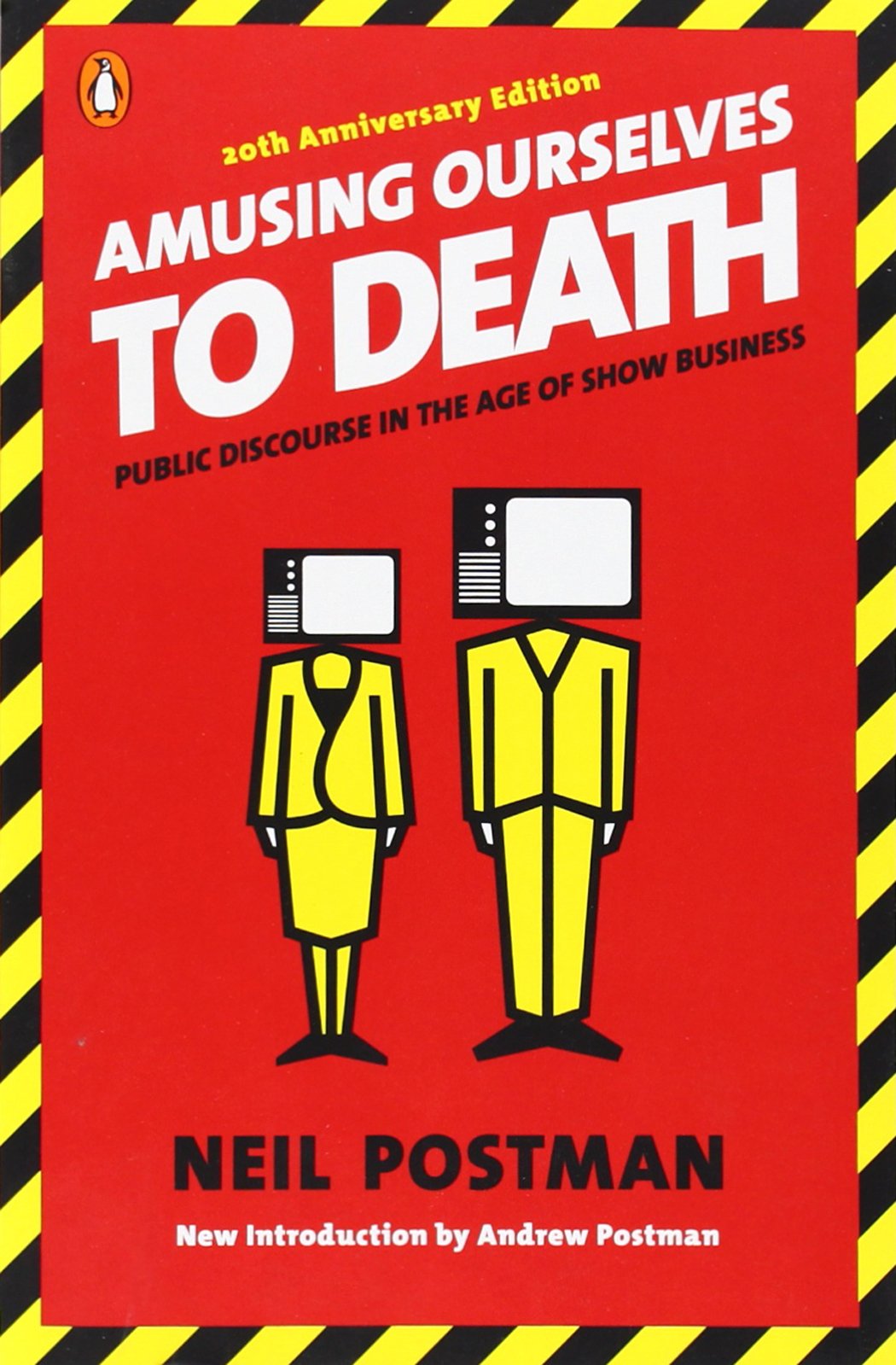
For some time now I had been thinking of reading a book that deals with the ill-effects of viewing too much Television. Thanks to Amazon’s recommendation system, I stumbled upon ‘Amusing Ourselves to Death’ by Neil Postman. The book was written in 1985, and deals with the ill-effects of too much TV on American society. I wish every Indian reads this book for what TV viewing patterns did to Americans in the seventies and eighties, they are doing to Indians in the second decade of this millennium.
Some of the key points discussed in the book are:
The book is divided into two parts: the first part deals with historical context on how America transitioned from the Age of Typography to the Age of Television. The second part deals with the effects (on the American society) of television transforming key aspects of American society (News, Politics, Religion and Education) into entertainment packages. The book is short but thought provoking. The author’s observations and choice of words are spot-on and make for an interesting and absorbing read.
Though written about thirty years back the book is still relevant and its importance only increases when we consider the fact that we have augmented the age of TV with the age of internet, the age of social media and the age of mobile. As technology become ever pervasive in our lives it is very important to pause and think if every change introduced by technology in our lives is for our betterment and if every change promised by technology is necessary in the first place. Reading this book and following it with some contemplation is a welcome first step in that process.
Below are the two part interviews by Neil Postman on the Book given in December 1985 and January 1986.


My thoughts on the ongoing protests to lift the ban on Jallikattu:
#Jallikattu #Jallikattuprotest #AmendPCA
Everything made Art.
The goal of this blog is to create a list of super facts. Important facts that are true with very high certainty and yet surprising, misunderstood, or disputed by many. This blog aims to be challenging, educational, and fun, without it being clickbait. I determine veracity using evidence, data from reputable sources and longstanding scientific consensus. Prepare to be challenged (I am). Intentionally seek the truth not confirmation of your belief.
The musings and ramblings of a young poet.
Rhymes and Reasons for Every Season
words. hearts. humidity.
The Life & Ramblings Of A Zillennial
welcome to my paradoxes
where wellness meets authenticity.
Just Inked Thoughts- Poems, Quotes, and Reflections
Here's To Express.. :)
THIS SITE IS ABOUT ME, MY CREATIVITY, MY IMAGINATION AND MY FEELINGS.
Hi! my name is Sebastian (You can call me Seb!) ...welcome to my Blog. I'm a photographer from Worcester, Worcestershire, England. Thanks for dropping by! I hope you enjoy my work.
Open Your Mind
Epic fantasy & military sci-fi author.
An Independent Nondiscriminatory Platform With No Religious, Political, Financial, or Social Affiliations - FOUNDED 2014
Living slowly, adventuring often ✨️
Connecting Inner voice to External World
Gray clouds trail across the sky. In the pale winter sun a flock of geese (Ben Grafström--Akita, Japan)
This is Your Quest - Your Mission to Find Happiness
Tip Shack generates inspiring, positive, informative, entertaining and useful tips & guide, covering fast and fun gastronomy, movies, entertainment, sports, beauty, news, relationships and technology.
Climbing, Outdoors, Life!
Challenging and Supporting People to do the Most Important Work of their Lives
A Journey Through the Looking Glass - Views Expressed Are My Own


 Yogi's Blogosmos