The Wise Angel

In the book ‘Springboard,’ Professor Richard Shell narrates the story of an elderly man (from working class background) who walked into a Wharton School seminar on income and happiness. After listening to what was being discussed, during Q&A session the elderly man described that happiness is just three things: good health, meaningful work and love. Professor Shell who was also present in the audience that day describes in the book that the aura of the academic world had for a moment fallen away under the weight of those simple words. Professor Shell goes on to describe that anonymous gentleman as the WISE ANGEL.

Today as I was lost in a stream of random thoughts, my mind finally came to anchor at the ‘WISE ANGEL’ island. I was thinking if I had met such a ‘WISE ANGEL’ in my life; or did I have the fortune of meeting someone who came at least close to the ‘WISE ANGEL’ – someone who was able to express a profound thought in a simple way.  For a few minutes my mind circling just like a man stranded in an unfamiliar woods on a foggy day.

After a few minutes I remembered of my visit to a Homeopathic Doctor at Mandaveli, Chennai – a few months back. I generally avoid taking allopathic medicine for recurring and nagging issues. I generally try to find some natural cure or take Homeopathic medicine. After repeated failures to locate a Homeopathic doctor near my locality, I found one near my sister’s place.

On this particular day, I had gone to see this doctor for a bout of common cold. He asked me for my age (35 years) and other details. He was trying to explore my medical history, allergies if any, family medical history etc. Then I started explaining about the issues for which I had gone to visit him. Before prescribing me the medicine he said, ‘You should realize that your first innings is over.’ Puzzled, I replied, ‘I don’t understand.’

The doctor went on to explain: ‘Till 35 years of age we are in the first innings of our life. From 35 years to 70 years we are in the second innings of our life. If we are fortunate enough to live beyond 70 years, we should consider it as super over. Since you are past 35 years of age, it is better to realize that you are in the second innings of your life and make modifications to your lifestyle accordingly.’  For a moment I was like thunderstruck.

Looking at the rather strange look in my face the doctor went on to add, ‘Our health is the most important asset that we have. We should do everything under our control to ensure that this asset remains healthy as long as possible.’ The doctor went to on to explain some of the food items that I can eat to increase my basic immunity. Then then prescribed medicines for me; I paid the fees and left the clinic. That day as I was riding back home on my bike, I had mixed feelings.

But over the next few days as I reflected on what the doctor said, I realized that the doctor only helped me realize the reality sooner than later. And as I think back on the incident today and associate the incident that Professor Shell narrates in his book I can clearly see that the Homeopathic Doctor is one of the ‘WISE ANGELS’ that I have encountered in my life.

Book Review: Springboard by G. Richard Shell

‘The end of all our exploring will be to arrive where we started and know the place for the first time.’ – T.S. Eliot

‘Happiness is just three things: good health, meaningful work and love. You have that, you are happy.’ – The Wise Angel

‘You must bake with the flour you have.’ – Danish folk saying

The book ‘Springboard: Launching Your Personal Search for SUCCESS’ by the creator Wharton School’s ‘Success Course,’ Professor G. Richard Shell is not a breezy read superficial success book that one likes to read while waiting at a railway station or an airport. It is rather a complete success workbook that is filled with a number of exercises that helps us to reflect on what success is to us and how can we go about achieving it in our life.

The Book is divided into two parts. In the first four chapters that constitute the first section, Professor Shell tries to help us in answering the question ‘What is Success?’ In the next five chapters Professor Shell tries to help in answering the question ‘How will I Achieve Success?’ The book starts with the six lives exercise wherein Professor Shell briefly chronicles the lives of six individuals to drive home the point that ‘there is nothing called a perfect life and there are trade-offs involved in every kind of life.’

In each chapter, in addition to introducing a few solid foundations that would aid us in quest, the author also uses the case study of some famous and some not so famous lives to illustrate the point that he is making. Some of the lives that we get to see in this book are that of Tennis Legend Andre Agassi, Celebrity Chef & TV personality Julia Child, social entrepreneur Eric Adler, one of California lottery winners Cynthia Stafford, the first person to a solo nonstop flight across the Atlantic Charles Lindbergh and one of the most influential naval architects in American history William Francis Gibbs. What I liked about this book is that the author does not leave out the dark sides of success for some of the very people that he uses as case studies.

But the first narrative in the book is about Professor Shell himself. As a young man during Vietnam War era, Professor Shell shunned his family tradition of joining the U.S. military services and as a result estranged his relationship with his parents. From then on he embarked on perilous journey towards self-defeat and its lowest point had the wisdom to turn around to embark on an odyssey that will lead to his metamorphosis into a Wharton Professor helping talented embark on their unique journey towards success.

The book introduces us to multiple concepts including: Simcha, three types of happiness: Momentary Happiness, Overall Happiness and Wisdom Experiences, two types of respect: Recognition Respect and Informed Respect, Hungry Ghosts of Fame and Fortune, three ways of looking at work: jobs, career and calling/meaningful work, the SAME Personality Assessment, the PERFECT work motivations, three types of friendships: friends of pleasure, friends of utility and friends of virtue, among others.

In a way this is more of a workbook cum reference book and one would gain maximum benefit from this book by truthfully working on the various exercises given in the book. The book does a very good job of explaining the multi-dimensional aspect of success and the various trade-offs and pitfalls of following the cultural and societal stereotypes of success. The book would serve as a light house or guiding beacon when we get swept in the rat-race and by referring back to this book from time to time we can ensure that we are not led astray from our own unique success journey. The book could serve as a virtual mentor for people who have difficulty finding a real-life mentor.

Books I Read in 2015

I read more than a dozen books in 2015, most of them in the non-fiction category, a couple of them in the fiction category and a couple of Haiku handbooks. Given below are my favorite books among the ones that I read in 2015.

Man’s Search for Meaning by Viktor Frankl: This book is written by Nazi concentration camp survivor and a Psychotherapist Viktor Frankl. He is in fact the founder of third Viennese school of Psychotherapy, ‘Logotheraphy.’  The first part of the book deals with the recollection of Viktor Frankl’s time in multiple Nazi concentration camps through his Psychotherapist lens. The second part goes on to give a brief overview about ‘Logotheraphy.’ According to Viktor Frankl, ‘Life is a quest for Meaning. The great task for any person is to find meaning in his or her life.’ The book is about a man whose soul got enlightened and strengthened by the darkest days of his life and at the most inhuman of places.

Choose Yourself by James Altucher: I read a free version of ‘Choose Yourself’ in 2014. I liked the book so much that when I decided to re-read it in 2015, I decided to buy a copy and then read it. The book is written by a serial entrepreneur who has seen both his hey-days as well as professional abyss. The book is about how to reinvent ourselves, reinvent our goals and career. The book is about how to ‘Choose Ourselves’ and ‘Take Charge of our Life.’ The writing style of the author is completely different from that of most other authors of self-help books; he does not use a paternalistic tone and goes on to state that the world around us has changed and we better change for our own good.

The Happiness Hypothesis by Jonathan Haidt: This book by Social Psychologist Jonathan Haidt is about the origins of positive psychology in ancient wisdom and the applications of positive psychology today. The authors takes ten great ideas from world’s ancient civilization, analyses them using (social) science research principles and synthesizes the lessons that are still relevant to our present day lives.

How to Fail at Almost Everything and Still Win Big by Scott Adams: This book provides a sneak-peek into Scott Adams’ life and the lessons that we can use to improve our lives. While it is very easy to assume that a very successful person like Scott Adams’ might have tasted success from the word go, in reality his life has not been a bed of roses. He has faced a number of failures before and after Dilbert. I liked the fact that most of the chapters are short, crisp and clear. Overall the book is a delight to read and has a healthy mix of success advice, insights from Scott Adams’ life, humor and Dilbertoons.

Springboard by G. Richard Shell: This book is a complete success workbook that is filled with a number of exercises that helps us to reflect on what success is to us and how can we go about achieving it in our life. The book does a very good job of explaining the multi-dimensional aspect of success and the various trade-offs and pitfalls of following the cultural and societal stereotypes of success. The book could serve as a virtual mentor for people who have difficulty finding a real-life mentor.

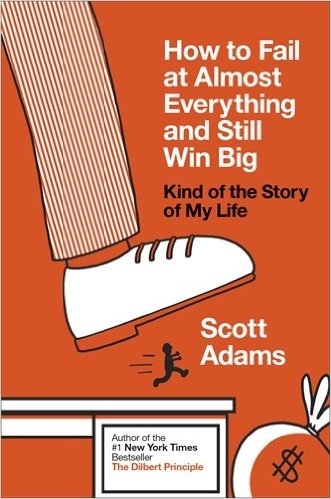
Book Review: How to Fail at Almost Everything and Still Win Big by Scott Adams

How to Fail at Almost Anything Book

Recently I read Scott Adams’ (the creator of Dilbert) part auto-biography cum part self-help book, ‘How to Fail at Almost Everything and Still Win Big: Kind of the Story of My Life.’ I started with the book with the intention of reading one chapter per day. However after I started reading curiosity and Scott Adam’s writing style got the better of me and I completely ignored my original rule and read as much as possible in a day. I finished the book in about a week’s time.

The book provides a sneak-peek into Scott Adams’ life. While it is very easy to assume that a very successful person like Scott Adams’ might have tasted success from the word go, in reality his life has not been a bed of roses. He has faced a number of failures before and after Dilbert; in fact the book has two entire chapters where he recollects all his failures (being a hyper-optimist, he actually sees them as learning opportunities).

Scott Adams actually spent 16 years in the corporate world before starting out as a cartoonist and then had to cross several hurdles before tasting success with Dilbert. Twice in his life he also faced career threatening medical issues that did not have any known medical remedies at that time. While the author does not a portray his story as that of Knight winning against dismal odds, his story is inspiring. I liked the fact that most of the chapters are short, crisp and clear.

Scott Adams seems to be a big believer in ‘Affirmations.’ The book has three chapters about how he has used affirmations at different stages in his life. While he gives several reasons as to why one should indulge in the practice of affirmations and why it might actually help, I like the particular reasoning that affirmations might be a way focusing your energies around something that you aspire for.  Some of Scott Adams’ observations in the book that I liked are given below:

‘Success caused passion more than passion caused success.’

‘Failure is where success likes to hide in plain sight.’

‘If you want success, figure out the price, then pay it.’

‘Ideas change the world routinely, and most of those ideas originate from ordinary people.’

‘Good health is a baseline requirement for success.’

‘Every skill you acquire doubles your odds of success.’

‘There’s no denying the importance of practice. The hard part is figuring out what to practice.’

‘The idea I’m promoting here is that it helps to see the world as math and not magic.’

Scott Adams’ has given a list of 13 skillsets (psychology, business writing etc.) that every adult should gain a working knowledge of. The author also quotes a number of studies by experts in support of some the advice that he is proposing. The book is laid out in a way that Scott Adams is reflecting on his life journey and recollecting some of the pivotal moments. He discusses about which approaches worked for him and advises us to think about similar approaches that might assist us in our journey towards success. Overall the book is a delight to read and has a healthy mix of success advice, insights from Scott Adams’ life, humor and Dilbertoons.

Print Books vs. E-Books – Part 3

This is a follow up post to my previous post: Print Books VS. E-Books and Print Books VS E-Books – Part 2.

Amazon might promote Kindle E-Reader as device ‘for the love of reading.’ But we would get locked into Amazon’s system if we buy the Kindle E-reader. A friend of mine reads using his smart phone through Kindle e-Reading app as well as Flipkart’s e-reading app. He says he does comparison shopping and buys from the vendor who offers a book at the lowest price.

Reading only using e-reader also makes it difficult to come across interesting books other than what Amazon’s or other such vendors’s recommendation algorithm would suggest. In one particular instance, I was watching Barry Shwartz’s TED video on my laptop and then decided to buy his book, ‘The Paradox of Choice’. Using only the e-reader would rule out possibilities like these.

While most of the time we come across opinions that portray Social Media as unnecessary distraction, they can be useful too. Most non-fiction authors take between one year and three years to publish a new book. Following them on Social Media sites like Twitter would help us to find out about any follow up research or development after a book (on a particular topic) got published. Professors/Authors like Steven Pinker, Richard Thaler, Dan Ariely and Nassim Nicholas Taleb post about interesting ongoing academic research from their respective Twitter handles quiet often. Some of these ongoing research might act as supplement to the book that we might be reading. As is always the case with any social media we have to have the discipline to selectively browse and read, otherwise we will be wasting our time. This is where a general purpose device like a smartphone or a tablet might come in handy rather than a dedicated e-reader.

Having access social media tools like Facebook, Twitter and WhatsApp will also help us to share with our friends and acquaintances about what book we are reading. Rather than a way of just bragging, we can use these tools to share quotes, anecdotes, statistics, etc. from the book that we are reading. About a few days ago I was reading an article by James Altucher on Pope Francis. I found a quote by Pope Francis about the media very interesting and I shared it via my Twitter handle. What’s the fun of any activity including reading if we cannot assimilate (good) aspects of it into our personality and bring it to the fore in our social interactions? Reading from sources like blogs, forums and websites will also not be possible with a dedicated e-reader.

Having a general purpose device like a smartphone or tablet can be useful in other situations as well. On a couple of occasions, I have taken snaps at the most unlikeliest of places and times using my smartphone and used these snaps later to write blog posts (Examples: Urban Nomads, Free Bird Peeking at Caged Birds and Cloud – awkward wingman). There was another occasion when I was waiting in the reception of a dental clinic while my wife was getting her dental procedure done, I opened the Kindle e-reading app and read a book.

With passage time displays in smartphones and tablets might improve to negate some of the advantage enjoyed by e-readers. There might be some new development such as in spectacles and contact lens that can eliminate or at least drastically reduce the eye strain developed due to reading on smartphone or tablet displays.

Amazon markets its Kindle e-reader with the tagline: “For the love of reading.” In a way, we can assume, any e-reader carries a hidden tagline: ‘For the confinement of reading from e-books alone.”   While there is no doubt that e-books are superior to printed books on a number of utility factors, a dedicated e-reader is not absolutely necessary to enjoy these benefits. Ultimately buying and owning a dedicated e-reader is more a matter of affordability and preference than any technological requirement to enjoy e-books. A general purpose device like a smartphone or a tablet would allow us to read from a myriad sources in addition to e-books. We can actually use a smartphone or a tablet as a device to fulfil and enhance our ‘love for reading’ provided we only have the discipline to do so.

Print Books vs. E-Books – Part 2

This is a follow up post to my previous post: Print Books VS. E-Books.

A friend of mine introduced me to the idea of general reading during my MBA days. I wish I had picked up this wonderful habit much earlier. I generally used to read non-fiction books in paperback format. One of the problems I have encountered every now and then is that after starting a book and getting the basic message of the book, if the writing style is not to my liking, I tend to discontinue reading further. I also tend to get very restless in reading books that run beyond 300 to 350 pages. I have accumulated so many books over the course of the last ten years that managing them has become a problem (at least the ones that I have not finished reading and don’t foresee reading either). The problem is compounded by the fact that I have lived in four different cities over the course of the last ten years or so and moving and maintaining these books has been a problem.

So the last few books that I have bought have all been in e-book format. I do not own a Kindle e-book reader. I have been thinking about buying one for a long time now. Instead I have continued to read these e-books using the Kindle app in my smartphone or my laptop. The kind of money that I will have to shell out on a Kindle e-reader would transform my book reading experience from simple pleasure to a guilty pleasure. Let’s dig a little deeper in to this.

Amazon has been promoting Kindle e-readers in a big way in India these days. They have stepped up the print and television ads in the last few months. They are also sponsoring a short story writing contest in tie-up with The Times of India. The cheapest Kindle e-reader is INR 5,999, the Kindle Paperwhite is priced at INR 10,999 and the Kindle Voyage is priced at INR 16,499. Most of Amazon’s ads feature the Kindle Paperwhite and to enjoy most of the benefits that are being advertised, one would have to have at least the Kindle Paperwhite. Let’s take the case of Kindle Paperwhite for the sake of this post.

Amazon India sells E-books at a discount compared to paperback versions. The discount is not substantial but let’s assume that the average money saved by buying an e-book is INR 100. If I buy a Kindle Paperwhite, I would have to read at least 110 books to start accumulating actual savings in money when compared to buying all these books in paperback format. On an average I read about one book a month. At that rate it will take me 9 years to realize the above said savings. I am not sure if the e-reader will function fully well till that period (accounting for durability of the product as well as my own handling of it). Amazon itself gives only one year warranty for the product. It’s safe to say that like most gadgets these days it will reach end of life between third and fifth year.

We might argue, the cost benefit analysis is not the right way to look at the Kindle e-reader; it enhances the reading experience. But only as long as I am fine with reading books and/or magazines in black and white. Kindle e-reader is Henry Ford’s equivalent of a gadget: ‘We can read whatever we want to read on the Kindle e-reader as long as its BLACK and White.’ I went to Croma Retail store a couple of days back to check out the Kindle Paperwhite. The children’s magazine (cartoon) that was loaded in the demo version was in black and white. That same magazine (in colorful form) is available for INR 25 in print edition. I am not sure if I or my daughter would ever be interested in reading a cartoon strip in black and white. I can safely say never. If I have to pay INR 10,999 and still make a compromise with my reading experience (on some of the stuff that I would read) then I might as well make a compromise with my reading experience without spending INR 10,999 (by reading on the app on my mobile and laptop). As of now the only person in my circle who owns a Kindle e-reader (basic version) did not actually buy it; his friends gifted it to him!

Print Books vs. E-Books

On Thursday (September 24), I came across this Tweet by Professor Stew Friedman: “I love the smell of paper in the morning. E-book sales slip, print books alive & kicking! @xanalter @NYTimes http://nyti.ms/1KuGItp” I clicked on the link and landed on New York Times article titled: “The Plot Twist: E-Book Sales Slip, and Print Is Far From Dead.”

Some of the key points from the article are:

  • E-book sales fell by 10% in the first five months of this year (Source: Association of American Publishers)
  • While analysts once predicted that e-books would overtake print by 2015, digital sales have instead slowed sharply.
  • There are signs that some e-book adopters are returning to print, or becoming hybrid readers, who juggle devices and paper.
  • The article quotes a co-owner of a bookstore saying, “The e-book terror has kind of subsided.”
  • The double- and triple-digit growth rates in sales of e-reading devices have become thing of the past.
  • Around 12 million e-readers were sold last year, a steep drop from the nearly 20 million sold in 2011 (Source: Forrester Research).
  • The portion of people who read books primarily on e-readers fell to 32% in Q1 2015, from 50% in 2012 (Source: Nielsen survey).

As I was reading through this article I was reminded of an article about ‘climate change’ from nature.com that I read last year.  The key quote from the article from Nature.com that would serve as counter point to the New York Times article is: “If you are interested in global climate change, your main focus ought to be on timescales of 50 to 100 years.’ I guess the article in New York Times is getting the timescale wrong. Looking at what happened in the first five months of a year or in particular year might not serve as a good barometer for a long term trend. If we are interested in examining a business trend then we should be looking at least a ten year period. We might brush aside the comment from nature.com as a natural phenomenon and is not applicable to economic systems. Let’s take the example of the Dow Jones Industrial Average. In the long run it has been going up, but there have been short term reversals (during recessions). The dip in e-book sales could just be a short term reversal.

Another key aspect to keep in mind is that usually most analysts predict technological shifts to happen (using models) in much shorter time frame they actually take in the real world. Think of what analysts have written about adoption of cloud computing, etc. These technological shifts have taken longer than what the analysts had predicted. E.g. Oracle and many other technology companies had envisioned and were working on projects of what would eventually become cloud computing way back in the nineties and yet cloud computing is nowhere close to replacing legacy systems completely.

When analysts predict the adoption of new technologies, they place less weightage on how the players who benefit from the status-quo would retaliate. One of the reasons for the dip in e-book sales could be aggressive initiatives by print book publishers and distributors. Or it could be due to the fact that people are spending more and more time with electronic media and once in a while may return to non-electronic formats like print books. Also historically new technologies have not replaced old ones like an asteroid-strike wiping off dinosaurs from the face of the planet. There have been extended periods of time where the technology that is being replaced and the one that is replacing it have co-existed; examples: horse drawn coaches and motor cars, land-line phones and mobile phones, feature phones and smart phones, type writers and printers, etc.

Like the New York Times article rightly concludes, it’s too early in the day to conclude that print books have defended their turf against invading e-books. The trend of digitization is all around us and consuming books in electronic format is consistent with the way people consume other forms of media. There are multiple benefits of reading books in electronic format compared to print book format and in due course of time an entire generation that will find it very natural to read books in electronic form will form the bulk of the customer base. I guess eventually e-books will become the dominant form.