Around the time of First Gulf War, on Fridays I used to stay awake at night longer than usual to view my favorite program, ‘World This Week,’ the international news show by NDTV. The topics covered, the visuals and the presentation were completely different from what Doordarshan’s other news programs had to offer. In those days Doordarshan was the only TV Channel available. On Friday evenings when ‘Oliyum Oliyum’ (a program from DD Chennai featuring Tamil Movie songs) was telecast the streets used to be empty. In those days I, like a lot of boys of my age used to bunk school to watch Indian Cricket Team Play, on TV.
Cut to today, January 14, 2018, the day of Pongal, the most auspicious and important of Tamil Festivals. All Tamil Satellite and Free-to-Air TV channels are drowning viewers in Pongal Special Programs (read movies and programs featuring Movie Actors and Technicians). As I write this post Indian Cricket Team is playing against South Africa in their second Test Match somewhere in South Africa; India is actually batting. Countless news channels are blaring about the day’s happenings. Yet instead of getting glued to one of the three TV sets at home, I am sitting and writing this blog post about a book that talks about the ill-effects of Television. From yearning for more TV content to TV addiction to weaning myself of TV, my world has come full circle.
From being deprived of TV channels and TV content to literally drowning in TV programs, India has come a long way. All this started with liberalization in the early nineties. Today my DTH subscription offers me hundreds of channels from all corners of the world. For each category there are a dozen channels. I could have a dozen clones of myself but still may not be able to cover all the TV programs in my favorite channels in a single day.
I always used to think of TV as a source of general knowledge. When I think of TV programs like ‘Turning Point,’ ‘Surabhi,’ and ‘World This Week’ come to my mind. Not to mention the various news telecasts that helped me to be update with the happenings in the world. But somewhere after my MBA days, I started realizing that a lot of incidents not worthy of being covered were getting unusually disproportionate amount of airtime. Consider the news flash telecast by a popular news channel, ‘Police Commissioner’s lost pet dog has been found.’ How about manufactured for TV sporting events like IPL, ISL, PBL, etc. The worst type programs on TV are the reality shows (think of ‘Rakhi Ka Swyamwar’ and its close cousins). How about Radia Tapes which nearly destroyed the credibility of TV News Channels? Also I realized that while random acts of crime/ hatred will find airtime, random acts of kindness never got a mention; TVs Channels have and obsessive compulsion to focus and telecast negative news.
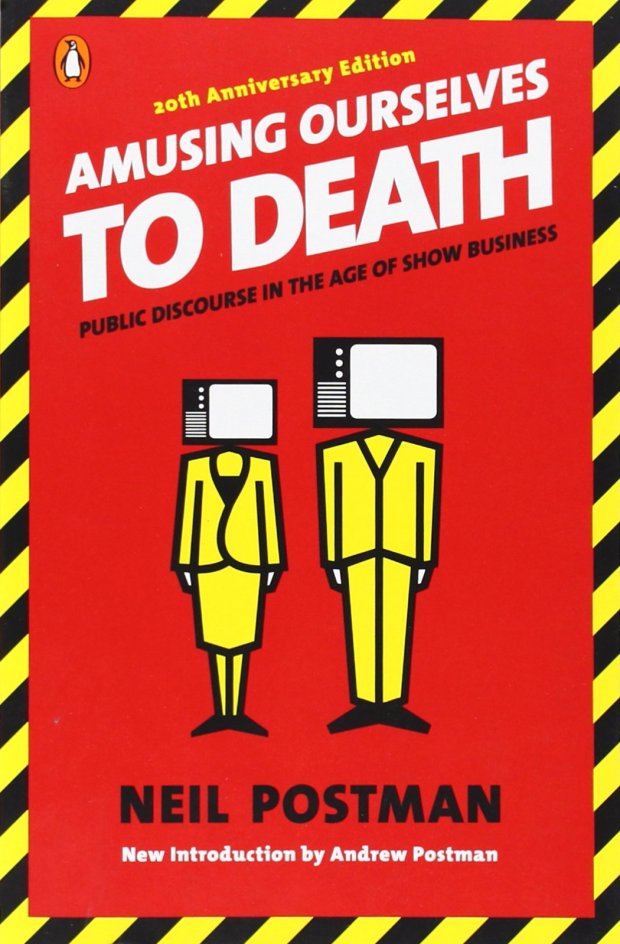
For some time now I had been thinking of reading a book that deals with the ill-effects of viewing too much Television. Thanks to Amazon’s recommendation system, I stumbled upon ‘Amusing Ourselves to Death’ by Neil Postman. The book was written in 1985, and deals with the ill-effects of too much TV on American society. I wish every Indian reads this book for what TV viewing patterns did to Americans in the seventies and eighties, they are doing to Indians in the second decade of this millennium.
Some of the key points discussed in the book are:
- Between the dystopian futures prophesized by George Orwell, ‘People will be overcome by externally imposed oppression. Truth will be concealed from people’ and Aldous Huxley, ‘People will come to love their oppression, to adore the technologies that undo their capacities to think. Truth would be drowned in a sea of irrelevance,’ Huxley’s Prophesy has come true.
- The most significant American Cultural fact of the second half of the twentieth century is the decline of the Age of Typography and the ascendancy of the Age of Television.
- The news of the day is a figment of our technological imagination. Most of our daily news is inert, consisting of information that gives us something to talk about but cannot lead to any meaningful action.
- In every tool that we create, an idea is embedded that goes beyond the function of the thing itself.
- Every new technology for thinking involves trade-off. It giveth and taketh away, although not quite in equal measure. Media change does not necessarily result in equilibrium.
- The form in which ideas are expressed affects what those ideas will be.
- There is a difference between thinking in a word-centered culture and thinking in an image-centered culture.
- Each of the media that entered the electronic conversation in the late nineteenth and early twentieth centuries followed the lead of telegraph and the photograph, and amplified their biases.
- Television does not extend or amplify literate culture. It attacks it.
- The problem is not that TV presents us with entertaining subject matter but all subject matter is presented as entertaining. Entertainment is the supra-ideology of all discourse on television.
- Television is our culture’s principal mode of knowing about itself. Therefore, how television stages the world becomes the model for how the world is properly staged.
- Television serves us most usefully when presenting junk entertainment; it serves us most ill when it co-opts serious modes of discourse – news, politics, science, education, commerce, religion – and turns them into entertainment packages.
- To be unaware that a technology comes equipped with a program for social change, to maintain that technology is neutral, to make the assumption that technology is a friend to culture, is stupidity.
- Introduce the alphabet to a culture and you change its cognitive habits, its social relations, its notion of community, history and religion. Introduce the printing press with movable type, and you do the same. Introduce speed-of-light transmission of images and you make a cultural revolution. Without a vote. Without polemics. Without guerilla resistance. Here is ideology, pure if not serene.
The book is divided into two parts: the first part deals with historical context on how America transitioned from the Age of Typography to the Age of Television. The second part deals with the effects (on the American society) of television transforming key aspects of American society (News, Politics, Religion and Education) into entertainment packages. The book is short but thought provoking. The author’s observations and choice of words are spot-on and make for an interesting and absorbing read.
Though written about thirty years back the book is still relevant and its importance only increases when we consider the fact that we have augmented the age of TV with the age of internet, the age of social media and the age of mobile. As technology become ever pervasive in our lives it is very important to pause and think if every change introduced by technology in our lives is for our betterment and if every change promised by technology is necessary in the first place. Reading this book and following it with some contemplation is a welcome first step in that process.
Below are the two part interviews by Neil Postman on the Book given in December 1985 and January 1986.














 Yogi's Blogosmos