Book Review: Springboard by G. Richard Shell

‘The end of all our exploring will be to arrive where we started and know the place for the first time.’ – T.S. Eliot

‘Happiness is just three things: good health, meaningful work and love. You have that, you are happy.’ – The Wise Angel

‘You must bake with the flour you have.’ – Danish folk saying

The book ‘Springboard: Launching Your Personal Search for SUCCESS’ by the creator Wharton School’s ‘Success Course,’ Professor G. Richard Shell is not a breezy read superficial success book that one likes to read while waiting at a railway station or an airport. It is rather a complete success workbook that is filled with a number of exercises that helps us to reflect on what success is to us and how can we go about achieving it in our life.

The Book is divided into two parts. In the first four chapters that constitute the first section, Professor Shell tries to help us in answering the question ‘What is Success?’ In the next five chapters Professor Shell tries to help in answering the question ‘How will I Achieve Success?’ The book starts with the six lives exercise wherein Professor Shell briefly chronicles the lives of six individuals to drive home the point that ‘there is nothing called a perfect life and there are trade-offs involved in every kind of life.’

In each chapter, in addition to introducing a few solid foundations that would aid us in quest, the author also uses the case study of some famous and some not so famous lives to illustrate the point that he is making. Some of the lives that we get to see in this book are that of Tennis Legend Andre Agassi, Celebrity Chef & TV personality Julia Child, social entrepreneur Eric Adler, one of California lottery winners Cynthia Stafford, the first person to a solo nonstop flight across the Atlantic Charles Lindbergh and one of the most influential naval architects in American history William Francis Gibbs. What I liked about this book is that the author does not leave out the dark sides of success for some of the very people that he uses as case studies.

But the first narrative in the book is about Professor Shell himself. As a young man during Vietnam War era, Professor Shell shunned his family tradition of joining the U.S. military services and as a result estranged his relationship with his parents. From then on he embarked on perilous journey towards self-defeat and its lowest point had the wisdom to turn around to embark on an odyssey that will lead to his metamorphosis into a Wharton Professor helping talented embark on their unique journey towards success.

The book introduces us to multiple concepts including: Simcha, three types of happiness: Momentary Happiness, Overall Happiness and Wisdom Experiences, two types of respect: Recognition Respect and Informed Respect, Hungry Ghosts of Fame and Fortune, three ways of looking at work: jobs, career and calling/meaningful work, the SAME Personality Assessment, the PERFECT work motivations, three types of friendships: friends of pleasure, friends of utility and friends of virtue, among others.

In a way this is more of a workbook cum reference book and one would gain maximum benefit from this book by truthfully working on the various exercises given in the book. The book does a very good job of explaining the multi-dimensional aspect of success and the various trade-offs and pitfalls of following the cultural and societal stereotypes of success. The book would serve as a light house or guiding beacon when we get swept in the rat-race and by referring back to this book from time to time we can ensure that we are not led astray from our own unique success journey. The book could serve as a virtual mentor for people who have difficulty finding a real-life mentor.

Books I Read in 2015

I read more than a dozen books in 2015, most of them in the non-fiction category, a couple of them in the fiction category and a couple of Haiku handbooks. Given below are my favorite books among the ones that I read in 2015.

Man’s Search for Meaning by Viktor Frankl: This book is written by Nazi concentration camp survivor and a Psychotherapist Viktor Frankl. He is in fact the founder of third Viennese school of Psychotherapy, ‘Logotheraphy.’  The first part of the book deals with the recollection of Viktor Frankl’s time in multiple Nazi concentration camps through his Psychotherapist lens. The second part goes on to give a brief overview about ‘Logotheraphy.’ According to Viktor Frankl, ‘Life is a quest for Meaning. The great task for any person is to find meaning in his or her life.’ The book is about a man whose soul got enlightened and strengthened by the darkest days of his life and at the most inhuman of places.

Choose Yourself by James Altucher: I read a free version of ‘Choose Yourself’ in 2014. I liked the book so much that when I decided to re-read it in 2015, I decided to buy a copy and then read it. The book is written by a serial entrepreneur who has seen both his hey-days as well as professional abyss. The book is about how to reinvent ourselves, reinvent our goals and career. The book is about how to ‘Choose Ourselves’ and ‘Take Charge of our Life.’ The writing style of the author is completely different from that of most other authors of self-help books; he does not use a paternalistic tone and goes on to state that the world around us has changed and we better change for our own good.

The Happiness Hypothesis by Jonathan Haidt: This book by Social Psychologist Jonathan Haidt is about the origins of positive psychology in ancient wisdom and the applications of positive psychology today. The authors takes ten great ideas from world’s ancient civilization, analyses them using (social) science research principles and synthesizes the lessons that are still relevant to our present day lives.

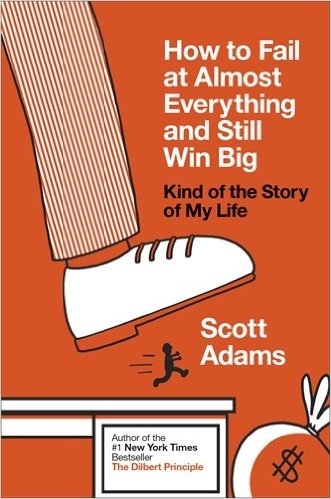
How to Fail at Almost Everything and Still Win Big by Scott Adams: This book provides a sneak-peek into Scott Adams’ life and the lessons that we can use to improve our lives. While it is very easy to assume that a very successful person like Scott Adams’ might have tasted success from the word go, in reality his life has not been a bed of roses. He has faced a number of failures before and after Dilbert. I liked the fact that most of the chapters are short, crisp and clear. Overall the book is a delight to read and has a healthy mix of success advice, insights from Scott Adams’ life, humor and Dilbertoons.

Springboard by G. Richard Shell: This book is a complete success workbook that is filled with a number of exercises that helps us to reflect on what success is to us and how can we go about achieving it in our life. The book does a very good job of explaining the multi-dimensional aspect of success and the various trade-offs and pitfalls of following the cultural and societal stereotypes of success. The book could serve as a virtual mentor for people who have difficulty finding a real-life mentor.

Book Review: How to Fail at Almost Everything and Still Win Big by Scott Adams

How to Fail at Almost Anything Book

Recently I read Scott Adams’ (the creator of Dilbert) part auto-biography cum part self-help book, ‘How to Fail at Almost Everything and Still Win Big: Kind of the Story of My Life.’ I started with the book with the intention of reading one chapter per day. However after I started reading curiosity and Scott Adam’s writing style got the better of me and I completely ignored my original rule and read as much as possible in a day. I finished the book in about a week’s time.

The book provides a sneak-peek into Scott Adams’ life. While it is very easy to assume that a very successful person like Scott Adams’ might have tasted success from the word go, in reality his life has not been a bed of roses. He has faced a number of failures before and after Dilbert; in fact the book has two entire chapters where he recollects all his failures (being a hyper-optimist, he actually sees them as learning opportunities).

Scott Adams actually spent 16 years in the corporate world before starting out as a cartoonist and then had to cross several hurdles before tasting success with Dilbert. Twice in his life he also faced career threatening medical issues that did not have any known medical remedies at that time. While the author does not a portray his story as that of Knight winning against dismal odds, his story is inspiring. I liked the fact that most of the chapters are short, crisp and clear.

Scott Adams seems to be a big believer in ‘Affirmations.’ The book has three chapters about how he has used affirmations at different stages in his life. While he gives several reasons as to why one should indulge in the practice of affirmations and why it might actually help, I like the particular reasoning that affirmations might be a way focusing your energies around something that you aspire for.  Some of Scott Adams’ observations in the book that I liked are given below:

‘Success caused passion more than passion caused success.’

‘Failure is where success likes to hide in plain sight.’

‘If you want success, figure out the price, then pay it.’

‘Ideas change the world routinely, and most of those ideas originate from ordinary people.’

‘Good health is a baseline requirement for success.’

‘Every skill you acquire doubles your odds of success.’

‘There’s no denying the importance of practice. The hard part is figuring out what to practice.’

‘The idea I’m promoting here is that it helps to see the world as math and not magic.’

Scott Adams’ has given a list of 13 skillsets (psychology, business writing etc.) that every adult should gain a working knowledge of. The author also quotes a number of studies by experts in support of some the advice that he is proposing. The book is laid out in a way that Scott Adams is reflecting on his life journey and recollecting some of the pivotal moments. He discusses about which approaches worked for him and advises us to think about similar approaches that might assist us in our journey towards success. Overall the book is a delight to read and has a healthy mix of success advice, insights from Scott Adams’ life, humor and Dilbertoons.