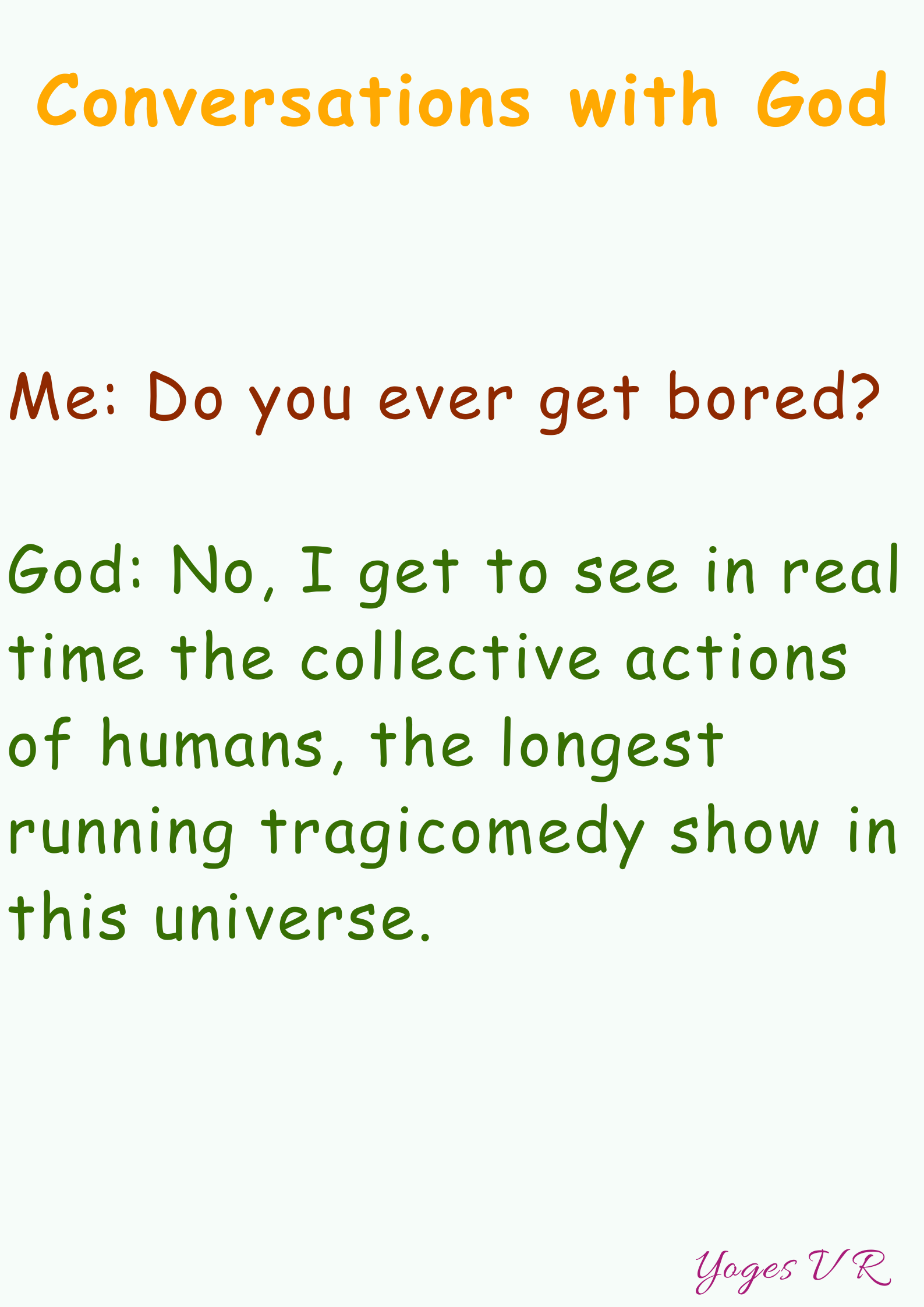
Conversations with God #36
I recently came across ‘UX Week 2011’ talk by former Google User Experience Researcher and former Facebook Product Manager, Paul Adams. I found the talk both fascinating as well as useful. As a result I decided to read his book, ‘Grouped.’ The book essentially builds on the ideas that Paul Adams discusses in the talk. The 10 chapter book is crisp and concise and one can easily finish reading it within a couple of days which exactly what I did. The book draws on a lot of network science, social psychology and sociology research findings and points to how these insights can be used for business success in the web world. Another highlight of the book is the number of simple but powerful diagrams to drive home the point that the author is making.
The book starts by discussing about four key shifts that are shaping our world:
Towards the end of the introduction chapter, Paul Adams makes the following observation, ‘Humans are social creatures, and an understanding of social behavior on the web will soon be required knowledge for almost all businesses.’ Paul Adams also discusses multiple instances of web 2.0 companies reaping the benefits by putting their understanding of this ‘social behavior’ to good use.
The author points to research studies that divide our family, friends and acquaintances into strong ties and weak ties. The discussion on how we don’t make friends but groups of friends based on different contexts that we are embedded in different stages of our life is fascinating. In his Paul Adams’ own words, ‘Social networks of connected independent groups of friends is the most important observation in this book.’
I found the fifth chapter of the book, ‘The myth of the influentials’ very interesting. The basic premise of this chapter is that highly connected individuals are not necessarily highly influential and in a sense each one of us influence people around us to varying degrees. Quoting Duncan Watts’ research study, Paul Adams notes that, ‘The most important factor in determining whether an idea spread was not whether there were influential people, but whether there was a critical mass of easily influenced people who were connected to other people who were easy to influence.’
There are individual chapters focused on ‘how our relationships influence us,’ ‘how our brain influences us,’ and ‘how our biases influence us’ each filled with multiple ‘Aha!’ insights. In a way ‘Grouped’ by Paul Adams is an antithesis to Malcolm Gladwell’s ‘The Tipping Point.’ Overall the book is a very delightful and informative read and is recommended to anyone who wants to understand social networks and influence in social networks.
Happiness is an eternal quest. Happiness is a mirage. Happiness is like passing clouds. There are two kinds of happiness: Happiness that we derive by doing the things that we like and happiness that we derive by doing the right things irrespective of whether we like it or not. Happiness is not a one-size fits all suit. The activities that lead to happiness in one stage of our life will not lead to happiness in a different stage in life; it might look outright absurdity too. Happiness can’t be expressed well with words but we can recognize moments when we were/are happy (if we are not evaluative or critical).
While I am sleeping do I actually know that I am sleeping? The moment that I try to gauge my level of happiness or if I am happy at all, I am no happier. Happiness can be achieved by being in the moment. Happiness is the fuel that drives life forward. Without happiness, that sense of well-being, what is the point of the pursuit called life? It is better to identify the unique set of activities and things from which we derive happiness than being driven in pursuit of the social stereotypes of happiness. Enough of the philosophical rhetoric on happiness.
Now to the practical aspect of how I experience happiness in my daily life. To me happiness is series of little moments scattered across my entire lifetime. My pursuit of happiness is as unique as me. Below are the list of things/ activities that give/have given me happiness at different times:
Note: This post has been written for Indiblogger’s Indispire edition 108: ‘What does happiness mean to you? Do you go looking for happiness?’

Recently I read Scott Adams’ (the creator of Dilbert) part auto-biography cum part self-help book, ‘How to Fail at Almost Everything and Still Win Big: Kind of the Story of My Life
The book provides a sneak-peek into Scott Adams’ life. While it is very easy to assume that a very successful person like Scott Adams’ might have tasted success from the word go, in reality his life has not been a bed of roses. He has faced a number of failures before and after Dilbert; in fact the book has two entire chapters where he recollects all his failures (being a hyper-optimist, he actually sees them as learning opportunities).
Scott Adams actually spent 16 years in the corporate world before starting out as a cartoonist and then had to cross several hurdles before tasting success with Dilbert. Twice in his life he also faced career threatening medical issues that did not have any known medical remedies at that time. While the author does not a portray his story as that of Knight winning against dismal odds, his story is inspiring. I liked the fact that most of the chapters are short, crisp and clear.
Scott Adams seems to be a big believer in ‘Affirmations.’ The book has three chapters about how he has used affirmations at different stages in his life. While he gives several reasons as to why one should indulge in the practice of affirmations and why it might actually help, I like the particular reasoning that affirmations might be a way focusing your energies around something that you aspire for. Some of Scott Adams’ observations in the book that I liked are given below:
‘Success caused passion more than passion caused success.’
‘Failure is where success likes to hide in plain sight.’
‘If you want success, figure out the price, then pay it.’
‘Ideas change the world routinely, and most of those ideas originate from ordinary people.’
‘Good health is a baseline requirement for success.’
‘Every skill you acquire doubles your odds of success.’
‘There’s no denying the importance of practice. The hard part is figuring out what to practice.’
‘The idea I’m promoting here is that it helps to see the world as math and not magic.’
Scott Adams’ has given a list of 13 skillsets (psychology, business writing etc.) that every adult should gain a working knowledge of. The author also quotes a number of studies by experts in support of some the advice that he is proposing. The book is laid out in a way that Scott Adams is reflecting on his life journey and recollecting some of the pivotal moments. He discusses about which approaches worked for him and advises us to think about similar approaches that might assist us in our journey towards success. Overall the book is a delight to read and has a healthy mix of success advice, insights from Scott Adams’ life, humor and Dilbertoons.
I and my family went on a quick pilgrimage trip to Rameswaram and nearby temples. Our first stop was Thirupullani. From there we went to Sethukarai where we had to do a poojai. The view from Sethukarai beach was amazing. We had reached there by around 7 AM, the sun was still hidden behind a thick patch of clouds. As a result the sky resembled a cake made of blue and orange layers with the dark cloud serving as the icing.
The color of the sea made me wonder if it was some kind of magic potion with swirls of emerald green, turquoise and aquamarine. The nomadic fishing boats with wind sails and the rising sun as the backdrop would be any photographers dream come true. Alas I did not have even a point and shoot camera and was shooting with my mobile camera.
The sight at the shore was an eyesore. Clothes strewn all over the shore was strangulating the beauty of the beach. With not much of a tide in the water, kids were having time of their life playing in the water. The multiple fishing boats somehow added to the beauty of the sea. It was surreal to see the sea change to multiple shades as the sun kept ascending.


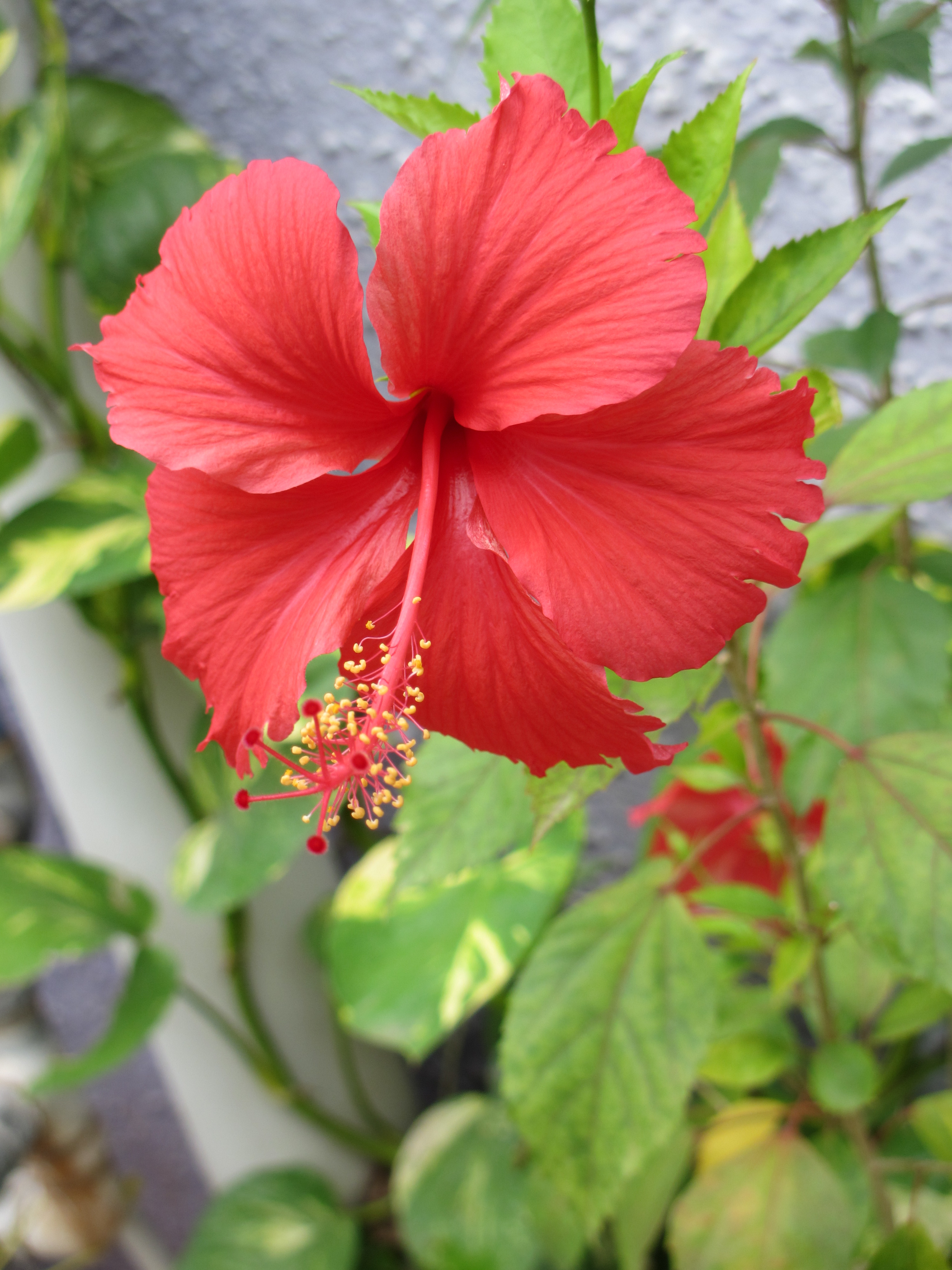
Hibiscus from the small garden in my apartments. Got inspired to post this photo after looking at photo posted by Cee Neuner in her Flower of the Day Blog Series.
My name is Yoges V R, a thirty four year old guy living in Chennai, India. I am married and have a two and half years old daughter. I am an engineer and MBA by qualification. I am a research analyst in the technology industry by profession.
This is my first blogging 101 post. I am blogging in WordPress platform since October 19, 2014. I started blogging as a way of getting into a writing habit. I think writing publicly would let me connect with others like me and receive constructive feedback to improve my writing skills. I am writing a blog post after a brief hiatus. So far I have written about education and success and I hope to continue to write on these topics as well others like behavioral psychology, current affairs, etc. Well, getting into the regular habit of writing is what I plan to accomplish in 2015.
I think the two dark forces that have been impeding my progress are Impulsiveness and Inertia. Impulsiveness has been leading me to spend time, money and energy on all the wrong stuff. Inertia has been preventing me from doing all the right stuff like reading a good book. My biggest fear in writing blog posts is being judged and the feeling of what if this post is not worthy of being published.
I like reading non-fiction books. The fact that the story or the idea in the book has happened somewhere in this world is what keeps me hooked to a non-fiction book. In addition to various WordPress blogs, I also follow blogs by Austin Kleon, James Altucher and Oliver Emberton.
Very Inspiring Post by Lynne Strang (https://wordpress.com/read/blog/id/18642940/). Read it and also watch the YouTube video in the post. Feel inspired and Have a Great Day.
If you’ve been reading this blog for a while, you might remember this post about entrepreneur Len Forkas’ experience as a solo competitor in the 2012 Race Across America — a grueling, 3,000-mile bicycle race that starts in California and ends in Maryland. At age 52, Len finished in less than 12 days, placing first in his age group and tenth overall. Best of all, he raised over $300,000 for Hopecam, his nonprofit that uses technology to connect young cancer patients with their friends at school.
Earlier this year, Len published What Spins the Wheel, a book that describes his journey and lists ten lessons he learned during the race. Lesson #8 is to “See in Others What They Can’t See in Themselves.” By doing so, “we can inspire people to achieve more than they ever thought possible,” he wrote.
That lesson came to mind when I watched Dananjaya Hettiarachchi’s winning performance in Toastmasters International’s 2014 World Championship of Public Speaking. Over six months, Hettiarachchi…
View original post 36 more words

Everything made Art.
The goal of this blog is to create a list of super facts. Important facts that are true with very high certainty and yet surprising, misunderstood, or disputed by many. This blog aims to be challenging, educational, and fun, without it being clickbait. I determine veracity using evidence, data from reputable sources and longstanding scientific consensus. Prepare to be challenged (I am). Intentionally seek the truth not confirmation of your belief.
The musings and ramblings of a young poet.
Rhymes and Reasons for Every Season
words. hearts. humidity.
The Life & Ramblings Of A Zillennial
welcome to my paradoxes
where wellness meets authenticity.
Just Inked Thoughts- Poems, Quotes, and Reflections
Here's To Express.. :)
THIS SITE IS ABOUT ME, MY CREATIVITY, MY IMAGINATION AND MY FEELINGS.
Hi! my name is Sebastian (You can call me Seb!) ...welcome to my Blog. I'm a photographer from Worcester, Worcestershire, England. Thanks for dropping by! I hope you enjoy my work.
Open Your Mind
Epic fantasy & military sci-fi author.
An Independent Nondiscriminatory Platform With No Religious, Political, Financial, or Social Affiliations - FOUNDED 2014
Living slowly, adventuring often ✨️
Connecting Inner voice to External World
Gray clouds trail across the sky. In the pale winter sun a flock of geese (Ben Grafström--Akita, Japan)
This is Your Quest - Your Mission to Find Happiness
Tip Shack generates inspiring, positive, informative, entertaining and useful tips & guide, covering fast and fun gastronomy, movies, entertainment, sports, beauty, news, relationships and technology.
Climbing, Outdoors, Life!
Challenging and Supporting People to do the Most Important Work of their Lives
A Journey Through the Looking Glass - Views Expressed Are My Own




 Yogi's Blogosmos