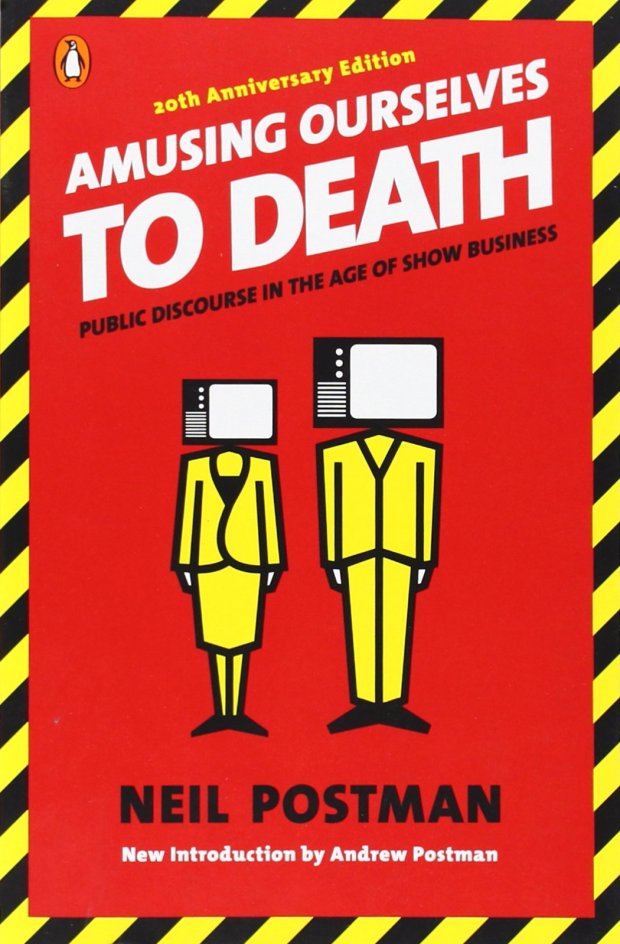
Amusing Ourselves to Death by Neil Postman

Amusing Ourselves To Death

Around the time of First Gulf War, on Fridays I used to stay awake at night longer than usual to view my favorite program, ‘World This Week,’ the international news show by NDTV. The topics covered, the visuals and the presentation were completely different from what Doordarshan’s other news programs had to offer. In those days Doordarshan was the only TV Channel available. On Friday evenings when ‘Oliyum Oliyum’ (a program from DD Chennai featuring Tamil Movie songs) was telecast the streets used to be empty. In those days I, like a lot of boys of my age used to bunk school to watch Indian Cricket Team Play, on TV.

Cut to today, January 14, 2018, the day of Pongal, the most auspicious and important of Tamil Festivals. All Tamil Satellite and Free-to-Air TV channels are drowning viewers in Pongal Special Programs (read movies and programs featuring Movie Actors and Technicians). As I write this post Indian Cricket Team is playing against South Africa in their second Test Match somewhere in South Africa; India is actually batting. Countless news channels are blaring about the day’s happenings. Yet instead of getting glued to one of the three TV sets at home, I am sitting and writing this blog post about a book that talks about the ill-effects of Television. From yearning for more TV content to TV addiction to weaning myself of TV, my world has come full circle.

From being deprived of TV channels and TV content to literally drowning in TV programs, India has come a long way. All this started with liberalization in the early nineties. Today my DTH subscription offers me hundreds of channels from all corners of the world. For each category there are a dozen channels. I could have a dozen clones of myself but still may not be able to cover all the TV programs in my favorite channels in a single day.

I always used to think of TV as a source of general knowledge. When I think of TV programs like ‘Turning Point,’ ‘Surabhi,’ and ‘World This Week’ come to my mind. Not to mention the various news telecasts that helped me to be update with the happenings in the world. But somewhere after my MBA days, I started realizing that a lot of incidents not worthy of being covered were getting unusually disproportionate amount of airtime. Consider the news flash telecast by a popular news channel, ‘Police Commissioner’s lost pet dog has been found.’ How about manufactured for TV sporting events like IPL, ISL, PBL, etc. The worst type programs on TV are the reality shows (think of ‘Rakhi Ka Swyamwar’ and its close cousins). How about Radia Tapes which nearly destroyed the credibility of TV News Channels? Also I realized that while random acts of crime/ hatred will find airtime, random acts of kindness never got a mention; TVs Channels have and obsessive compulsion to focus and telecast negative news.

For some time now I had been thinking of reading a book that deals with the ill-effects of viewing too much Television. Thanks to Amazon’s recommendation system, I stumbled uponAmusing Ourselves to Deathby Neil Postman. The book was written in 1985, and deals with the ill-effects of too much TV on American society. I wish every Indian reads this book for what TV viewing patterns did to Americans in the seventies and eighties, they are doing to Indians in the second decade of this millennium.

Some of the key points discussed in the book are:

  • Between the dystopian futures prophesized by George Orwell, ‘People will be overcome by externally imposed oppression. Truth will be concealed from people’ and Aldous Huxley, ‘People will come to love their oppression, to adore the technologies that undo their capacities to think. Truth would be drowned in a sea of irrelevance,’ Huxley’s Prophesy has come true.
  • The most significant American Cultural fact of the second half of the twentieth century is the decline of the Age of Typography and the ascendancy of the Age of Television.
  • The news of the day is a figment of our technological imagination. Most of our daily news is inert, consisting of information that gives us something to talk about but cannot lead to any meaningful action.
  • In every tool that we create, an idea is embedded that goes beyond the function of the thing itself.
  • Every new technology for thinking involves trade-off. It giveth and taketh away, although not quite in equal measure. Media change does not necessarily result in equilibrium.
  • The form in which ideas are expressed affects what those ideas will be.
  • There is a difference between thinking in a word-centered culture and thinking in an image-centered culture.
  • Each of the media that entered the electronic conversation in the late nineteenth and early twentieth centuries followed the lead of telegraph and the photograph, and amplified their biases.
  • Television does not extend or amplify literate culture. It attacks it.
  • The problem is not that TV presents us with entertaining subject matter but all subject matter is presented as entertaining. Entertainment is the supra-ideology of all discourse on television.
  • Television is our culture’s principal mode of knowing about itself. Therefore, how television stages the world becomes the model for how the world is properly staged.
  • Television serves us most usefully when presenting junk entertainment; it serves us most ill when it co-opts serious modes of discourse – news, politics, science, education, commerce, religion – and turns them into entertainment packages.
  • To be unaware that a technology comes equipped with a program for social change, to maintain that technology is neutral, to make the assumption that technology is a friend to culture, is stupidity.
  • Introduce the alphabet to a culture and you change its cognitive habits, its social relations, its notion of community, history and religion. Introduce the printing press with movable type, and you do the same. Introduce speed-of-light transmission of images and you make a cultural revolution. Without a vote. Without polemics. Without guerilla resistance. Here is ideology, pure if not serene.


The book is divided into two parts: the first part deals with historical context on how America transitioned from the Age of Typography to the Age of Television. The second part deals with the effects (on the American society) of television transforming key aspects of American society (News, Politics, Religion and Education) into entertainment packages. The book is short but thought provoking. The author’s observations and choice of words are spot-on and make for an interesting and absorbing read.

Though written about thirty years back the book is still relevant and its importance only increases when we consider the fact that we have augmented the age of TV with the age of internet, the age of social media and the age of mobile. As technology become ever pervasive in our lives it is very important to pause and think if every change introduced by technology in our lives is for our betterment and if every change promised by technology is necessary in the first place. Reading this book and following it with some contemplation is a welcome first step in that process.

Below are the two part interviews by Neil Postman on the Book given in December 1985 and January 1986.

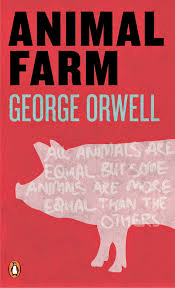


Animal Farm by George Orwell

Animal Farm

One of my MBA professors once said, ‘If I have to talk sense, I can make it even in five minutes; I don’t need a whole hour.’ Animal Farm by George Orwell is small book (a novella – 95 pages in Penguin Book that I read) that makes a lot of sense even though seventy years have passed since it was first published. The author wrote this fable/ allegory or fairy tale with Soviet Union under Stalin in mind and yet a vast majority of the situations and observations are applicable even today’s world, even to democracies like India.

Such is the brilliance of Orwell that while reading some of the lines in the book, I was reminded about news items that I have read in the recent past. Take for example this line from the book: ‘Two cows, enjoying a drink at the pool, would exclaim, “Thanks to the leadership of Comrade Napoleon, how excellent this water tastes!”’ On reading this line I was reminded of the umpteen number of times how the success of government schemes are attributed directly to the efforts of only the Chief Minister/ Prime Minister. Another one: ‘Squealer always spoke of it as a “readjustment,” never as a “reduction.” On reading this one I got reminded of how Hillary Clinton claimed on TV during a prime time interview that FBI Investigation against her is just a “Security Review” and “not an investigation.”’ Not to forget the barrage of ‘my statement was taken out of context’ or ‘my tweet was taken out of context’ statement that you get to hear these days.

Another brilliant line from the book, ‘Somehow it seemed as though the farm had grown richer without making the animals themselves richer – except, of course, for the pigs and the dogs.’ This line could just be an apt criticism against today’s Capitalism and Globalization. I was also reminded of the growing income inequality and the recent Bernie Sanders campaign which focused a lot on the income and wealth of the richest one-tenth of one percent of Americans.

A gem of a statement from the book, ‘All animals are equal. But some animals are more equal than others.’ On reading this I was reminded of how a loan defaulter billionaire was allowed to leave this country, how the hit and run case of a Bollywood super star has progressed nowhere in over a decade and how even a retired judge was also in favor of clemency for a Bollywood actor convicted of possessing a gun.

Or this wonderful line: ‘Throughout the whole period of his seeming friendship with Pilkington, Napoleon had been in secret agreement with Frederick.’ This line reminded me of how parties that competed against each other in assembly elections become allies by the time the Lok Sabha elections are around the corner, within just a few months.

In the end Animal Farm is about a few simple truths:

  1. No sooner than the objectives of a movement are achieved, the ideals behind the crusade are forgotten
  2. The leaders of the movement who get elevated to power centers soon forget the people and enforce policies that are beneficial only to themselves, which would aid in extend their reign.
  3. Without proper checks and balance any system would fail in the long run
  4. Blind faith and apathy of the people are as dangerous to the people and the country as nepotism, corruption or tyranny.

Animal Farm is a must read for anyone irrespective of their political ideology. It is a short but brilliant book. Hats Off to George Orwell for writing this timeless Classic.

A Time of Need and a Time for Greed

The world has enough for everyone’s need, but not enough for everyone’s greed.’ – Mahatma Gandhi

Neither a man nor a crowd nor a nation can be trusted to act humanely or to think sanely under the influence of a great fear.’ – Bertrand Russell, Unpopular Essays

As the rains receded on December 3rd, I and my brother in law ventured out to buy essential household items. It was around 11.30 AM and we had to go from one shop to another as there was stock out situation for some of the essential items. I had walk the entire Kottur area in search of Milk and Candles. Not a single candle was available in any of the stores. A solitary vendor was selling milk outside a big vegetable store in Kottur market. But instead of the usual Rs. 40 per liter he was charging Rs. 100 per liter, a full 150% mark-up to the usual price. Most people were buying multiple packets of milk from him and yet after walking a few feet from the shop complained that it was wrong on the part of the vendor to hike the price in that hour of distress.

After an extended period of incessant rains, the prices of some of the vegetables had reached the stratosphere. On this particular day these darlings of every household’s kitchen were not even available at even these extremely inflated prices. Bread and Rice were running out of stock too. A couple of days later as I was standing in line to buy milk at another milk depot, a woman was hoarding about hundreds of packets of milk in her tricycle. When one of the customers asked why the woman was siphoning off milk meant to be distributed through regular channel, she hurled abuses at the customer. The irony was that within a few minutes she was selling the same milk packets in a nearby street with a fat markup.

Though most of us complain about the greediness of opportunistic vendors, we are opportunistic and greedy too. A case in point was a trip a petrol pump on the same day. My brother in law’s two wheeler was almost at the verge of running out of petrol. By this time most petrol pumps were closing down as they had no more petrol or diesel to sell. The unending lines of people outside petrol pumps rivaled the queues outside places of worship on auspicious days. I went along with my nephew to one of the petrol pumps near Royapettah. Among the crowd to my disappointment and chagrin, there were a bunch of guys who had come with multiple 30 to 40 liter cans. Why would anybody need so much petrol or diesel? Clearly they were greedy arbitrageur who was planning to sell the fuel at much higher prices in suburban localities. Even people who were buying for their own use too were buying more than necessary.

Around the same time, another irrational phenomenon was unfolding across the city. There was a run on the banks, no actually there was a run on ATMs. With most of the bank branches in Chennai on leave due to rains, the cash balance in ATMs was already low. The situation was made even worse by a lot of anxious people (foreseeing more rain and bank holiday) each withdrawing up to their daily permissible limit. The anxious withdrawal pattern resulted in most ATMs going out of cash by afternoon that day and as result the entire city was indulging a real life treasure-hunt, running from one ATM to another. Only after bank branches opened the following day and some of the banks started operating mobile ATMs the situation limped back to normalcy.

While it is understandable that there were long queues at grocery stores, milk vending booths, ATMs and petrol pumps to everyone’s surprise there was queue in wine shops too. And contrary to ATMs and petrol pumps that ran out of stock, these wine shops were fully stocked and was buzzing with so much activity and life that one could have easily mistaken them for an ant colony or a beehive. It is billion dollar puzzle that how in a democratic country there is stock out for essential commodities but wine shops are fully stocked.

No amount of technology can serve as replacement for irrationality of human beings. No amount of rules and processes can check human greed. As I think back on the events that unfolded during the recent rainy spell, I get reminded of a dialogue from a recent movie: ‘By eating even a single mouthful of food after our hunger has been quenched, we are ensuring that another person remains hungry.’ This principle is very apt in situations of natural or man-made calamities like the recent rainy spell.

Rains in Chennai

I do not remember the last time when I saw so many helicopters fly. The incessant rains in December first week left my hometown Chennai as battered like a war-torn city. Unable to cope with unfolding disaster, the state government asked for center’s help which soon dispatched the army, navy, air force, the coast guards to join the NDRF which was already assisting the state government with rescue and relief operations.

Someone photographing the earth from several kilometers high in the sky would have been baffled at the sudden appearance of numerous islands in India’s South East. The railway tracks in the city, the major roads leading to and from the city, the roads linking different localities within the city were all under water. With the airport runway too submerged the geographic isolation of the city was complete. This is probably the first time in several years that train service from the three major railway stations in the city were stopped completely. And for the first time in several years that the airport operation in Chennai came to a grinding halt. And so many people in and around Chennai became aware of the names of all the rivers, canals and lakes in and around the city for the first time in their lives.

The photos that were being relayed across the globe of the devastation would have made everyone question, ‘Is this India’s fourth largest metropolitan city?’, ‘Is this the city whose name used to synonymous with South India until a few years ago?’, ‘Is this the same city that was so strategic to the British in India that it became the only Indian city that was bombed by the Germans in World War I?’ Every locality in the city was affected by the rains. Electricity and Telecommunication were completely cut-off. Instead of resembling a major metropolis, Chennai resembled a series of islands in distress and people were just castaway in their own homes.

The rainfall received in the month of November is the highest in nearly a hundred years. The rainfall received on December 1, is the second highest rainfall in day in the past one hundred years. In addition to Chennai, four other northern districts (Kancheepuram, Thiruvallur, Cuddalore and Villupuram) and the Union Territory of Pondicherry had to bear the brunt of the cloud’s fury. The endless streams of clouds resembled the unstoppable army of Anubis from ‘The Mummy II’: These streams of cloud unleased hell on Tamil Nadu’s northern districts and crippled normal life.

Nature became a neutralizing agent that made the young and the old, the rich and the poor, the well-connected and the not-so well-connected all equal in that moment of misery. While we cannot do much about the vagaries of nature, one should not forget the fact much of Chennai’s present problem is actually man-made. The steady disappearance of lakes and ground level tanks, the encroachment of canals and rivers, reckless urbanization, greed of the residents for cheaper real estate, toothless civil administration that that did not stand firm in instances where it should have been are all the pieces in the not-so difficult to understand puzzle that shamefully managed to convert the fourth largest city in India into a ‘DISASTER ZONE.’

Voting is both a right and a responsibility

With great power comes great responsibility.’ – Uncle Ben in Spiderman

Caveat Emptor (Let the buyer beware)’ – Ancient Maxim

For every public role that a man or woman would play there is a qualification. If we want to be doctor we have to undergo schooling, then enroll in medical school as an MBBS student. All along the away at every important milestone we have to appear for qualifying examination and then clear it to move to the next level and receive the qualification/ degree. The same applies for other professions like Engineer, Auditor or Lawyer, etc.

However for one of the most important public roles, that of being a CITIZEN of the country, there is no training or qualifying exam in our country. As a democracy, everyone above the age of 18 years has the right to vote. The problem is that people are willing to treat their power to VOTE as a RIGHT and an ENTITLEMENT but forget that the power to vote is equally a RESPONSIBILITY too. Are we exercising that responsibility well? Are electing the right candidates to represent us? Definitely not. We pass on the blame for all of our nation’s maladies on to our politicians but we are part of the problem too. In fact the problems starts with us. Our political class is nothing but symptoms of deep rooted problems in our society.

Every one of us dreams of India becoming a great nation; but we are personally not willing to incur the small but numerous everyday costs that would collectively enable this dream to become a reality. Some of the guidelines to be followed in choosing our representatives include (but not limited to):

  1. We need to make informed choices and choose our representatives based on weighing the pros and cons of his governance record
  2. We should never choose a candidate because he represents the party we support (if the candidate does not merit being elected)
  3. We should not blindly support a party because historically our family elders have voted for that party
  4. We should not cast our vote for someone just because he or she is related to the leader whom we like

We blame that there are not many good candidates contesting in elections. But can we tell the difference between a good candidate and bad candidate? Do we know what information to use to arrive at that decision? Do we know where to look for that information? Do we understand the consequences of sending the wrong candidates to represent us? When the government doles out freebies, what are the other important projects that are being shelved? Where is the government borrowing from and who will pay the principal and interest for these borrowings? What would ensure in long term social progression? Where does India as a whole and individual states within India stand on each and every one of the parameters of Human Development Index? What’s the progress been over the years on these parameters? The answer to all these questions would be an EMPHATIC NO.

The only way to ensure this situation changes for the better is to have systematic qualification exam for voters or voters who are due to be eligible to vote. Going forward, the Election Commission of India, instead of adding anyone above the age of 18 (based on the proof of Indian Citizenship) to the voters’ list, should also conduct a qualification exam to assess if they are aware of the rights and responsibilities of a voting citizen. People who do not clear the exam should be denied a voter’s ID card and a place in the voter’s list. Since the cut-off age for being eligible to vote in India is 18 years, the age around which most kids finish their higher secondary schooling, we can have a subject for 11th and 12th standards across all school boards that deal with various aspects of the rights and responsibilities of a voting citizen. The curriculum for this subject should be handled by a constitutional body like the Election Commission of India. For people who are not fortunate enough to be part of the schooling system, the Election Commission of India should have an independent certification process.

The topics to be covered should include (but not limited to): a brief overview the constitution of India, the electoral process, the powers of the Supreme Court of India, Lok Adalat system, The Right to Information Act, sources to look for unbiased information on the back ground information of contesting candidates, etc. In addition, we should it make it mandatory for people to read the following books or similar books that deal with topics covered in these books:

  1. Manufacturing Consent: The Political Economy of the Mass Media by Noam Chomsky and Edward Herman
  2. Basic Economics: A Citizen’s Guide to the Economy by Thomas Sowell
  3. Games Indians Play by V. Raghunathan (this book provides the Indian Context very well)
  4. Predictably Irrational: The Hidden Forces that Shape Our Decisions by Dan Ariely

Note: The above list is only indicative and not an exhaustive one. There can be other relevant topics and books as well. Also there might be books that deal with the Indian context better.

People might question why limit this exercise only to new voters. The costs, logistics and politics of doing this for existing voters are enormous to overcome. Over four or five iterations of this exercise, we will have significant number of voters who would have come through this filtering process. If you don’t believe, keep in mind that the number of first time voters in the 2014 National Elections was around 12 crores!!! In four iterations, at an average of 10 crore new voters per iteration, we can bring in 40 crore voters through this process, a voting block significant enough make a positive change. It is well known in social sciences circle that the minority influence can in fact bring about social change, so making a start which is directionally correct is more important. Also starting with the younger population provides the added advantage that the young are not as much influenced by the social prejudices prevalent in our society and will be more open to change. We can also hope that the awareness created by the process of implementing this new system would have a positive influence on existing voters as well. We should also create incentives for voters to put into use, the knowledge obtained through this system.

There will always be loopholes and we might not be able to create a completely foolproof system. However at this point in time we need to only worry about whether we are moving in the right direction. We should bear in mind that social as well as political change is a slow and evolutionary process and we should be patient enough to give this new system the right amount of time to flourish. Some people might ask why not a qualification system for contesting candidates as well. It is a much more difficult idea to implement. Also as more and more candidates with cleaner and better governance records get elected, political parties themselves will see the merit in fielding right candidates. After all, aren’t Indian political parties’ masters at playing vote bank politics?