There’s a Circus in Town

There’s a circus in town
Election circus is in town
Selling us Utopia
Cashing on our Myopia
Begging for our votes
Enticing us with notes
There’s a circus in town
Election circus is in town
Bottles mask the potholes
Money masks the assholes
The trivial trumps the actual
The troll trumps the factual
There’s a circus in town
Election circus is in town
Clowns pose as knights
As defaulters board flights
Caste & cult, a heady combo
Leaving the nation in a Limbo
There’s a circus in town
Election circus is in town
Devotion to them is delusion
Choice is but an illusion
Election day is quite an occasion
Leading to five years of suffocation
There’s a circus in town
Election circus is in town
All of us yearn for the pinnacle
All we get is election spectacle
Money and power are in bed
Leaving our democracy in red
There’s a circus in town
Election circus is in town
The crooks get the crowns
And make us all clowns
It’s been quite a long night
There’s no dawn still in sight
There’s a circus in town
Election circus is in town

My Thoughts on the ongoing Pro-Jallikattu Protests

Three Famous Protestors.png


My thoughts on the ongoing protests to lift the ban on Jallikattu:

  1. In India thousands of people die in road and train accidents every year. Would the court ask for stringent implementation of regulations and better regulations or would it ban road and train transport altogether?
  2. India is the largest exporter of beef, 7th largest exporter of goat and sheep meat and the 2nd largest producer of footwear and leather garments in the world. Shouldn’t the animal right activists first target these industries before targeting an ancient sport? Isn’t killing animals, de-skinning them and cutting them to pieces more cruel than bull-taming?
  3. Under UNESCO’s Convention for the Safeguarding of the Intangible Cultural Heritage, article 13 specifically calls for national governments to a) adopt a general policy aimed at promoting the function of the intangible cultural heritage in society, and at integrating the safeguarding of such heritage into planning programs and b) designate or establish one or more competent bodies for the safeguarding of the intangible cultural heritage present in its territory. ‘Social practices, rituals and festive events’ is one of the domains under ICH. Shouldn’t India (and its highest court) as a member of the UN protect Jallikattu, a festive event, rather than ban it?
  4. In its observation in January 2016, the Supreme Court observed, ‘in this modern world of computers, it is better to play Jallikattu on computer.’ Shouldn’t the judges of the Supreme Court be value-neutral? Why mock at a tradition?
  5. The Youth of Tamil Nadu protesting peacefully across the state are not questioning the authority of the Supreme Court, but questioning the logic of putting the values of one group (the animal right activists) above the values of another group (people who want to ensure in the continuity of their tradition). People who think that Tamil Youths’ stand is wrong should bear in mind that they are following in the footsteps of Mahatma Gandhi and Jayaprakash Narayan.
  6. Human Beings are like Trees; just like trees we need strong roots (nationality, religion, language and culture, etc.) and strong branches and leaves (education, experience and appreciation of diversity, etc.). In the end the choice between where to strike a balance between tradition and modernity is each individual’s right and no one has to the right to infringe on it. PETA is at best a Ponzi scheme of the Animal Rights World and no true animal lover should believe in them.
  7. People still don’t get the fact that India is not a Homogenous Nation but a mosaic of cultures and nation of immense diversity. In the way the former British colonies came together to form a new country, India is similar to USA. In terms of a huge population of people, India is similar to China. In terms of the sheer diversity of languages, ethnic groups, religions and group identities, India is similar to the European Union. In terms of the way politicians and rich people embrace each other, India is similar to dictator ruled countries. In short India is a first of its kind POLITICAL and SOCIAL EXPERIEMENT in history. Any individual or institution that is going to treat India as a homogenous nation/ entity and enact/ implement laws based on this assumption is going to create more frictions like the Jallikattu-ban issue. Any such attempt is an attempt to trample the dreams of the founding fathers of this nation, an assault on the foundation of our constitution and an assault on the very idea of INDIA itself.


#Jallikattu #Jallikattuprotest #AmendPCA

Mirror mirror on the wall who is the most ritualistic of them all?

Question Mark

It has become fashionable these days to question anything and everything related to beliefs and sentiments of Indians, especially anybody of knowledge or way of living handed to us by our earlier generation. Sadly it’s the Indians who indulge in this activity more than westerners. ‘In this age’…. Wow, I like the phrase, it makes me feel like mortality has been conquered, Planets unknown until recently have been colonized, India has become the richest and the most equitable country in the universe, Elephants and Apes are signing in Opera Houses, Humans have stopped unleashing hell on each other in the name of ideology and men have started giving birth to babies. None of the above have become true and the fact is that this age is not much different from the by-gone ones.

It seems to me that to some us anything that our elders taught us is ritualistic, burdensome and not relevant anymore. Going to a place of worship on an auspicious day…. That’s too ritualistic. Touching the feet of our elders… that is so uncool. Living in harmony with nature…that’s not relevant to this age. We are quick and proud to declare that each one of these is just a solace to fight our fears and insecurities. We are one hundred percent sure that our ancestors were delusional crackpots who made our life miserable by making us dance to the tunes of meaningless rituals. ‘To Hell with the Rituals.’

Well, let’s look at some of the super-cool episodes from the rational life and ultra-modern age of ours. When a bunch of friends want to meet, the place that we choose is most often a bar and we can’t discuss about the happenings in our life without gulping a few glasses of alcohol. Does this not sound like a ritual? When a bunch of youngsters want to travel bike from one place to another, they have to ride without wearing helmets, have to over speed on the roads and honk horns like hell. Does this not sound like a ritual? Any new movie has to be watched on the day of its release and we have to perform abhishekam to the hero’s cutout wasting either our or our parent’s hard earned money. Does this not sound like a ritual?  Smoking has become so integral to the act of colleagues taking a break from work for a chat, that the session is popularly called as ‘Sutta Socializing Session.’ If this is not a ritual what else would you call as a ritual?

Oh let’s not forget our trips to malls and shopping therapies every single weekend. How about evening after evening spent watching IPL, ISL and Pro Kabbaddi matches? How about a ‘Facebook Like’ for every random post by our friends and ‘Updates on Twitter’ for every trivial action of ours? How about compulsory selfies at get-togethers? What about the mother of all modern day rituals – Valentine’s Day Celebration? Isn’t showering lover or spouse with cards, gifts, flowers and lavish dinners at upscale restaurants on one particular day every year a ritual?

The fact is Beer Bash, Valentine’s Day Celebration and Over Speeding on Roads are as much ritualistic as visiting a place of worship or fasting for religious reasons. The last two are rituals that have been handed down to us and the first three are the ones that we ourselves have added to the list. Nothing more and nothing less. The reasons attributed to each one of them may vary. The demographics of the population indulging in each of these activities may vary as well. Value systems, aside each of these rituals is a method to the madness for traversing through the chaos called Life. The Indian way of life is very flexible. After all we are not a nation that restrict our political sphere to only two political parties. We have hundreds of languages and multiple religions. We have as much choice possible in most issues that are important to us. What matters is that each one of us rationally chooses a way of life that is meaningful and provides satisfaction to us. What is even more important is not to mock, ridicule or look down upon the way of life that is suitable to another person. Let’s make ‘Mutual Respect to Each Other,’ the foundation for our ‘Indian Way of Living.’

Note: This post is written for IndiSpire – Edition 115: ‘We Indians give too much importance to rituals…visiting a temple on a particular day, fasting for religious reasons…are these relevant in this age? Or they are just a solace to fight our fears and insecurities? #rituals

Pirates in the Ocean called Democracy

A democracy cannot exist as a permanent form of government. It can only exist until the people discover they can vote themselves largess out of the public treasury. From that moment on, the majority always votes for the candidate promising the most benefits from the public treasury, with the result that democracy always collapses over a loose fiscal policy–to be followed by a dictatorship.”  ― Alexander Fraser Tytler (Scottish advocate, judge, writer and historian)

Government! Three fourths parasitic and the other fourth stupid fumbling.” ― Robert A. Heinlein, Stranger in a Strange Land

The hardest thing in the world to understand is the income tax.”–Albert Einstein

Hindi Saying: “Dhobi ka kutta, na ghar ka, na ghat ka’” which roughly translates to “Neither here, nor there.”

The political class of this country has to take care of the people at the bottom of the pyramid (at least once in a while) because they form the bulk of the voting population; these people basically sign the politicians’ appointment order to rule the country. The politicians worship the rich men of this country because they generously fund, albeit without much transparency, the political parties. The Tax paying population is actually in no man’s land with nobody to care for them. In fact the maxim for the tax paying population could be: ‘I Pay Taxes Therefore I Am.’ If a history book is to be written about Independent India’s achievement, the tax paying population would be mentioned just in the footnotes: ‘All the achievements of this country were funded by the country’s generous, unsuspecting and helpless tax payers.’ The only reason that we ever matter to the country is because we pay taxes, Period. Our true existence is for politicians to use our tax money to indirectly pay incentives to the poor people to elect them. It’s a good old carrot and stick approach: The politician get the carrot and the taxpayer gets the stick!

The tax payer is the poor soul caught between hell (inflation) and high water (government) that ensure that his or her hard earned money is used lesser and lesser for his or her own well-being with each passing year. The Indian Taxpayers are like the poor oxen used by a farmer to plough his barren land. The farmer (Politician) knows fully well that his land (Indian Economy) has been rendered barren (in bad shape) by his greed (rampant corruption) and nature (global economic situation), yet he expects that by making the oxen (tax payer) work harder (pay more taxes/ forego subsidies) he can get better returns (continued support from the voting population).

The Indian Tax payer is like the bonded slave of Colonial India. We are bonded for life to pay taxes to the government. We have an eternal duty to pay taxes but no right to ensure that the money that we pay as taxes is spent wisely. We pay taxes and travel in potholed roads but our tax money will used to provide free television for the Needy!!! We pay taxes and endure innumerable power cuts every year while our money is used not to build power plants or public schools or hospitals but in some arcane, utopian and symbolic public scheme that ensures the most votes for the politician who announces the scheme.

The first thing that we should be willing to keep open during our travel in this country using our personal vehicles: ‘Our Purse.’ Why should we, the tax payers pay toll duties at every toll booth? We already pay duties (taxes) to the government every month. And shouldn’t that duty (taxes) that we pay be used to build the roads. Shouldn’t the non-taxpayer who uses his own mode of transport be the one who should pay toll duties? In free India, the Indian tax payer is probably paying more duties/ tributes to the Indian Government Machinery than paid by Indians of Colonial India to their British Masters.

By the time we understand what one type of tax actually means and how much it will offset us, the government roles out yet another tax or cess. Income Tax, Professional Tax, Property Tax, Value Added Tax/ Service Tax, Toll Fees, Excise Duties, Entertainment Tax, Fuel Surcharge, Education Cess, Swachh Bharat Cess, etc., the list of assault on the tax payers income is endless. Just like the omnipresent microbes that threaten the physical well-being of individuals, the government imposed taxes and its bad policies threaten the financial well-being of the taxpayer. What is the success rate of various populistic scheme rolled out by the government? Shouldn’t the tax payer have some say in the way his or her money is spent?

What have successive governments done to broaden the tax net? What have successive governments done to catch hold of the tax evaders? What have successive governments done to bring back black money holed up in tax heavens? What have successive governments done to plug the leakages in the public distribution systems? What have successive governments done to roll back various privileges and subsidies being bestowed upon politicians and parliamentarians? The answers is an EMPHATIC NOTHING.

Politicians mask their incompetence by running media campaigns about how a Good Samaritan has to give up his or her LPG subsidy. The LPG subsidy to the taxpayer is just a drop in the ocean of government spending. The LPG subsidy to the tax payer is like ‘a pimple on an ant’s rear’: It is awfully small compared to various other spending by the government.  Lawmakers, ‘Please address the real issues that are setting back this country before you target the tax payer once again.’ I guess not only in kids’ stories but in real life as well, the greedy owner (government) is hell-bent on killing the goose (tax payer) that lays the golden egg (taxes).

Why does someone who makes above 10 lakhs of income have to forego subsidies whereas parliamentarians with crores worth of personal assets enjoy subsidies and privileges of various kind? Why can’t we roll back various tax benefits given to the largest of Indian companies? How about taxing super rich of the country on any money that they have not used in productive, job creating investments (holding idle) for more than a period of, say five years? Well parliamentarians of India, ‘Please lead by example. Please say no to all the privileges that you enjoy.’ Ultimately what is the difference between the pirates of medieval times who used weapons to loot ships in high seas for their own benefit and modern day governments that use the threat of the law to make taxpayers part with their hard earned money which these governments eventually spend as they wish with absolutely zero accountability?

Note: This post has been written for IndiSpire Edition #100: ‘Gas Subsidy has been ended for people with income more than 10 Lac and prices hiked. What is your take on this decision?’

 

A Time of Need and a Time for Greed

The world has enough for everyone’s need, but not enough for everyone’s greed.’ – Mahatma Gandhi

Neither a man nor a crowd nor a nation can be trusted to act humanely or to think sanely under the influence of a great fear.’ – Bertrand Russell, Unpopular Essays

As the rains receded on December 3rd, I and my brother in law ventured out to buy essential household items. It was around 11.30 AM and we had to go from one shop to another as there was stock out situation for some of the essential items. I had walk the entire Kottur area in search of Milk and Candles. Not a single candle was available in any of the stores. A solitary vendor was selling milk outside a big vegetable store in Kottur market. But instead of the usual Rs. 40 per liter he was charging Rs. 100 per liter, a full 150% mark-up to the usual price. Most people were buying multiple packets of milk from him and yet after walking a few feet from the shop complained that it was wrong on the part of the vendor to hike the price in that hour of distress.

After an extended period of incessant rains, the prices of some of the vegetables had reached the stratosphere. On this particular day these darlings of every household’s kitchen were not even available at even these extremely inflated prices. Bread and Rice were running out of stock too. A couple of days later as I was standing in line to buy milk at another milk depot, a woman was hoarding about hundreds of packets of milk in her tricycle. When one of the customers asked why the woman was siphoning off milk meant to be distributed through regular channel, she hurled abuses at the customer. The irony was that within a few minutes she was selling the same milk packets in a nearby street with a fat markup.

Though most of us complain about the greediness of opportunistic vendors, we are opportunistic and greedy too. A case in point was a trip a petrol pump on the same day. My brother in law’s two wheeler was almost at the verge of running out of petrol. By this time most petrol pumps were closing down as they had no more petrol or diesel to sell. The unending lines of people outside petrol pumps rivaled the queues outside places of worship on auspicious days. I went along with my nephew to one of the petrol pumps near Royapettah. Among the crowd to my disappointment and chagrin, there were a bunch of guys who had come with multiple 30 to 40 liter cans. Why would anybody need so much petrol or diesel? Clearly they were greedy arbitrageur who was planning to sell the fuel at much higher prices in suburban localities. Even people who were buying for their own use too were buying more than necessary.

Around the same time, another irrational phenomenon was unfolding across the city. There was a run on the banks, no actually there was a run on ATMs. With most of the bank branches in Chennai on leave due to rains, the cash balance in ATMs was already low. The situation was made even worse by a lot of anxious people (foreseeing more rain and bank holiday) each withdrawing up to their daily permissible limit. The anxious withdrawal pattern resulted in most ATMs going out of cash by afternoon that day and as result the entire city was indulging a real life treasure-hunt, running from one ATM to another. Only after bank branches opened the following day and some of the banks started operating mobile ATMs the situation limped back to normalcy.

While it is understandable that there were long queues at grocery stores, milk vending booths, ATMs and petrol pumps to everyone’s surprise there was queue in wine shops too. And contrary to ATMs and petrol pumps that ran out of stock, these wine shops were fully stocked and was buzzing with so much activity and life that one could have easily mistaken them for an ant colony or a beehive. It is billion dollar puzzle that how in a democratic country there is stock out for essential commodities but wine shops are fully stocked.

No amount of technology can serve as replacement for irrationality of human beings. No amount of rules and processes can check human greed. As I think back on the events that unfolded during the recent rainy spell, I get reminded of a dialogue from a recent movie: ‘By eating even a single mouthful of food after our hunger has been quenched, we are ensuring that another person remains hungry.’ This principle is very apt in situations of natural or man-made calamities like the recent rainy spell.

Voting is both a right and a responsibility

With great power comes great responsibility.’ – Uncle Ben in Spiderman

Caveat Emptor (Let the buyer beware)’ – Ancient Maxim

For every public role that a man or woman would play there is a qualification. If we want to be doctor we have to undergo schooling, then enroll in medical school as an MBBS student. All along the away at every important milestone we have to appear for qualifying examination and then clear it to move to the next level and receive the qualification/ degree. The same applies for other professions like Engineer, Auditor or Lawyer, etc.

However for one of the most important public roles, that of being a CITIZEN of the country, there is no training or qualifying exam in our country. As a democracy, everyone above the age of 18 years has the right to vote. The problem is that people are willing to treat their power to VOTE as a RIGHT and an ENTITLEMENT but forget that the power to vote is equally a RESPONSIBILITY too. Are we exercising that responsibility well? Are electing the right candidates to represent us? Definitely not. We pass on the blame for all of our nation’s maladies on to our politicians but we are part of the problem too. In fact the problems starts with us. Our political class is nothing but symptoms of deep rooted problems in our society.

Every one of us dreams of India becoming a great nation; but we are personally not willing to incur the small but numerous everyday costs that would collectively enable this dream to become a reality. Some of the guidelines to be followed in choosing our representatives include (but not limited to):

  1. We need to make informed choices and choose our representatives based on weighing the pros and cons of his governance record
  2. We should never choose a candidate because he represents the party we support (if the candidate does not merit being elected)
  3. We should not blindly support a party because historically our family elders have voted for that party
  4. We should not cast our vote for someone just because he or she is related to the leader whom we like

We blame that there are not many good candidates contesting in elections. But can we tell the difference between a good candidate and bad candidate? Do we know what information to use to arrive at that decision? Do we know where to look for that information? Do we understand the consequences of sending the wrong candidates to represent us? When the government doles out freebies, what are the other important projects that are being shelved? Where is the government borrowing from and who will pay the principal and interest for these borrowings? What would ensure in long term social progression? Where does India as a whole and individual states within India stand on each and every one of the parameters of Human Development Index? What’s the progress been over the years on these parameters? The answer to all these questions would be an EMPHATIC NO.

The only way to ensure this situation changes for the better is to have systematic qualification exam for voters or voters who are due to be eligible to vote. Going forward, the Election Commission of India, instead of adding anyone above the age of 18 (based on the proof of Indian Citizenship) to the voters’ list, should also conduct a qualification exam to assess if they are aware of the rights and responsibilities of a voting citizen. People who do not clear the exam should be denied a voter’s ID card and a place in the voter’s list. Since the cut-off age for being eligible to vote in India is 18 years, the age around which most kids finish their higher secondary schooling, we can have a subject for 11th and 12th standards across all school boards that deal with various aspects of the rights and responsibilities of a voting citizen. The curriculum for this subject should be handled by a constitutional body like the Election Commission of India. For people who are not fortunate enough to be part of the schooling system, the Election Commission of India should have an independent certification process.

The topics to be covered should include (but not limited to): a brief overview the constitution of India, the electoral process, the powers of the Supreme Court of India, Lok Adalat system, The Right to Information Act, sources to look for unbiased information on the back ground information of contesting candidates, etc. In addition, we should it make it mandatory for people to read the following books or similar books that deal with topics covered in these books:

  1. Manufacturing Consent: The Political Economy of the Mass Media by Noam Chomsky and Edward Herman
  2. Basic Economics: A Citizen’s Guide to the Economy by Thomas Sowell
  3. Games Indians Play by V. Raghunathan (this book provides the Indian Context very well)
  4. Predictably Irrational: The Hidden Forces that Shape Our Decisions by Dan Ariely

Note: The above list is only indicative and not an exhaustive one. There can be other relevant topics and books as well. Also there might be books that deal with the Indian context better.

People might question why limit this exercise only to new voters. The costs, logistics and politics of doing this for existing voters are enormous to overcome. Over four or five iterations of this exercise, we will have significant number of voters who would have come through this filtering process. If you don’t believe, keep in mind that the number of first time voters in the 2014 National Elections was around 12 crores!!! In four iterations, at an average of 10 crore new voters per iteration, we can bring in 40 crore voters through this process, a voting block significant enough make a positive change. It is well known in social sciences circle that the minority influence can in fact bring about social change, so making a start which is directionally correct is more important. Also starting with the younger population provides the added advantage that the young are not as much influenced by the social prejudices prevalent in our society and will be more open to change. We can also hope that the awareness created by the process of implementing this new system would have a positive influence on existing voters as well. We should also create incentives for voters to put into use, the knowledge obtained through this system.

There will always be loopholes and we might not be able to create a completely foolproof system. However at this point in time we need to only worry about whether we are moving in the right direction. We should bear in mind that social as well as political change is a slow and evolutionary process and we should be patient enough to give this new system the right amount of time to flourish. Some people might ask why not a qualification system for contesting candidates as well. It is a much more difficult idea to implement. Also as more and more candidates with cleaner and better governance records get elected, political parties themselves will see the merit in fielding right candidates. After all, aren’t Indian political parties’ masters at playing vote bank politics?

India’s Ultra-rich and their contribution to Philanthropy

The other day when we were having lunch in office, one of my colleagues brought the topic of philanthropic contributions by some of India’s richest men. Apparently a list of top Indian philanthropic contributors had been published recently. It struck me that it could serve as a topic for a blog post. The fact that the Oxfam report was also published around the same time served as an additional fodder for this thought. The institute that had published the report is a Shanghai based company, ‘Hurun Report.’ The company’s website has motto/ tag line: ‘Passionate about Chinese Entrepreneurship.’ The company has published two reports on India’s Ultra-rich towards the end of 2014: ‘Hurun India Rich List 2014’ in September 2014 featuring 230 Indians with a minimum wealth of $300 MN and ‘Hurun India Philanthropy List 2014’ in December 2014 featuring 50 Indians with a minimum contribution of INR 10 Crores (~1.63 MN USD, 1 USD = 61.49 INR and 1 Crore = 10 Millions).

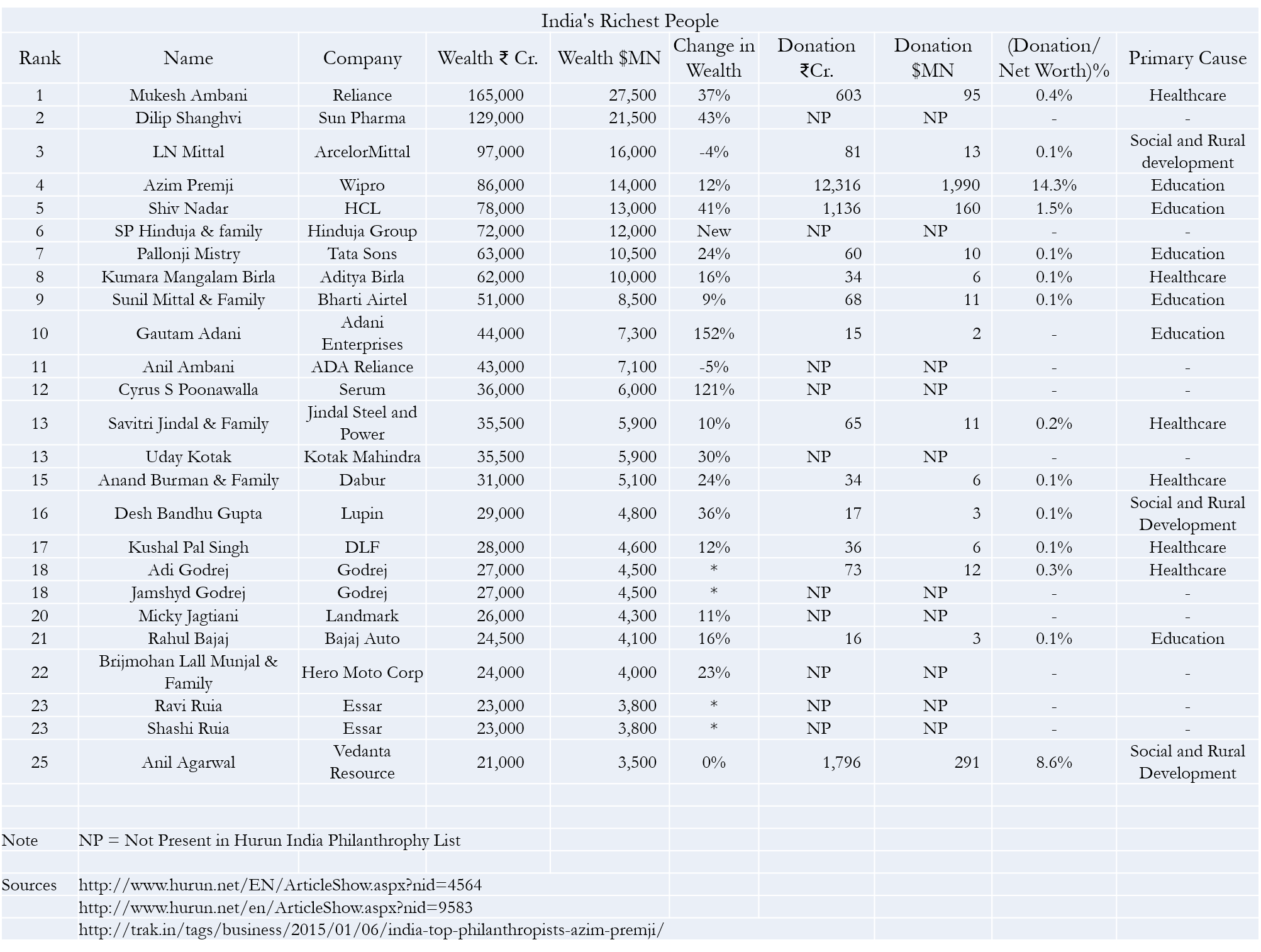
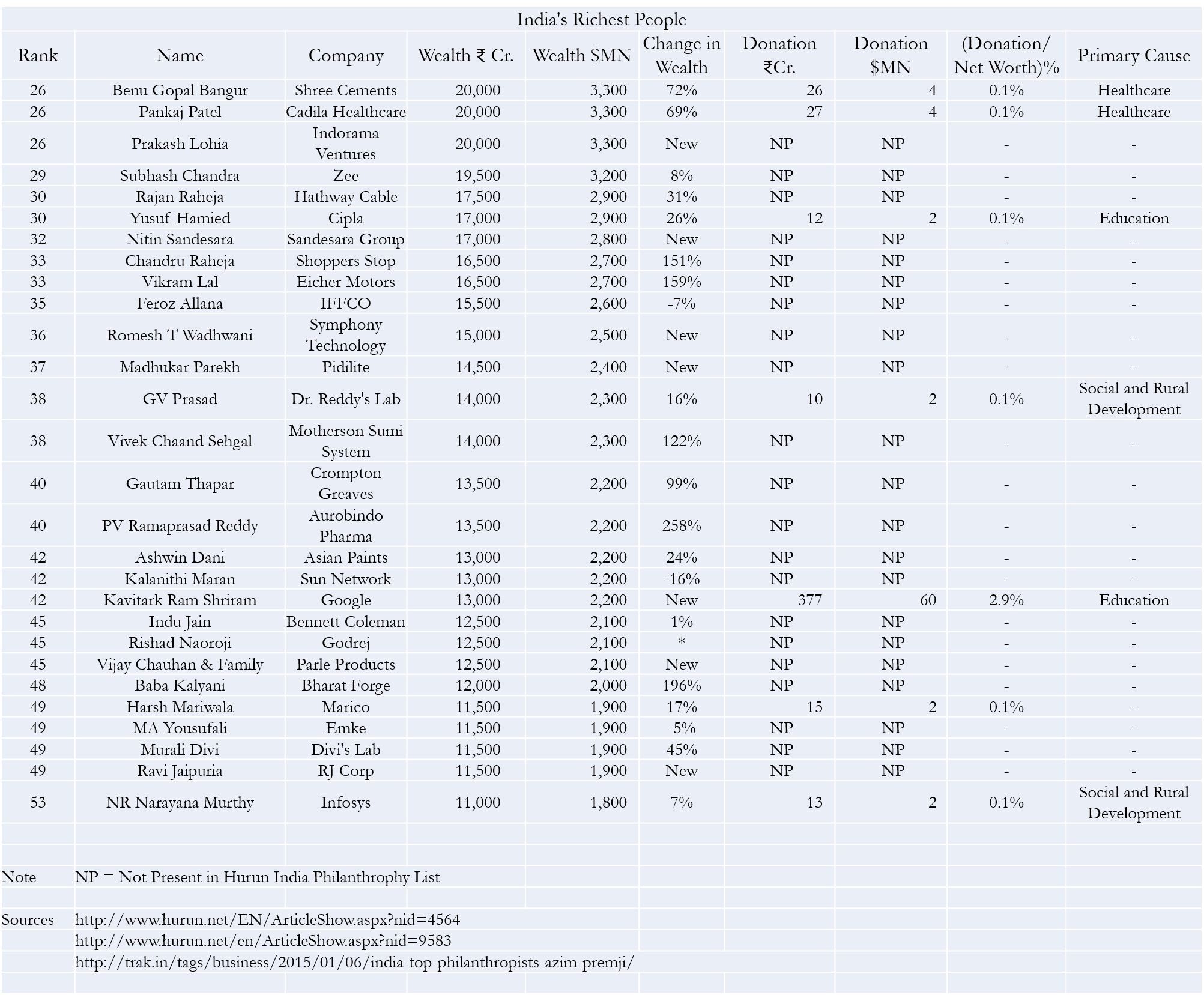
I decided to take the two lists and see how many of the top fifty richest Indian’s have contributed to Philanthropic causes (Taking top 50 richest Indian’s from ‘Hurun India Rich List 2014’ and checking if they are present in ‘Hurun India Philanthropy List 2014’). More importantly I wanted to figure out what proportion of their wealth they have contributed to Philanthropic causes. I had to extend the list to top 53 richest Indians, as there was tie between 4 people at number 49 and at number 53 was N R Narayanamurthy, one of the founders of Infosys, a charismatic business leader and a role model/ inspiration for a lot of youngsters. I have given the details of methodology followed by Hurun Report in notes section at the bottom of the post. The complete list is attached in the form of two pictures with the details of the top 25 in the first picture and the details of the next 28 in the second picture.

Donations by India's Top 25 Billionaires

Donations by India’s Top 25 Billionaires

Donations by nest 28 Indian Billionaires

Donations by nest 28 Indian Billionaires

My findings paint a dismal picture about contributions by richest Indians towards charitable causes. Out of the top 53 richest Indians, 32 are not present in the ‘Hurun India Philanthropy List 2014,’ a whopping 60%. Of the remaining only 4 of them have made contributions above 1% of their wealth, an uninspiring 8%. Azim Premji of Wipro Technologies tops the Hurun India Philanthropy List 2014 with donations of $1,990 MN, which amounts to very generous 14.3% of his wealth. Anil Agarwal of Vedanta Resource comes in at a distant second with a contribution of $291 MN, which however translates to an impressive 8.6% of his wealth. Kavitark Ram Shriram, a board member of Google and Shiv Nadar of HCL Technologies come in at number three and number four with contributions of 2.9% and 1.5% of their wealth respectively.

India’s richest man Mukesh Ambani of Reliance Industries has only donated 0.4% of his wealth to charitable causes in the assessment period. This is in stark contrast with China where the country’s richest man Jack Ma of Alibaba has donated an impressive 9.6% of his wealth towards charitable causes and the U.S. where the world’s richest man Bill Gates of Microsoft has (been estimated to have) contributed (life time contribution) of about 38% of wealth (as per 2013 article by Forbes).

While researching for this blog post I came across other interesting articles on India’s Ultra-rich. According to a Credit Suisse report, ‘India is home to 11th largest population of Ultra High Net Worth Individuals, but also figures among countries with “very high wealth inequality” with a large number of its residents being in the lower wealth strata.’

In his October 2012 blog post in The New York Times, Vivek Dehejia has made some interesting observations quoting a study economists Aditi Gandhi and Michael Walton: ‘The other important finding emerging from Ms. Gandhi and Mr. Walton’s research is that 43 percent of India’s billionaires came from sectors that the researchers classify as “rent-thick,” that is, those enjoying what economists would consider above-normal profits because the companies possess certain privileges. The Forbes list of richest Indians, released last week (in 2012), is full of businessmen and women from “rent-thick” sectors: real estate, construction, infrastructure, media, cement and mining. These are sectors in which the government continues to play a large role, in the form of licenses and other forms of control, and in which there’s a presumption of a government-business nexus – or collusion, to use a less flattering term, according to Ms. Gandhi and Mr. Walton.

There is some heartening news, though, in the study by Ms. Gandhi and Mr. Walton. According to their analysis, the majority of Indian billionaires are “self-made,” and around 40 percent represent wealth that is “inherited and growing,” like the Ambani brothers, Mukesh and Anil, sons of the late Dhirubhai Ambani, founder of the family business empire. According to research, there is a positive correlation between economic growth and the wealth of self-made billionaires, while there is a negative correlation between growth and inherited wealth. It’s impossible to establish a conclusive cause-and-effect relationship, but the finding is at least suggestive of the fact that economies populated by those whose wealth is self-made are more dynamic than those that rely on the perpetuation of existing economic elites and their descendants.’

An October 2014 article in Forbes notes that only four Indians had thus far signed The Giving Pledge, a campaign (initiated by Warren Buffett and Bill Gates in 2010) to encourage the wealthiest people in the world to make a commitment to give most of their wealth to philanthropic causes. Out of the four only Azim Premji is based in India. The other three (Vinod Khosla, Manoj Bhargava and Romesh Wadhwani) are Indian-Americans. A study by economists from the University of Southampton who performed an analysis of the pledgers’ letters to The Giving Pledge has found that billionaires who have built their own fortunes are more likely to pledge to donate a large portion of their wealth to charities, than those who are heirs to family fortunes.  This doesn’t augur well for Indian Philanthropic scene since some of the most well-known ultra-rich in India have inherited their wealth. To close this blog I will leave with a video of an interview by Warren Buffet and Bill Gates on Philanthropy. To quote Warren Buffet from the video: ‘A Philanthropic family on balance is going to feel better about themselves and their progeny than the family who has been hanging on to every single penny.

Note:

Hurun India Rich List 2014: ‘A list of the richest people in India with a cut-off of INR 1,800 Crores. Wealth calculations are a snapshot of 3 September 2014 when the rate of exchange to the US dollar was INR 60.33.’

Hurun India Philanthropy List 2014: ‘Donations were measured by the value of the cash or cash equivalent from 1 April 2013 to 31 October 2014.’