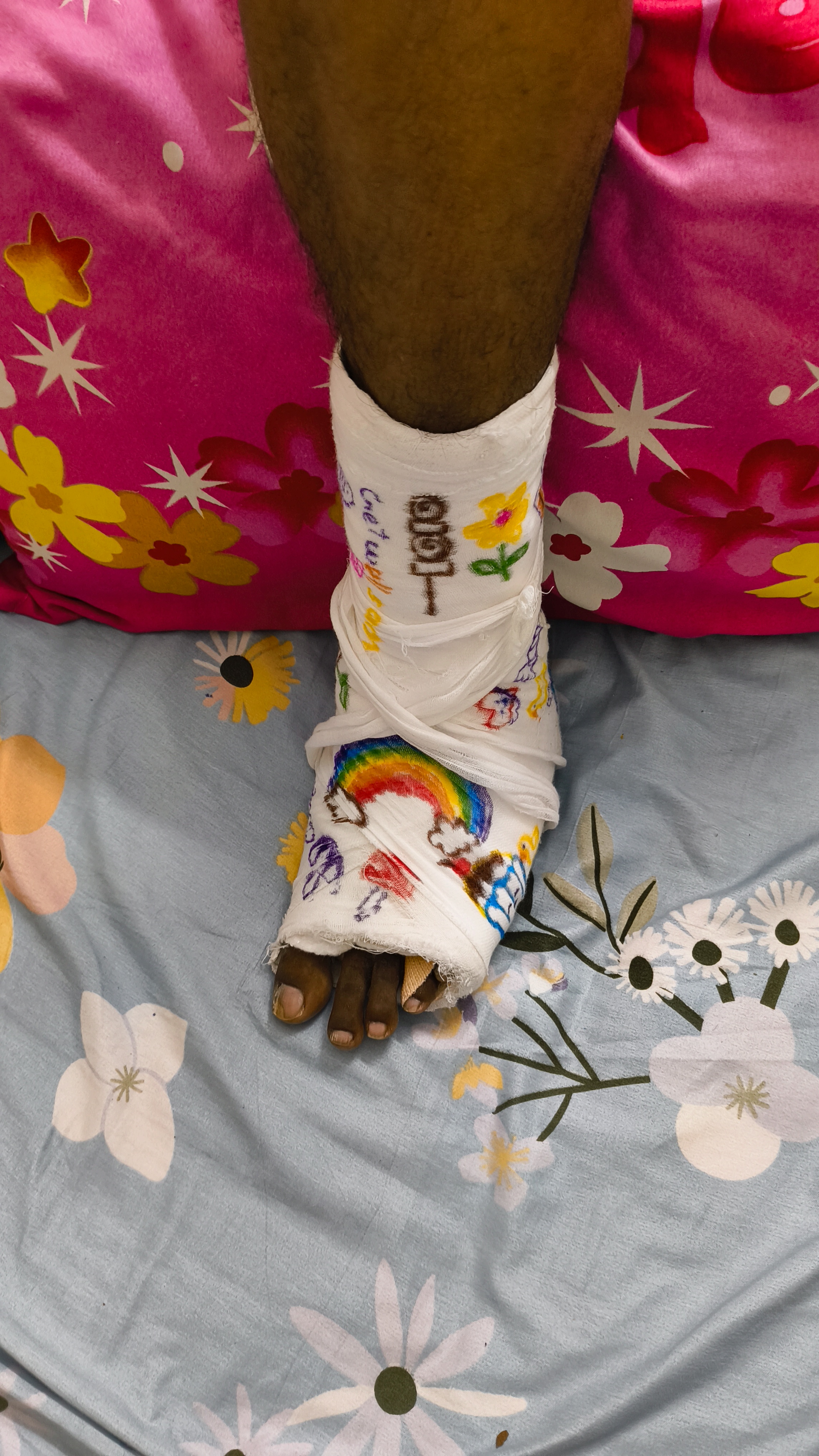
Agonizing over a cast – painting our own rainbow

The first day my son saw me with the cast on my leg, he asked me if he could draw on it. I said he can do it later. I was not sure if I was going to have the cast, so I did not allow him to draw.

But on the evening of the penultimate day on which I was supposed to have the cast removed, I asked my son, “Do you want to draw on my cast?”

“Yes,” he ran out of the room as he was replying. He came back with his sketch pen set, sat near my leg, and started drawing on the cast. The first one he drew was a skull similar to the ones we see in danger symbols.

I looked at him. “Dei, I have a fracture, and you are drawing a skull on the cast.”

In response he looked at me with the most mischievous smile that an eight-year-old could come up with.

He continued to draw—a crescent, a star, a candy, and a two-tiered birthday cake with a candle on top of it. Then he looked at me and said, “I am done.”

“Go and call your sister.”

When she came in, I asked her, “Do you want to draw?”

With a smile she started drawing cute Japanese doodles. In between she asked if I had a wish list. I asked her to bring the book ‘How to Draw Almost Every Day’ from the bookshelf.

I flipped through the book and pointed to doodles one after another. She drew for about an hour. I ended up with 24 doodles on my cast. I even published a blog post with a photo of my cast with the doodles as well as a haiku about it.

When I was listening to my wife convey the doctor’s message about a week ago, it was a hopeless situation. If anyone had told me that day that I would manage to retain the cast for the entire duration of eight days, I would have mocked them. But I did manage to retain the cast for the eight days that the doctor had advised.

This stage is only the first and most important phase in the six-plus weeks required for recovery. There are still so many ifs and buts. But I am hopeful of the best outcome.

So, what are the lessons that I learned from my inner battle?

  • Our long-term mental resolve is much better than what we assume it to be in the immediate aftermath of an adversity.
  • The mind is like a parachute. If we want to make a situation work, we will be able to gather the resolve to make it work.
  • More than the physical ailment, it is the lack of control over one’s own situation that hurts the most. So, always focus on what is under our control and take solace from it.
  • Seek out inspiration from a source appropriate for the situation, even if it is someone much younger than you.
  • Do not let a good crisis go to waste. Use it as an opportunity for self-discovery. You will be in for a surprise.
  • Lean into your bonds. Laugh or smile at whatever sliver of the situation that deserves a laugh or smile.
  • Tap into the collective wisdom of humanity for help.
    • I heard about the story about God Murugan and the Tamil sayings from my grandmother when I was a toddler nearly forty years ago.
    • I heard the “mind is like a parachute” quote from my B-school professor nearly twenty years ago.
    • Nearly ten years ago I came to know about a) the Marshmallow Test conducted on American children by b) an Austrian-born psychologist from c) an Irish professor working in a B-school in Spain, d) from his talk at TED Talks, a forum started by an American and a Britisher via e) YouTube, a technology platform started by an American, a German, and a Taiwanese.

This essay is part 5 of the 5-part personal essay series – Agonizing over a cast

Part 1: https://yogesvr.xyz/2025/10/05/agonizing-over-a-cast-the-crybaby/

Part 2: https://yogesvr.xyz/2025/10/21/agonizing-over-a-cast-the-bad-news/

Part 3: https://yogesvr.xyz/2025/10/22/agonizing-over-a-cast-conjuring-up-scenarios/

Part 4: https://yogesvr.xyz/2025/10/23/agonizing-over-a-cast-the-zen-master-in-the-house/

Agonizing over a cast – the Zen Master in the house

There is an episode in Hindu mythology in which God Murugan, being a cosmic child, would teach Pranava Mandhiram to his dad, God Shiva—one of the trinity of gods in Hinduism. Because he taught his dad, God Murugan got the title of ‘Thanthaiku Mandhiram Sonnavan’ (translation: The one who taught the sacred hymn to his dad).

With every passing hour of my battle with the itching sensations, I had a profound sense of respect for my son, similar to the reverence that a disciple would have for a Zen master. Maybe kids have an inherent optimism and chirpiness that guard them against such adversaries. That’s something that could not be matched by worn-out souls of forty-somethings. Nonetheless, I decided to use my son’s resolve as an inspiration. If he can manage to have a cast for seven weeks, I can at least try and manage for a week.

Somewhere in between all my ruminations, an insight hit me—I am facing my own version of the Marshmallow Test with a twist. Do I want to endure a lesser pain (cast) in the short term, or do I want to endure more severe pain (two possible surgeries and casts) in the long run?

I first heard about the Marshmallow Test in the TED talk ‘The Discipline of Finishing’ by Conor Neill. The Marshmallow Study,’ or ‘The Marshmallow Test,’ is one of the most famous psychological studies of the second half of the twentieth century. This study was carried out between the late 1960s and early 1970s at Stanford University and was headed by a distinguished professor by the name of Walter Mischel. The key finding of the study is that the ability to delay gratification (self-discipline) in kids, more than intelligence, is a much better predictor of future success.

Once I realized that my situation was a version of the Marshmallow Test, which pain I needed to endure became clear to me. It’s relatively easy to have a moment of realization but very difficult to consistently act based on that insight. The short-term pains, like the real or imagined itching sensation on my left leg, are very concrete. They are effective in drawing our attention towards them. In contrast, long-term pains or gains are very vague, like a daydream. So, I used a combination of insights to come up with my coping mechanism.

In his TED talk, Conor Neil spoke about endurance high-performance athletes. They only worry about the immediate challenge in front of them—sometimes just about one step at a time. I decided not to think about the remaining five days before my next visit to the doctor. I decided not to think about an entire day, not an hour, not even a minute ahead. I decided that I will focus on what I will do when the itching sensation hits.

One of the key insights from the Marshmallow Test is that distraction is an effective strategy when faced with an immediate temptation. Kids who were able to succeed in the Marshmallow Test were able to come up with multiple ways to distract themselves from looking at the short-term temptation or prize in front of them. Whenever the itching sensation hit, I tried to distract my mind. I was mostly successful. We usually consider distraction to be a bane. But, without the ability to get distracted from adversities and bad luck, we would be constantly ruminating about them and pretty soon end up as a nervous wreck.

The human mind is very resilient and tends to cope very well with adversities. After a couple of days, there were only fewer instances of itching sensations and the urge to scratch. I also noticed that mostly the itching sensation subsided after a few seconds even if I didn’t scratch.

In addition, the grip of the cast also loosened in a couple of days. This reduced the episodes of itching sensations further. In fact, the grip loosened so much that I had to see the doctor a couple of days ahead of schedule, as I was worried that the cast was no more effective. The doctor mentioned that it was normal for the cast to become loose with each passing day. He tightened the cast by tying a gauze cloth around it. I felt uncomfortable for the rest of the day but was pretty much unbothered from the next day. I am reminded about a comment by one of my professors during MBA days: “The mind is like a parachute. It works only when it is open.” Once I decided that I wanted to have the cast for the entire duration that the doctor prescribed it, I was able to come up with coping mechanisms against the discomfort of the cast. I did not stand in the way of my well-being.


This essay is part 4 of the 5-part personal essay series – Agonizing over a cast

Part 1: https://yogesvr.xyz/2025/10/05/agonizing-over-a-cast-the-crybaby/

Part 2: https://yogesvr.xyz/2025/10/21/agonizing-over-a-cast-the-bad-news/

Part 3: https://yogesvr.xyz/2025/10/22/agonizing-over-a-cast-conjuring-up-scenarios/

Part 5:  https://yogesvr.xyz/2025/10/24/agonizing-over-a-cast-painting-our-own-rainbow/

Agonizing over a cast – conjuring up scenarios

There are a couple of Tamil sayings that I’ve got to implement over the next few days:

  • Vallavanukku Pullum Ayudham

Translations: A capable man will turn even a grass into a weapon.

  • Siru Thurumbu Pal Kutha Udhavum

Translation: Even a small splinter can be useful as a toothpick.  

I became a samurai warrior fighting against the itching sensations that my mind started throwing at me. My armory consisted of two plastic scales (one flexible and another non-flexible) and a comb. The comb was part of a gift set given to my daughter by one of my sisters a couple of months ago. When I had a first glimpse of this comb, I thought to myself, ‘What a weird-looking comb. Which idiot has designed it?”

After the usefulness of its pointed tip in getting through my cast and helping me to scratch the itches, I would say he or she is a genius. My soul wants to stand on top of the Eiffel Tower and declare to the world, “The designer of the comb deserves an iF Design Award and a Red Dot Design Award.”  If I came across the designer today, I would even kiss his or her hand with the same reverence that underlings had for Don Corleone in The Godfather.

Once I heard a comment in a documentary, “The best of our dreams and the worst of our nightmares never come true.”

After getting the cast on my feet, there was one scenario that I used to ruminate endlessly. What if a mosquito enters into my cast with the precision of a Japanese Kamikaze pilot conducting his bombing sorties? Once inside the cast, what if the mosquito sips my blood with the sophisticated pleasure of James Bond sipping his martini? And in response I would be agonizing over the unfairness of life like an indentured laborer in one of the 19th-century British colonies. Luckily for me, this phantom of my imagination did not come true.

And whenever I would reach out inside the cast with a scale or comb to scratch, the Shastri and Manjrekar in my house would come uninvited for a pitch report, sans the mikes.

One of them: “You are ruining the structural integrity of the cast.”

My mind voice: “This is a cast. Not the RMS Titanic.”

One of them: “The doctor is going to scold you for messing with his creation.” My mind voice: “He is not my father-in-law, and this cast is not his daughter.”


This essay is part 3 of the 5-part personal essay series – Agonizing over a cast

Part 1: https://yogesvr.xyz/2025/10/05/agonizing-over-a-cast-the-crybaby/

Part 2: https://yogesvr.xyz/2025/10/21/agonizing-over-a-cast-the-bad-news/

Part 4: https://yogesvr.xyz/2025/10/23/agonizing-over-a-cast-the-zen-master-in-the-house/

Part 5:  https://yogesvr.xyz/2025/10/24/agonizing-over-a-cast-painting-our-own-rainbow/

Agonizing over a cast – the bad news

So how did this start?

Tuesday – 23, September:

Around 8 PM, I was taking the washed and dried clothes lying on the bed to the sofa in the living room. I had placed one bunch of clothes on the sofa and was coming back for the remaining clothes.

I was walking into the bedroom in an absent-minded way that only middle-aged Indian uncles can do when they reluctantly do household chores. I have a tendency to walk fast from time to time. This time I was walking fast in an absent-minded way towards the narrow passage between the steel bero (almirah) and wooden cot in our bedroom. As I was taking the first step into the passage, my left foot hit one of the two large wooden blocks supporting the weight of the cot. The edge of the smallest toe and the one immediately preceding it on my left foot.  

Within a split second, the impact transmitted a shooting pain to my brain. My vocal cords involuntarily made an acoustic projection of a painful scream. I managed to sit down on the bed with tightly clenched fists and my upper and lower rows of teeth in airtight formation.

On hearing me scream, my wife, who was on a call, cut the call and asked me, ‘Are you ok?’ I did not answer her immediately. My mind was quickly scanning through its database of painful memories. Being housed within a body that had endured 45 years of life of falling down, getting hit with cricket balls, more falling, bumping against walls, furniture, etc., it could quickly recognize that this one didn’t have an equivalent entry.

“I think I have fractured my toe,” I blurted out.

Once the pain receded a little bit, I placed both my feet side by side. The smaller toe on the left foot had moved outward compared to the little toe on my right foot.

“Not good… not good,” I said to myself. 

I tried to lift all the toes on my left foot. I was able to lift them despite the pain.

“Ah, good,” with a sigh of relief.

As we started discussing if we needed to see a doctor, the little toe on my left foot started swelling like a thin sheet of damp maida dropped into boiling oil.

“Oh no… oh no… oh no, no, no.”

We decided to go to the Ortho clinic in Mandaveli. It was around 8:30 PM, but the clinic was not far from our house. When we reached the clinic, they were already closing it for the day. The assistant opened the door to the doctor’s room. He was about to leave, but we caught him in the nick of time.

The doctor made me sit on a long wooden bench. He asked me to lift all my toes. Then he pressed the injured too. There was so much pain, I started to shout.

“The toe is fractured. But it’s swollen, and there are so many blood clots around it. It’s not a good idea to put a plaster around the toe or a cast around the leg now. I will prescribe you some tablets. Come back on Thursday evening with an X-ray of the left foot. I will put a plaster around the toe and a cast for the left foot,” the doctor delivered the bad news in an ambivalent manner.

As he was busy prescribing medicine, I tried to indulge in oodles of self-pity.

“Be thankful that the toe did not get dislocated. Otherwise, you would need a surgery right away. This will heal in about six to eight weeks,” the doctor tried to console me with his expert advice. Yes, it was comforting to hear his opinion, but in a very darkly comic way.

After buying the medicines, we got into an auto to go home. On the way we spotted a lab still open. We went in to get the X-ray taken. One look at the X-ray, the technician said, “It’s a hairline fracture. But it should heal in six to eight weeks.” 

I looked at the X-ray. The crack looked deeper and much more visible compared to the one on my son’s X-ray from January.

On reaching home, we decided to cheer up the damp evening with burrito bowls for us. The thought of my fractured toe and the possibility of a cast around my left foot made the Barbeque Paneer Burrito bowl taste like Rava Upma.


This essay is part 2 of the 5-part personal essay series – Agonizing over a cast

Part 1: https://yogesvr.xyz/2025/10/05/agonizing-over-a-cast-the-crybaby/

Part 3: https://yogesvr.xyz/2025/10/22/agonizing-over-a-cast-conjuring-up-scenarios/

Part 4: https://yogesvr.xyz/2025/10/23/agonizing-over-a-cast-the-zen-master-in-the-house/

Part 5:  https://yogesvr.xyz/2025/10/24/agonizing-over-a-cast-painting-our-own-rainbow/