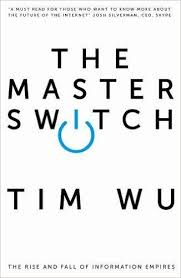
I chose to read ‘The Master Switch’ by Tim Wu due to its tagline, ‘the rise and fall of information empires.’ The main theme of the book is how each one of the information technologies have gone through a cycle: From openness to closed control by monopoly/ cartel followed by disruption from new/ different information technology.
The book traces each one the major information technologies such as telephone, AM radio, FM Radio, Television, Digital television, Cable Television, Motion picture, etc. from their tech cradles to their baby steps as tinker toys of hobbyists, to a new source of gold rush for entrepreneurs and finally ending as the ‘goose that lays the golden eggs’ caged by monopolists/ cartels. A recurring theme of the book is how the originals ideals of inventers, innovators and entrepreneurs and the full potential of a new information technologies get strangled in legal and regulatory cobwebs and crushed under the economic juggernaut of entrenched players (read monopolists and cartels controlling old information technologies which were ripe for disruption).
Through various vignettes across five sections, the book traces the sad saga of how the egalitarian ideals of inventors get crushed by economic-empire building ambitions of people like Theodre Vail, Adolf Zukor, etc. Along the way author also lays in great details the dangers of important industries being controlled by a handful of players including the ‘Production Code’ imposed on Hollywood from mid 1930s to 1960s, the role of telecom players in surveillance regimes, etc.
The book is an interesting read as it takes us on a time travel to the very cross-roads where the crusades to keep important information technologies open were lost. On the lines of the famous poem ‘The Road Not Taken’ by Robert Frost, this book is about the technological road not taken and the economic model not embraced. Needless to say in these different historic moments the seeds of change for modern life were sown.
One keeps wondering from time to time on how history would have been different: had Julius Cesar not been assassinated, had Dara Sikoh prevailed over Auranzeeb, had Abraham Lincoln not been assassinated or more recently had Bernie Sanders won the nomination instead of Hillary Clinton. In a similar vein the author also rues from time to time on how what could have been oases of technology openness have instead turned into walled castles under the siege of monopolists and cartels.
The main aim of the author is not to take us through a journey of suspended disbelief but to drive home the point that the openness of internet is under constant attack. While we are thankful to these information technologies for making our lives better, easier and richer the author wants us to reflect about an alternate universe in which: open model had prevailed over closed model, the vision of innovators had prevailed over the ambitions of capitalists, the larger good of the society had prevailed over the economic interests of entrenched players. The author’s warning is not to take the openness of the internet for granted and to understand that powerful forces are at play to convert the internet also into another walled garden. At stake is not only the economic model embedded in the internet but the very basis of our future for while humans shape technologies in the short run, technologies shape humans in the long run.
Some interesting Quotes from the Book:
- History shows a typical progression of information technologies: from somebody’s hobby to somebody’s industry; from jury-rigged contraption to slick production marvel; from a freely accessible channel to one strictly controlled by a single corporation or cartel—from open to closed system.
- It is an under-acknowledged truism that, just as you are what you eat, how and what you think depends on what information you are exposed to.
- From AT&T’s first meeting with Justice, we see for the first time something that will occur again and again in the history of communications, the state’s calculated exercise of discretion over whether to bless or destroy the monopoly power, deciding in effect what industry it will allow to be dominated.
- In the course of a single decade, film went from one of the most open industries in the United States to one of the most controlled. The flip shows how abruptly industrial structure can change when the underlying commodity is information.
- In the language of innovation theory, the output of the Bell Labs was practically restricted to sustaining inventions; disruptive technologies, those that might even cast a shadow of uncertainty over the business model, were simply out of the question.
- The best antidote to the disruptive power of innovation is overregulation. That is to say, the industry learned how to secure the enactment of seemingly innocuous and sensible regulations that nonetheless spelled doom for any rival.
- Three important waves of innovation followed the great consolidation of broadcasting in the 1920s: mechanical television, electronic television, and FM radio transmission. And despite the importance of each technology, what is so striking is that none managed to produce an independent industry capable of challenging the dominant Radio Trust, comprising primarily RCA, NBC, and NBC’s industrial allies, CBS, General Electric, and Westinghouse.
- We fancy having in the United States the most open of markets for innovation, in contrast to the more controlled economies of other nations. In truth, however, the record is decidedly uneven, even given to excesses that would shame a socialist, with the federal government, at the behest of an entrenched industry, putting itself in charge of the future.
- Industry structure, as I have suggested, is what determines the freedom of expression in the underlying medium.
- While television is supposed to be free, it has in fact become the creature, the servant, and indeed the prostitute, of merchandising
- Cable was born commercial, while the Internet was born with no revenue model, or any need of one. Its funding came in research grants, making it, for a long time, the information media equivalent of a public park.
- There is no understanding communications, or the American and global culture industry, without understanding the conglomerate.
- In fact, the combination of Apple, AT&T, and Hollywood now held out an extremely appealing prospect: Hollywood’s content, AT&T’s lines, and Apple’s gorgeous machines—an information paradise of sorts, succeeding where AOL–Time Warner had failed.
- Google is the Internet’s switch. In fact, it’s the world’s most popular Internet switch, and as such, it might even be described as the current custodian of the Master Switch.
- Google is not a switch of necessity, such as the telephone company was, but rather a switch of choice.
- Those industries that supply the means of trade in information, goods, or cash are more obviously vital even than, say, a country’s sole producer of sugar. Practically, this focus has led to four basic industries being identified as “public callings”: telecommunications, banking, energy, and transportation.
- For it is the switch that transforms mere communications into networking—that ultimately decides who reaches what or whom. It is the Master Switch, as Fred Friendly reminds us, that will decide who is to be heard.
- If one allows that the Internet is our key means of conveyance, the “common medium” of our national life and economy, net neutrality is the twenty-first century’s version of common carriage.
- Put most simply, net neutrality is what prevents the telephone and cable industry from killing Google, Amazon, Wikipedia, blogs, or anything else that might incur their displeasure.
- The owner of an iPod or iPad is in a fundamentally different position: his machine may have far more computational power than a PC of a decade ago, but it is designed for consumption, not creation.
- Technology has reached a point where the inventive spirit has a capacity for translating inspiration into commerce virtually overnight, creating major players with astonishing speed, where once it took years of patient chess moves to become one, assuming one wasn’t devoured.
- The Internet with its uniquely open design has led to a moment when all other information networks have converged upon it as the one “superhighway,” to use the 1990s term.
- There is no escaping the reality that we have evolved into a society in which electronic information represents the substrate of much of daily life. It is a natural outcome of our having advanced past the mechanical age.
- Romance of the Three Kingdoms: An empire long united, must divide; an empire long divided, must unite. Thus it has ever been, and thus it will always be.
- Leopold Kohr: “there seems to be only one cause behind all forms of social misery: bigness.”
- For what he (Friedrich Hayek) found dangerous about the centralizing tendencies of socialism applies equally well to the overbearing powers of the corporate monopolist.
- “It’s the same old story,” he (Milton Mueller) would say, years later; “the inventor gets the experience, and the capitalist gets the invention.”
- The Kronos Effect: the efforts undertaken by a dominant company to consume its potential successors in their infancy.


 Yogi's Blogosmos