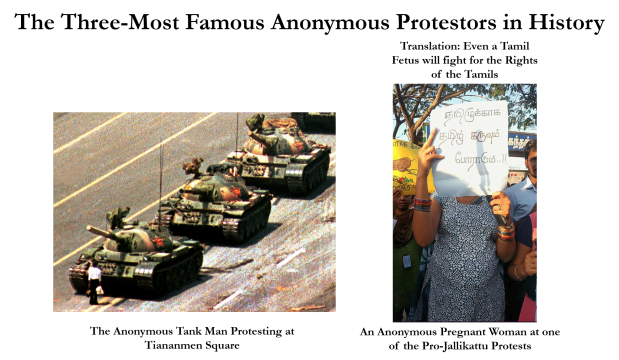
My Thoughts on the ongoing Pro-Jallikattu Protests

Three Famous Protestors.png


My thoughts on the ongoing protests to lift the ban on Jallikattu:

  1. In India thousands of people die in road and train accidents every year. Would the court ask for stringent implementation of regulations and better regulations or would it ban road and train transport altogether?
  2. India is the largest exporter of beef, 7th largest exporter of goat and sheep meat and the 2nd largest producer of footwear and leather garments in the world. Shouldn’t the animal right activists first target these industries before targeting an ancient sport? Isn’t killing animals, de-skinning them and cutting them to pieces more cruel than bull-taming?
  3. Under UNESCO’s Convention for the Safeguarding of the Intangible Cultural Heritage, article 13 specifically calls for national governments to a) adopt a general policy aimed at promoting the function of the intangible cultural heritage in society, and at integrating the safeguarding of such heritage into planning programs and b) designate or establish one or more competent bodies for the safeguarding of the intangible cultural heritage present in its territory. ‘Social practices, rituals and festive events’ is one of the domains under ICH. Shouldn’t India (and its highest court) as a member of the UN protect Jallikattu, a festive event, rather than ban it?
  4. In its observation in January 2016, the Supreme Court observed, ‘in this modern world of computers, it is better to play Jallikattu on computer.’ Shouldn’t the judges of the Supreme Court be value-neutral? Why mock at a tradition?
  5. The Youth of Tamil Nadu protesting peacefully across the state are not questioning the authority of the Supreme Court, but questioning the logic of putting the values of one group (the animal right activists) above the values of another group (people who want to ensure in the continuity of their tradition). People who think that Tamil Youths’ stand is wrong should bear in mind that they are following in the footsteps of Mahatma Gandhi and Jayaprakash Narayan.
  6. Human Beings are like Trees; just like trees we need strong roots (nationality, religion, language and culture, etc.) and strong branches and leaves (education, experience and appreciation of diversity, etc.). In the end the choice between where to strike a balance between tradition and modernity is each individual’s right and no one has to the right to infringe on it. PETA is at best a Ponzi scheme of the Animal Rights World and no true animal lover should believe in them.
  7. People still don’t get the fact that India is not a Homogenous Nation but a mosaic of cultures and nation of immense diversity. In the way the former British colonies came together to form a new country, India is similar to USA. In terms of a huge population of people, India is similar to China. In terms of the sheer diversity of languages, ethnic groups, religions and group identities, India is similar to the European Union. In terms of the way politicians and rich people embrace each other, India is similar to dictator ruled countries. In short India is a first of its kind POLITICAL and SOCIAL EXPERIEMENT in history. Any individual or institution that is going to treat India as a homogenous nation/ entity and enact/ implement laws based on this assumption is going to create more frictions like the Jallikattu-ban issue. Any such attempt is an attempt to trample the dreams of the founding fathers of this nation, an assault on the foundation of our constitution and an assault on the very idea of INDIA itself.


#Jallikattu #Jallikattuprotest #AmendPCA

A Country worth Exploring

Which is the closest country to Australia? If you answered New Zealand, you are wrong. If you answered Indonesia, you are wrong again. Papua New Guinea is the closest country to Australia. Papua New Guinea (PNG), is an independent country that occupies the eastern half of the island of New Guinea and its offshore islands in Melanesia, a region of the southwestern Pacific Ocean north of Australia. Its capital, located along its southeastern coast, is Port Moresby. The western half of New Guinea forms the Indonesian provinces of Papua and West Papua. Papua New Guinea achieved its independence in 1975 following almost 60 years of Australian administration. PNG is a member of the Commonwealth of Nations and Queen Elizabeth II is the head of state. The country has a population of about 8 Million people, has a per capita GDP of $2,283 and is classified as a developing nation by the IMF.

Some interesting facts about PNG:

  1. Papua New Guinea is only 3.7 kilometers away from Australian soil at its nearest point
  2. Papua New Guinea and Indonesia share the island of New Guinea which is one of the world’s largest islands.
  3. It is one of the very few places on earth which lie close to the equator where places at higher altitudes experience snowfall.
  4. PNG is one of the most ecologically and culturally diverse countries.
  5. The world’s only known poisonous bird, the Hooded Pitohui (Pitohui dichrous) is native to Papua New Guinea.
  6. Even until the 1950’s cannibalism and headhunting were rampant in Papua New Guinea.
  7. Until 1933 the country used sea-shells as its national currency. Post that, it switched to the Papua New Guinean Kina (PGK).
  8. 852 languages are listed for PNG, of which 12 have no known living speakers
  9. The highest point in the Independent State of Papua New Guinea is Mount Wilhelm (4,509 m).
  10. PNG is fantastic for birdlife with the famous birds of paradise and 750 different species to look out for. There are tree kangaroos, wallabies but no other real mammals.
  11. Many species of birds and mammals found on New Guinea have close genetic links with corresponding species found in Australia (e.g. kangaroos and possums)
  12. The Great Barrier Reef extends from Australia to almost the edge of Papua New Guinea
  13. The Japanese army suffered their first land defeat in the Pacific War (part of WWII) in 1942 in PNG

If you are interested in visiting PNG the following links might be useful to you:

http://www.pngtia.com/

http://wikitravel.org/en/Papua_New_Guinea

https://www.lonelyplanet.com/papua-new-guinea

http://www.papuanewguinea.travel/birdwatching

http://www.tropicalbirding.com/australasia-tours/new-guinea/papua-new-guinea/

http://world.new7wonders.com/?n7wn-finalist=great-barrier-reef-australia-papua-new-guinea

I will leave you with a couple of videos, one of PNG and one on Birds of Paradise.

Sources:

Article:

https://en.wikipedia.org/wiki/Papua_New_Guinea

http://www.traveller.com.au/have-you-visited-australias-closest-neighbour-papua-new-guinea-ghfi04

http://www.10-facts-about.com/papua-new-guinea/id/898

http://www.factsking.com/countries/papua-new-guinea/

https://papuanewguineacasestudy.wikispaces.com/Learn+More+about+Papua+New+Guinea,+Fun+Facts!

http://travelpost.noble-caledonia.co.uk/articles/papua-new-guinea-interesting-facts-travel-tips

https://en.wikipedia.org/wiki/Bird-of-paradise

Photos:

http://missionpng.com/PNGScene.htm

https://pucpng.wordpress.com/

http://www.globaldivingadventures.com/expedition-papua-new-guinea/

Note: This post has been written for IndiSpire Edition 116: ‘Choose a country you don’t know much about. Now read up/ research about it. And tell us something interesting about it. Can be anything – history, politics, music or whatever tickles your fancy.  #DiscoverACountry’

Even Scavenging Crows Don’t Sell Themselves Short

One of my fondest childhood memories is that of me and my sisters feeding rice to sparrows and crows in the verandah in our grandparent’s house. It’s an age old practice that our grandparents had encouraged us to indulge in and enjoy. These days sighting sparrows in Chennai has become a rarity and finding time in our extra rush-hour life to feed the crows has been difficult. The problem is also aggravated by the fact that it’s very difficult to find a suitable spot to feed the birds in apartment complexes. Nevertheless in the last couple of years I have got into the habit of feeding crows.

The compound wall of our current flat is just an arm’s distance from our kitchen. As a result we place food for the birds on the compound wall from our kitchen. The convenience factor has made it easier to feed the crows. The sound of the crows around breakfast and lunch times also serve as alarm bells that remind me to feed the crows. I hadn’t given it much thought but of late I have started noticing that even crows have foods preferences. The scavenging crows are the last creatures that I would have expected to have preference in meals but they seem to have preferences. Crows prefer non-veg items; that’s a no brainer. They prefer chapatti over rice; that’s a surprise to me. The spot where we place pieces of chapatti will become empty within a few minutes whereas when we place rice it will take a couple of hours to get finished. Crows seem to hate dosas; they are kind of ok with idlis.

This Saturday morning, something even more interesting happened. My wife was not keeping well and my mother was at my sister’s place. I went to kitchen to drink water and on hearing the sound of crows I reached out to the loaf of bread lying on the kitchen table. I pulled a couple of slices of bread and tore them into smaller pieces and placed them at the usual spot on the compound wall where we keep food for the crows. Then I went to wash my hands at the kitchen sink and simultaneously peeked through the window to see what was happening.

Four crows descended on the compound and were shouting loudly. However none of them touched the bread. One of the crows even looked very closely at the bread pieces similar to the way a lab technician would look through a microscope. Even after a couple of hours the bread pieces were still lying on the compound wall.

As I was having my lunch I could not help but wonder about the optimism of those crows. Crows are mostly scavengers eating on left overs, living a kind of rootless existence (in the eyes of a human) with not much guarantee about the next meal. Yet the experience of their life time had taught them to be so optimistic about their immediate future that they were not willing to sell themselves short. Even a lifetime of scavenging has not dented their optimism.

I wish I had the same optimistic outlook about my own life. At so many instances in life I have sold myself short thinking that it was risky to forego what was in front of me. There have been days at a stretch when I had been pessimistic, cynical and grumpy. I have also known of so many people (with the best of education, jobs, health and family condition) who have had the same feeling and would go an extra mile in propagating their pessimism to others as well. And yet here we have bunch of scavenging crows that were more optimistic than people like us and were refusing to sell themselves short. Optimism is not something that you deduce from your immediate environment or situation but something that you inculcate within yourself. Life and Nature are indeed great teachers.