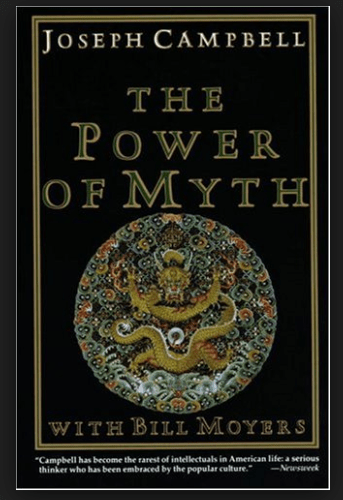
The Power of Myth by Joseph Campbell

The Power of Myth

Yesterday I finished reading ‘The Power of Myth’ based on a televised conversation between Comparative Mythologist, Joseph Campbell and TV anchor, Bill Moyers. The book set in the conversational style and makes for an easy read.

The sentence ‘Myths are clues to spiritual potentialities of the human life’ appear in the opening chapter as well as the closing chapter of the book. And that’s one of the key messages that this conveys. The other key theme discussed in this book is the similarity or proximities between myths from different cultures, places and times. The close association, as per Campbell, is due to ‘certain powers in the psyche that are common to all mankind.’ As per Campbell, ‘Every mythology has to do with the wisdom of life as related to a specific culture at a specific time. It integrates the individual into his society and the society into the field of nature.’

Some of the countless nuggets of wisdom from the book:

  • Every religion is true in one way or another. It is true when understood metaphorically. But when it gets stuck to its own metaphors, interpreting them as facts, then you are in trouble.
  • If you think that the metaphor is itself the reference, it would be like going to a restaurant, asking for the menu, seeing beefsteak written there, and starting to eat the menu.


  • Compassion is the fundamental religious experience, and, unless that is there, you have nothing. (A very important observation given the current series of religion based hate crimes).
  • You get a totally different civilization and a totally different way of living according to whether your myth presents nature as fallen or whether nature is in itself a manifestation of divinity, and the spirit is the revelation of the divinity that is inherent in nature.
  • Life is pain, but compassion is what gives it the possibility of continuing.
  • It’s characteristic of democracy that majority rule is understood as being effective not only in politics but also in thinking. In thinking, of course, the majority is always wrong.
  • Giving birth is definitely a heroic deed, in that it is giving over of oneself to the life of another.
  • Making money gets more advertisement. So the thing that happens and happens and happens, no matter how heroic it may be, is not news. Motherhood has lost its novelty, you might say.
  • Our life evokes our character. You find out more about yourself as you go on. That’s why it’s good to be able to put yourself in situations that will evoke your higher nature rather than your lower.
  • Mythology is not a lie, mythology is poetry, it is metaphorical.
  • The myth is the public dream and the dream is the private myth (just brilliant).
  • A legendary hero is usually the founder of something – the founder of a new age, the founder of a new religion, the founder of a new city, the founder of a new way of life.
  • In order to found something new, one has to leave the old and go in quest of the seed idea, a germinal idea that will have the potentiality of bringing forth that new thing.


  • You must have a room, or a certain hour or so a day, where you don’t know what was in the newspapers that morning……. This is a place where you can simply experience and bring forth what you are and what you might be. This is the place of creative incubation.
  • The earth does not belong to man, man belongs to the earth. All things are connected like the blood that unites us all. Man did not weave the web of life, he is merely a strand in it. Whatever he does to the web, he does to himself. (People carrying out the destruction of the ecology in pursuit of a fat bank account, please take a note.)
  • People say that what we’re all seeking is a meaning for life. I think that what we’re seeking is an experience of being alive, so that our life experiences on the purely physical plane will have resonances within our own innermost reality, so that we actually feel the rapture of being alive.
  • What we’re learning in our schools is not wisdom of life. We’re learning technologies, we’re getting information. There’s a curious reluctance on the part of faculties to indicate the life values of their subjects.

When I was watching the movie Troy, based on Greek epic Iliad, I was struck while watching the scene in which Achilles is killed by an arrow piercing his heel which is similar to a scene from Hindu epic Mahabharata, in which Krishna is killed by an arrow piercing his foot. After reading this book, I now realize that there are countless similarities between mythologies from different parts of the world.

There is one striking conversation in the second chapter in which Moyers reads verses from the creation story in Genesis and Campbell gives equivalent verses from other cultures ranging from the Pima Indians in Arizona, the Hindu Upanishads from India and the Bassari People of West Africa.

There is another conversation in the book about a story from Persia that Satan was condemned to hell because he loved God so much. I remember the The parallel episode to this from Hindu stories where the gate keepers of Vaikuntam, the heavenly abode of God Vishnu, are cursed by a group of saints. On the intervention of God Vishnu they are given an option between staying away from Vishnu for six births if they praise Vishnu in each birth or staying away from Vishnu for three births if they denounce him in each birth. Not able to bear the thought of being away Vishnu for six births, they accept to denounce him and are born as Asoora (Demon-like) kings in their next three births.

Reading ‘The Power of Myth’ is the best way to realize that humanity as whole shares the same roots, shares the same resources, shares the same fears and ultimately shares the same fate on this earth. As they say: ‘God is Love and Love is God.’ Love life and let all life forms live and flourish on this beautiful planet. May the power of sanity be with us and lead us to embrace the God within each one of us.

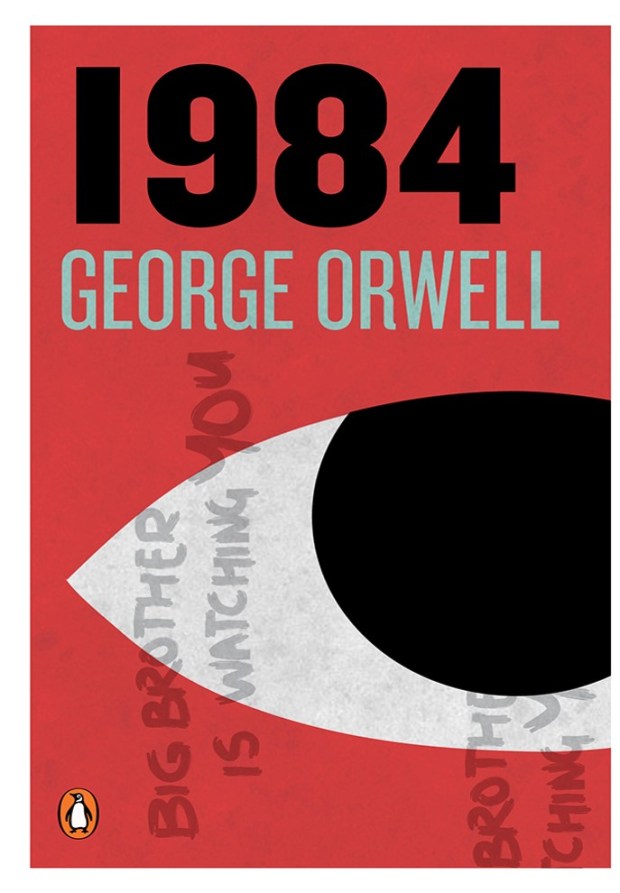
Nineteen Eighty-Four by George Orwell

1984 Book Cover

A while back I had read Animal Farm by George Orwell. I liked the book a lot and even wrote a book review on my blog. I decided to read Orwell’s other famous book ‘1984.’ In Animal Farm, George Orwell narrated about an idealistic revolution gone wrong and a totalitarian regime that arises as an aftermath in an easy to understand form. For people who did not get the message after reading Animal Farm, Orwell has written 1984 with all the gory details. The intensity of the novel was like Earth’s Gravitational Force; I could not prevent my mind from getting sucked into the novel.

Like I wrote in the review on Animal Farm, the brilliance of Orwell stems from the fact that he was able to clearly understand and present to us the pit falls of having a totalitarian regime without proper checks and balances in place. The only thing that he forgot to tell us in either books is that any system, including a democracy, could just be a tool serving only the people in power if there are no proper checks and balances in place. I am not sure if Orwell foresaw and would have written about it, but as the events of the past few years have shown, big business is as dangerous as big government. In a way the term big brother could be used to refer to anyone or any organization with too much of power to influence and control the fortunes of the general public.

For every Edward Snowden who succeeded in exposing the illegal practices of big governments countless many would have failed and would have paid a heavy price for their audacity. For every successful corporate whistle blower, countless many would have been silenced and had their careers ruined. For every media house that fights for the welfare of the people, there are countless many which have become part of the establishment that is oppressing the people. In a way, the protagonist of 1984 is symbolic of face-less, unknown and unsung heroes over the ages who had tried to fight against and change corrupt systems but ultimately got crushed under the weight and the power those very same systems.

A simple blog post would not be enough to narrate the brilliance of George Orwell’s work; Even an entire book would not suffice that purpose. Given the fact George Orwell’s was battling tremendous odds to complete this book, his last one, we would do ourselves a favor if we treat this book not just as a novel but as a ‘sacred text’ that explains the pitfalls of trading off our individual freedom for the sake non-existent stability and security. A few literary gems, nuggets of wisdom, revelations from the book are given below:

  • Nothing was your own except the few centimeters inside your skull
  • It was not by making yourself heard but by staying sane that you carried on the human heritage
  • The consequences of every act are included in the act itself
  • The immediate advantages of falsifying the past were obvious, but the ultimate motives was mysterious
  • The Heresy of heresies was common sense
  • It struck him that in moments of crisis one is never fighting against an external enemy, but always against one’s own body
  • Accepting the party as something unalterable, like the sky
  • In a way, the world-view of the Party imposed itself most successfully on the people incapable of understanding in it – just brilliant.


  • In the long run, a hierarchical society was only possible on the basis of poverty and ignorance
  • The essential act of war is destruction, not necessarily of human lives, but of the products of human labor


  • The consciousness of being at war, and therefore in danger, makes handing-over of all power to a small caste seem the natural, unavoidable condition of survival
  • The aim of the High is to remain where they are. The aim of the Middle is to change places with the High. The aim of the Low……is to abolish all distinctions and create a society in which all men shall be equal
  • No advance in wealth, no softening of manners, no reform or revolution has ever brought human equality a millimeter nearer. From the point of view of the Low, no historic change has ever meant much more than a change in the name of their masters
  • With the development of television, and the technical advance which made it possible to receive and transmit simultaneously on the same instrument, private life came to an end. – The smart phone and the social media are the logical extensions of this phenomenon.
  • It had long been realized that the secure basis for oligarchy is collectivism. Wealth and privilege are most easily defended when they are possessed jointly
  • What can you do against the lunatic who is more intelligent that yourself, who gives your arguments a fair hearing and then simply persists in his lunacy?
  • Power is not a means, it is an end
  • One does not establish a dictatorship in order to safeguard a revolution; one makes the revolution in order to establish the dictatorship.


  • The object of persecution is persecution. The object of torture is torture. The object of power is power.

For all the advancement in science & technology, social sciences, economics and arts in the last hundred years or so, the world of today is much closer to ‘Dystopia’ than ‘Utopia.’ The world of today is a dystopian one where there the focus is on profits and not on people and on earnings per share and not on ecological balance.

I found it every interesting that both in ‘Animal Farm’ as well as in ‘1984’ the ruling class instills the fear about a renegade in general public and uses that fear to safeguard their hold over the public. While the ‘Screen’ mentioned in the book sends out information that not everybody likes, today we all own a Screen (smart phone) which provides us with information (paid news and advertising) that we absolutely adore. Strangely we not only have allowed both big government and big business to snoop on us but have grown to absolutely love the idea (for the sake of a few freebies that we receive in return).

Today the single biggest influence on our lives is not our provincial or national governments but the unified global economic order. Under the influence of the globalization every country is like a conjoined twin with every other country. Free market proponents (read big businesses) have used the free of communism, socialism and the hold of big government to only increase their power and hold over our lives. Just to paraphrase what Orwell wrote in Animal farm, today there is no difference between Big Government and Big Business. They are two sides of the same coin with ‘subjugation of ordinary public’ as their common objective. Today if there is anything that is close to a totalitarian regime, it is the unified global economic order and the hold of capitalism over it.

The Big Businesses have found their ultimate example in the Roman Emperors who provided grand acts in the colosseum for the people to prevent them from thinking for themselves and questioning the emperors’ objectives and actions.  Similarly Big Businesses through their print houses, tabloids, TV channels, movie houses, sports teams are bringing us action and more unwanted and unnecessary action to our cities, our localities, our streets, our living rooms and ultimately to the sacred space in our palms. After exhausting all our time, energy, money and cranial capacity on all these activities, we can hardly think about and act in our own best interests.