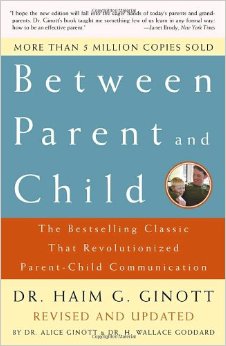
Book Review: ‘Between Parent and Child’ by Dr. Haim G. Ginott

Between Parent and Child.jpg

Of late my wife has been reprimanding me for being hypercritical and harsh with my daughter. Not wanting to get into my way versus your way debate with my wife, I decided to check for myself if my wife’s comments are actually true. Where else would I turn to counsel than my new-found best friends, books? I turned to Amazon search engine to shortlist a book to read on the subject and after a few clicks, I had found ‘Between Parent and Child’ by Dr. Haim G. Ginott, a book first published in 1965 and considered a classic on this subject.

Forget the content of the book, the book could easily called a classic for the number of high impact one-liners in it. Mid-way through the book I completely lost count of the number of one-liners that made me sit up and say wow! The book is concise but thorough and the chapters are short but effective. Most importantly at the end of each chapter I was motivated to read the next chapter. The book proceeds at a rapid pace in dispelling many myths about parenting and parent-child interactions. Overall it’s a very good and delightful book to read and could be an important source to refer back to, from time to time.

Some of my favorite pointers/ observations from the book are:

  1. Don’t be a parent, be a human being who is a parent
  2. Good parents need skill
  3. Communication for connection: Respond to children’s feelings, not their behavior
  4. Behind many childhood questions is the desire for reassurance
  5. Fish swim, birds fly, and people feel
  6. Praise, like penicillin, must not be administered haphazardly
  7. Abusive adjectives, like poisonous arrows, are not to be used against children
  8. Anger, like the common cold, is a recurrent problem. We may not like it, but we cannot ignore it.
  9. The niceties of the art of living cannot be a conveyed with a sledgehammer
  10. Emotions, like rivers, cannot be stopped, only directed
  11. Parents can initiate favorable changes in their child by listening with sensitivity
  12. Discipline, like surgery, requires precision – no random cuts, no careless attacks
  13. Discipline: Permissive of feelings but strict with behavior
  14. When children are punished they resolve to be more careful, not more obedient or responsible
  15. Effective upbringing is based on mutual respect between parent and child without the parent’s abdicating the adult role
  16. It’s desirable that a parent or other caring adult be home to greet children upon their return from school
  17. It hurts to share a parent’s or a spouse’s love
  18. Children do not yearn for equal shares of love: They need to be loved uniquely, not uniformly
  19. Efficiency is the enemy of infancy: Children need opportunities to experiment, struggle, and learn without being rushed or insulted
  20. Children need a clear definition of what is acceptable and what is unacceptable behavior

Even Scavenging Crows Don’t Sell Themselves Short

One of my fondest childhood memories is that of me and my sisters feeding rice to sparrows and crows in the verandah in our grandparent’s house. It’s an age old practice that our grandparents had encouraged us to indulge in and enjoy. These days sighting sparrows in Chennai has become a rarity and finding time in our extra rush-hour life to feed the crows has been difficult. The problem is also aggravated by the fact that it’s very difficult to find a suitable spot to feed the birds in apartment complexes. Nevertheless in the last couple of years I have got into the habit of feeding crows.

The compound wall of our current flat is just an arm’s distance from our kitchen. As a result we place food for the birds on the compound wall from our kitchen. The convenience factor has made it easier to feed the crows. The sound of the crows around breakfast and lunch times also serve as alarm bells that remind me to feed the crows. I hadn’t given it much thought but of late I have started noticing that even crows have foods preferences. The scavenging crows are the last creatures that I would have expected to have preference in meals but they seem to have preferences. Crows prefer non-veg items; that’s a no brainer. They prefer chapatti over rice; that’s a surprise to me. The spot where we place pieces of chapatti will become empty within a few minutes whereas when we place rice it will take a couple of hours to get finished. Crows seem to hate dosas; they are kind of ok with idlis.

This Saturday morning, something even more interesting happened. My wife was not keeping well and my mother was at my sister’s place. I went to kitchen to drink water and on hearing the sound of crows I reached out to the loaf of bread lying on the kitchen table. I pulled a couple of slices of bread and tore them into smaller pieces and placed them at the usual spot on the compound wall where we keep food for the crows. Then I went to wash my hands at the kitchen sink and simultaneously peeked through the window to see what was happening.

Four crows descended on the compound and were shouting loudly. However none of them touched the bread. One of the crows even looked very closely at the bread pieces similar to the way a lab technician would look through a microscope. Even after a couple of hours the bread pieces were still lying on the compound wall.

As I was having my lunch I could not help but wonder about the optimism of those crows. Crows are mostly scavengers eating on left overs, living a kind of rootless existence (in the eyes of a human) with not much guarantee about the next meal. Yet the experience of their life time had taught them to be so optimistic about their immediate future that they were not willing to sell themselves short. Even a lifetime of scavenging has not dented their optimism.

I wish I had the same optimistic outlook about my own life. At so many instances in life I have sold myself short thinking that it was risky to forego what was in front of me. There have been days at a stretch when I had been pessimistic, cynical and grumpy. I have also known of so many people (with the best of education, jobs, health and family condition) who have had the same feeling and would go an extra mile in propagating their pessimism to others as well. And yet here we have bunch of scavenging crows that were more optimistic than people like us and were refusing to sell themselves short. Optimism is not something that you deduce from your immediate environment or situation but something that you inculcate within yourself. Life and Nature are indeed great teachers.

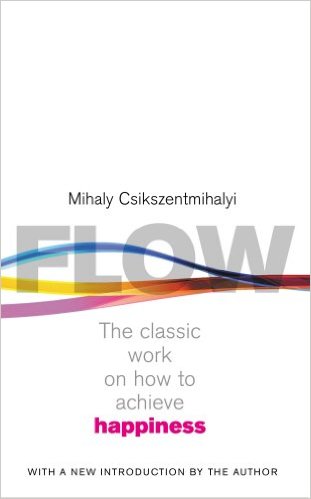
Book Review: ‘Flow: The classic work on how to achieve happiness by Mihaly Csikszentmihalyi’

Flow

If there was one book that was consistently quoted in the books that I read last year, it was ‘Flow: The classic work on how to achieve happiness by Mihaly Csikszentmihalyi.’ So I had this book on my ‘To Read’ list for quite some time. Even after I have finished reading this book, I still have trouble pronouncing the author’s name. The book is also not a breezy read kind of book and it takes a few pages to get used to the author’s style of writing. Some of the words and phrases that I came across in this book are completely new to me. But the concept that the book deals with has had so much appeal that as per the author it has been translated into 14 different languages.

The basic premise of the book is that happiness is not something that happens to a person. The author argues that Happiness is a condition that must be prepared for, cultivated, and defended by each person. This book summarizes decades of research by the author on the positive aspects of human experience — joy, creativity, and the process of total involvement with life that the author describes as Flow. To put it simply Flow is nothing but the state in which people are so involved in an activity that nothing else seems to matter; the experience itself is so enjoyable that people will do it even at great cost, for the sheer sake of doing it.

The author lays out the common characteristics of optimal experience, i.e. Flow: a sense that one’s skills are adequate to cope with the challenges at hand, in a goal-directed, rule-hound action system that provides clear clues as to how well one is performing. The author also addresses through individual chapters on how one can achieve Flow in activities that require physical skill, in intellectual and artistic pursuits, in one’s current vocation as well in interpersonal relationships. Towards the end of the book the author also handles how one can integrate discrete Flow activities in life into one unified Flow experience. It would be worth paying extra attention to the last chapter, ‘The making of Meaning.’

Some of my favorite lines from the book are:

Contrary to what we tend to assume, the normal state of the mind is chaos.

A person can make himself happy, or miserable, regardless of what is actually happening “outside,” just by changing the contents of consciousness.

‘Few things are sadder than encountering a person who knows exactly what he should do, yet cannot muster enough energy to do it.

The reality is that the quality of life does not depend directly on what others think of us or on what we own. The bottom line is, rather, how we feel about ourselves and about what happens to us. To improve life one must improve the quality of experience.

Potentiality does not imply actuality, and quantity does not translate into quality.

Purpose, resolution, and harmony unify life and give it meaning by transforming it into a seamless flow experience.

Overall the book would need extra investment in attention and time but it’s worth the effort. After all the book deals with how any journey can be worth pursuing for its own sake and there is no better place to start following the idea than in reading this very book that espouses the idea. The central idea of the book is so important that following it if not mastering it will greatly enrich our life.