I am posting a few photos that I took over the last week. Photos of common items that could be found in every home.

My daughter’s golf bat and ball

My Spectacles

My daughter’s playing cards
I am posting a few photos that I took over the last week. Photos of common items that could be found in every home.
My daughter’s golf bat and ball
My Spectacles
My daughter’s playing cards
I was watching YouTube videos after a gap of few weeks. I was not planning to share any video here. But, one comment made by the speaker made me share the video here.
The comment is: ‘Eloquent failure is better than boring success.’ Enjoy the video…..
Play lexicographer: Create a new word and explain its meaning and etymology.
When I saw the prompt for today, I thought it would be a good idea to write about a word from India that has found its way into the English dictionary. Even before this thought would vanish from my mind, the word that I am going to write about flashed in my mind’s eye.
The word is Juggernaut (pronounced as ‘Jug-ger-naut’), the word means a mercilessly destructive and unstoppable force. The word has been derived from the Sanskrit word Jagannath meaning ‘lord of the world.’ The word has its roots in the festive chariot carrying ‘Lord Jagannath’ of Puri, Orissa. It is said that once the chariot starts to roll, bringing it a standstill was difficult, almost impossible and often the people would get crushed under the weight of the chariot either voluntarily (as a sacrifice) or involuntarily (due to some freak accident). Hence the English word has come mean an unstoppable force. The word is quite often used in sports a team continues its winning streak unabated (e.g. The Juggernaut of Team India continues).
I missed writing about a personal milestone that fell on January 11, 2015. On January 11, 2015 I completed one full year of becoming a vegetarian (no animal products except milk and derivatives of milk). I never thought I would continue to be a vegetarian for such a long time. This has surprised both me, my family members and close friends as well.
Right from a young age, I was fond of eating non-vegetarian food. The fact that my mother was an expert at cooking and she was always interested in cooking new dishes for us was an added incentive. I was so fond of non-vegetarian food that in the three and half years that I lived in Hyderabad, except on Saturdays on all other days I used to have either Mutton Biryani or Chicken Biryani for lunch and dinner. During that period the concept of eating vegetables and leaves never appealed to me. There is even a saying in my mother tongue Tamil, ‘Konna Pavan, Thinna Pochu’ (If you a kill an animal it’s a sin; but if you eat it, you will be absolved of the sin).
During my college days, the most famous punch dialogue among me and my fellow non-vegetarian friends was, ‘Neenthurathula Submarainayum, Parakurathula Aeroplaneyum thavira maththadhu ellathayum sapiduvom.’ (We would eat everything that swims except the submarine and eat everything that flies except the aero plane). The most famous joke for me and my nephew was, ‘Eating non-vegetarian items is the most efficient way of eating vegetarian items.’
All these were about to change; only that I did not realize the sub-conscious change that was taking place inside me. I lived another three years in Bangalore continuing to be a non-vegetarian. In that period I got married and instead of eating non-vegetarian items in restaurants, I started eating non-vegetarian dishes cooked by my wife. And that’s where the seeds of change were sown. When I was a bachelor, I used to see only the non-vegetarian dishes at restaurants. I did not get to see how these animals were butchered. But when my wife started cooking for me, I had to visit the butchers’ shops at least once a week. There you get to see and experience all the gory details. For one, the live birds would be stored in cages in front of the shops. Every now and then, one of the shop guys would catch hold of few live birds and take them to the back yard. Within a few minutes he will come out with the butchered bird. After seeing these scenes as few dozen times, it became very difficult for me to ignore the fact that I am the reason that a bird had to be butchered that day.
Slowly I was losing the inclination to have non-vegetarian dishes. While earlier I used to give suggestions to my mother and/or wife on what non-vegetarian items to cook on Sundays or other festival days, now I was becoming indifferent to what’s being cooked. For a long time I was thinking about becoming a vegetarian at least for a short period of time. By this time, I had moved back to Chennai. One day as I was riding on my bike, I was about to cross a butcher’s shop when I saw live sheep being delivered to the shop (they were being unloaded from the truck and being pushed into the shop). Suddenly, one of the sheep was trying to escape and was about to run towards the road. One of the shop guys caught hold of the sheep and threw it very forcefully into the sheep. It hit me hard that it was non-vegetarians like me who are incenting butchers like him to throw those poor animals into certain death. Suddenly the statement, ‘I am not killing those animals’ that I used to justify myself seemed far from truth. I started hearing voices in my head: ‘Those animals are being killed to satiate the sadistic taste buds in your tongue. People like you are the reason why those animals are being killed. The foundation of health for your body is ultimate misery and merciless cruelty to animals.’
From here, it was only a matter fact that I give up eating non-vegetarian dishes. I chose January 11, 2014, the day of Vaikunta Ekadesi, an auspicious day for Vaishnavites as the day to discontinue being a non-vegetarians. Initially I was very skeptical that someone like me, who for more than thirty years has enjoyed eating non-vegetarian food could give up on meat, fish, crab, prawn and egg. I thought I’ll try for a brief period only and I was too confident I will not be able to do that itself. But as of today (28th January, 2015) I have not eaten non-vegetarian items not only in their direct form but in indirect forms as well (pastries, biscuits and puddings that contain egg).
While I don’t miss eating non-vegetarian food, there are couple of issues that I have faced quiet frequently. Since I do not eat even egg, I have to read the list of ingredients in packaged foods. Also my favorite bakery does not carry its entire line of pastries in their eggless form. Also when I attend family functions of close relatives, I run into an uncomfortable situation if they serve non-veg food; they feel offended if I say I have become a vegetarian and hence cannot eat non-veg food. I am not sure how long I will be a vegetarian. For now, I am proud and enjoy being a vegetarian.
The Daily Prompt: Free Association
Write down the first words that comes to mind when we say . . .
. . . home.
. . . soil.
. . . rain.
Use those words in the title of your post.
There are so many words that comes to my mind as I think of these three prompts.
Home: Heart, Family, Happiness, Comfort
Soil: Life, Patience, Roots
Rain: Elixir, Joy, Water, Flood
But if I try to associate these three prompts with my life, the word that comes to my mind is, ‘Journey.’ Please continue to read on about my journey.
Like a child eating his favorite candy happily, I was enjoying the pleasant comfort of my home. Years flew like seconds which I could barely acknowledge or recognize. I was jealous of the eagles that were flying, the horses that were running and the fishes that were swimming. But I never made an effort to figure out if I was an eagle or a horse or a fish. Soon enough like a loose soil, I was swept away from home by the winds of change. No goal to pursue and no destination in mind, but yet I continued my journey.
And like a voyager lost in the sea, with every additional step I was more lost than ever. Every time I tried to make a course correction or return, hope triumphed over experience. Years passed and here I was; sometimes stuck on the root of plant or sometime stuck on a rock but always wondering if this is where I wanted to be. But one fine day, there was rain. A rain like nothing this loose soil had seen before. A rain that brought back the loose soil back to where it started from.
It looks like the journey is over. What is most valuable thing that I earned in this journey, is it fortune or fame? Is it love or legacy? It is the ‘experience’ that I gained in pursuit of all these. And in this journey I learned as much about myself as I have learned about this world. A journey with no destination to pursue but which leads to self-awareness is much better than a journey that leads to an intended destination but with no self-awareness.
All human beings are in their own unique life-long journey with no permanent destination. The journey is the only constant thing, all destinations are only temporary. If I look back at my journey so far and have to assign an adjective to it, what would it be? ‘Interesting’. It was an interesting journey. It is an interesting journey and it will continue to remain so in future as well. The journey continues from another temporary destination.
Here is my entry for Cee’s Which Way Photo Challenge: 2015 Week #4. Photograph was taken at Semmozhi Poonga (Classical Language Park), Chennai.
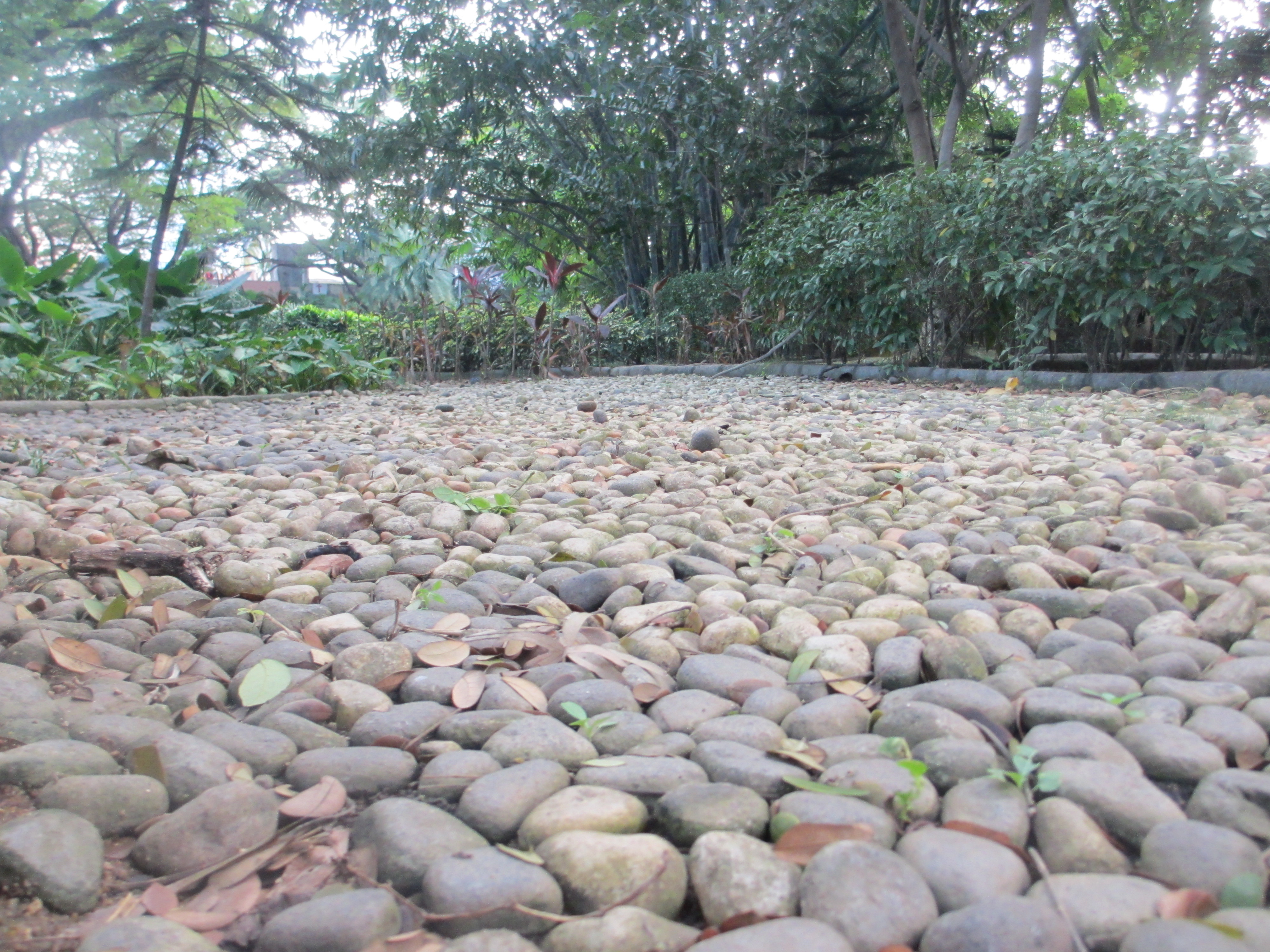
Peebles on a Sidewalk
I had a chance to go to Semmozhi Poonga, Chennai on January 24 with my Nephew. We took a lot of snaps. I am posting some of the snaps that I took.
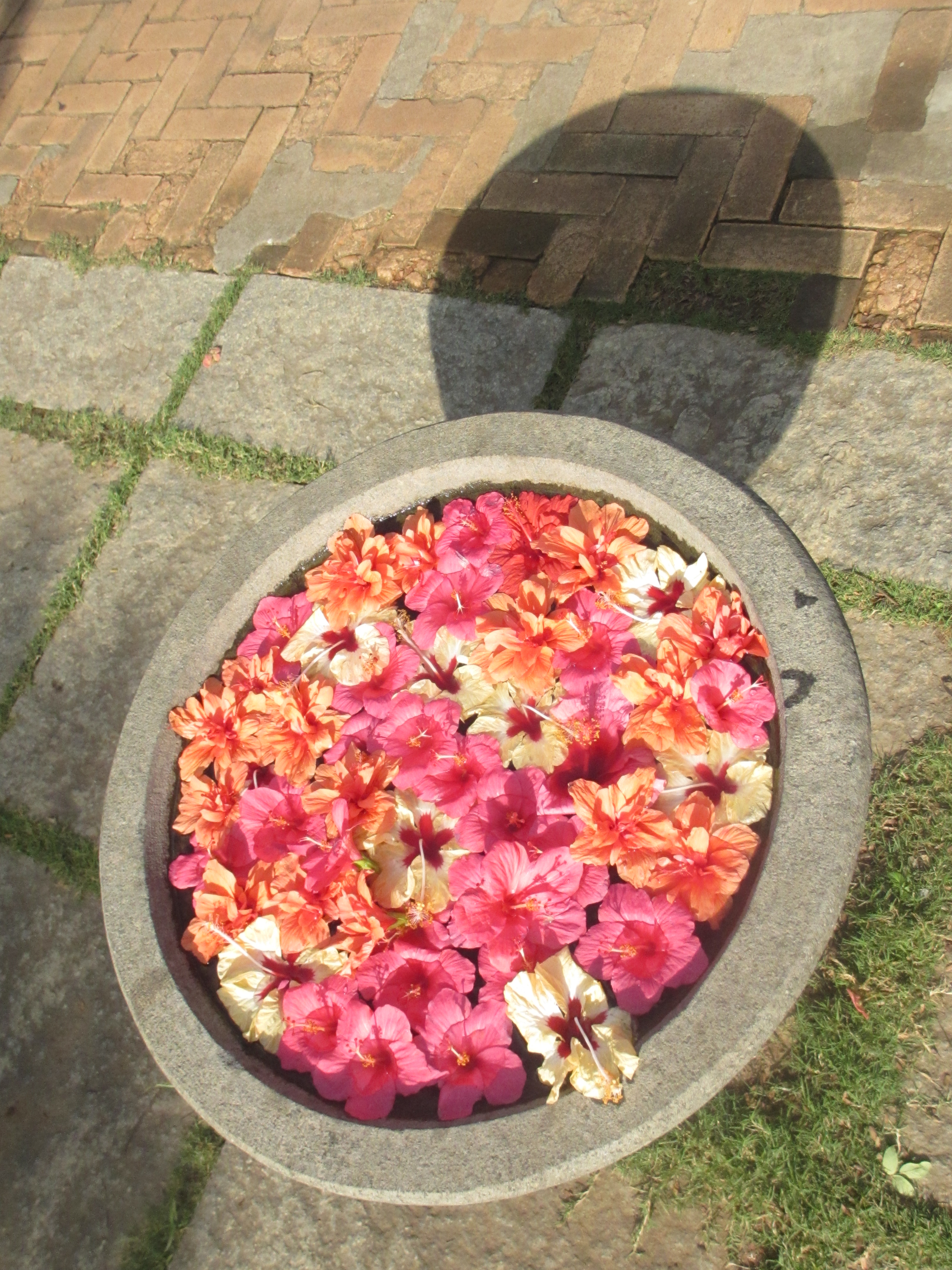
Hibiscus Flowers
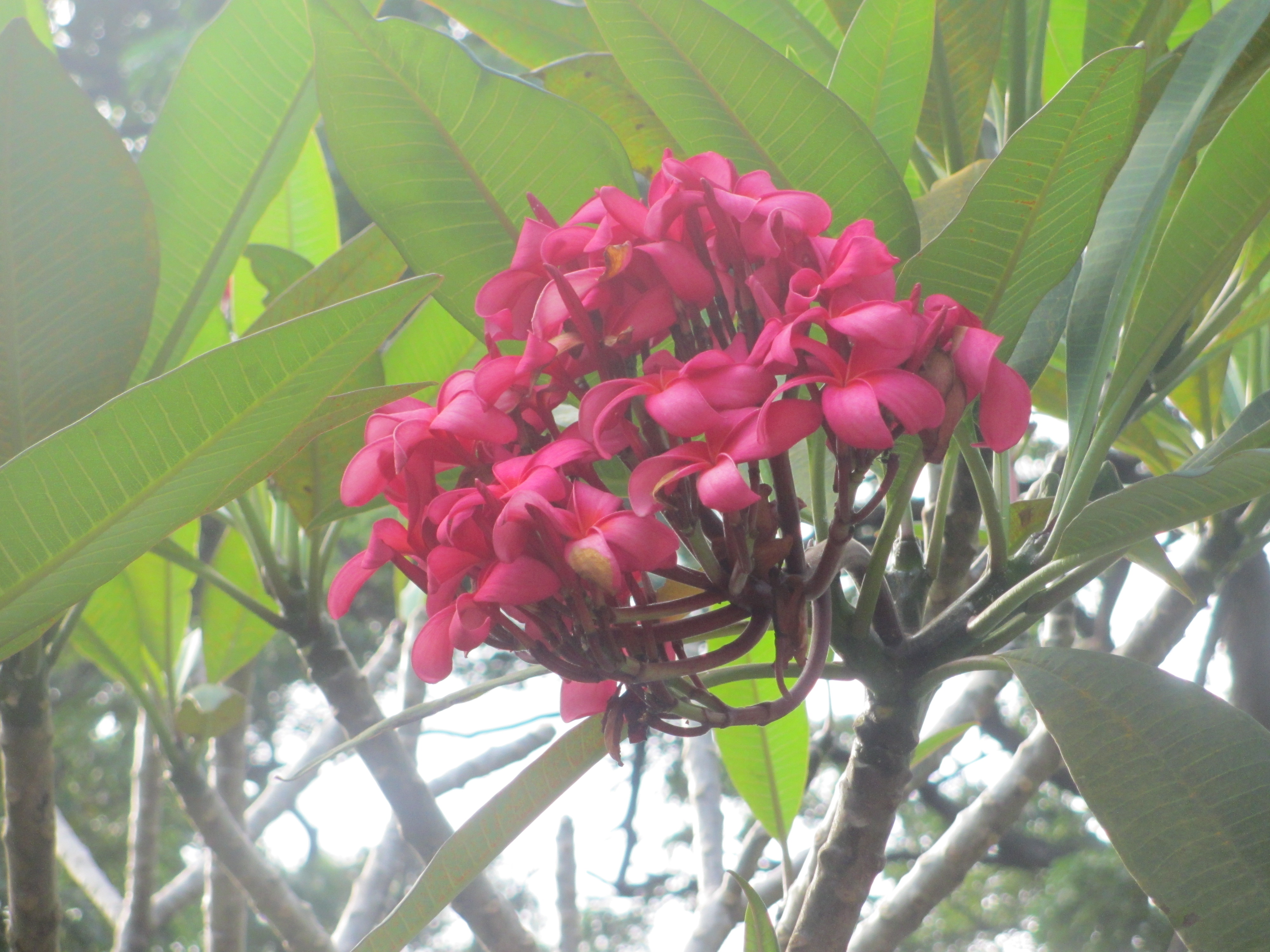
A bunch of flowers

Flowers (Cacti)
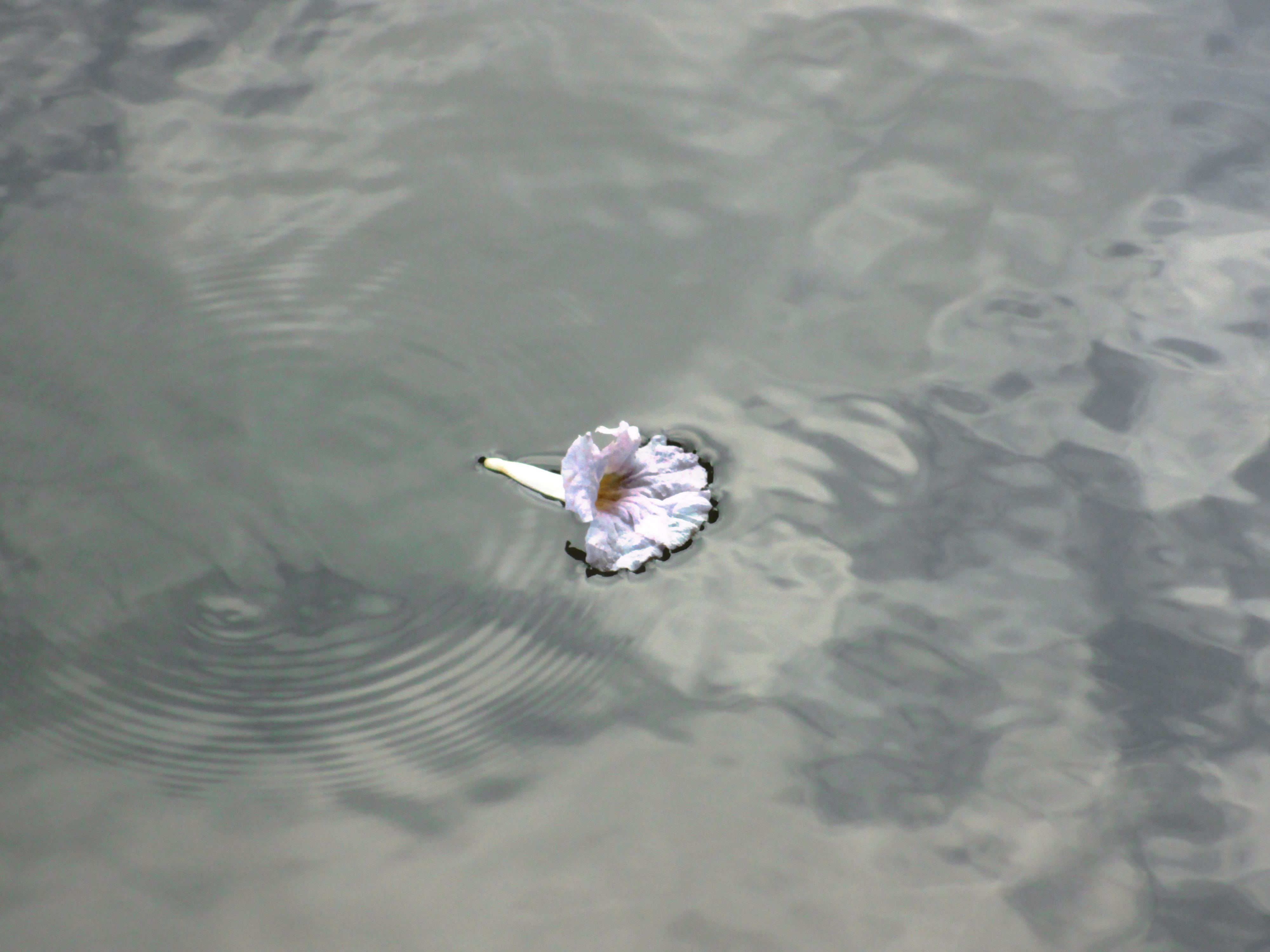
A Flower floating in water

A small sapling on a tree trunk
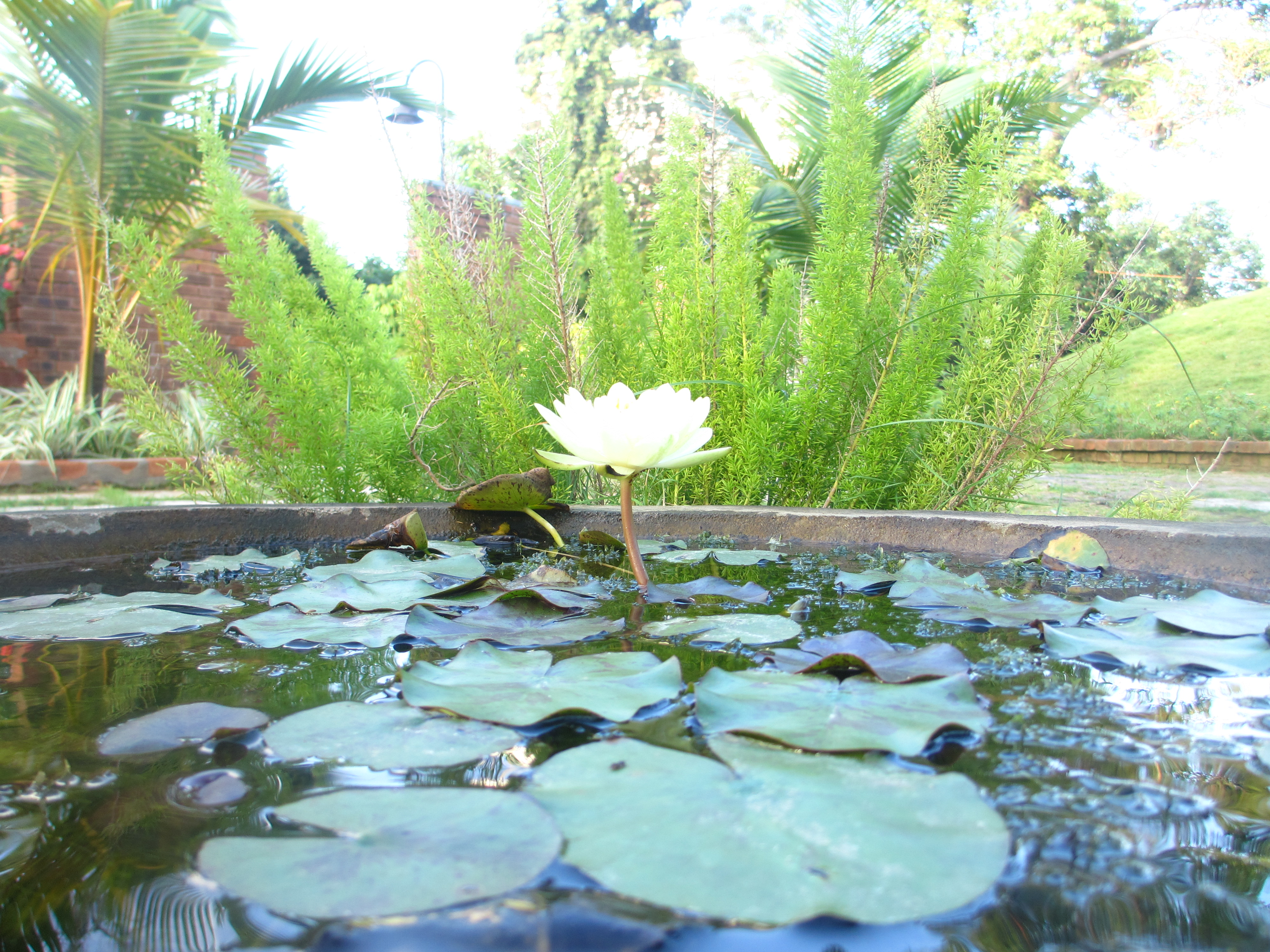
Lotus
The other day when we were having lunch in office, one of my colleagues brought the topic of philanthropic contributions by some of India’s richest men. Apparently a list of top Indian philanthropic contributors had been published recently. It struck me that it could serve as a topic for a blog post. The fact that the Oxfam report was also published around the same time served as an additional fodder for this thought. The institute that had published the report is a Shanghai based company, ‘Hurun Report.’ The company’s website has motto/ tag line: ‘Passionate about Chinese Entrepreneurship.’ The company has published two reports on India’s Ultra-rich towards the end of 2014: ‘Hurun India Rich List 2014’ in September 2014 featuring 230 Indians with a minimum wealth of $300 MN and ‘Hurun India Philanthropy List 2014’ in December 2014 featuring 50 Indians with a minimum contribution of INR 10 Crores (~1.63 MN USD, 1 USD = 61.49 INR and 1 Crore = 10 Millions).
I decided to take the two lists and see how many of the top fifty richest Indian’s have contributed to Philanthropic causes (Taking top 50 richest Indian’s from ‘Hurun India Rich List 2014’ and checking if they are present in ‘Hurun India Philanthropy List 2014’). More importantly I wanted to figure out what proportion of their wealth they have contributed to Philanthropic causes. I had to extend the list to top 53 richest Indians, as there was tie between 4 people at number 49 and at number 53 was N R Narayanamurthy, one of the founders of Infosys, a charismatic business leader and a role model/ inspiration for a lot of youngsters. I have given the details of methodology followed by Hurun Report in notes section at the bottom of the post. The complete list is attached in the form of two pictures with the details of the top 25 in the first picture and the details of the next 28 in the second picture.
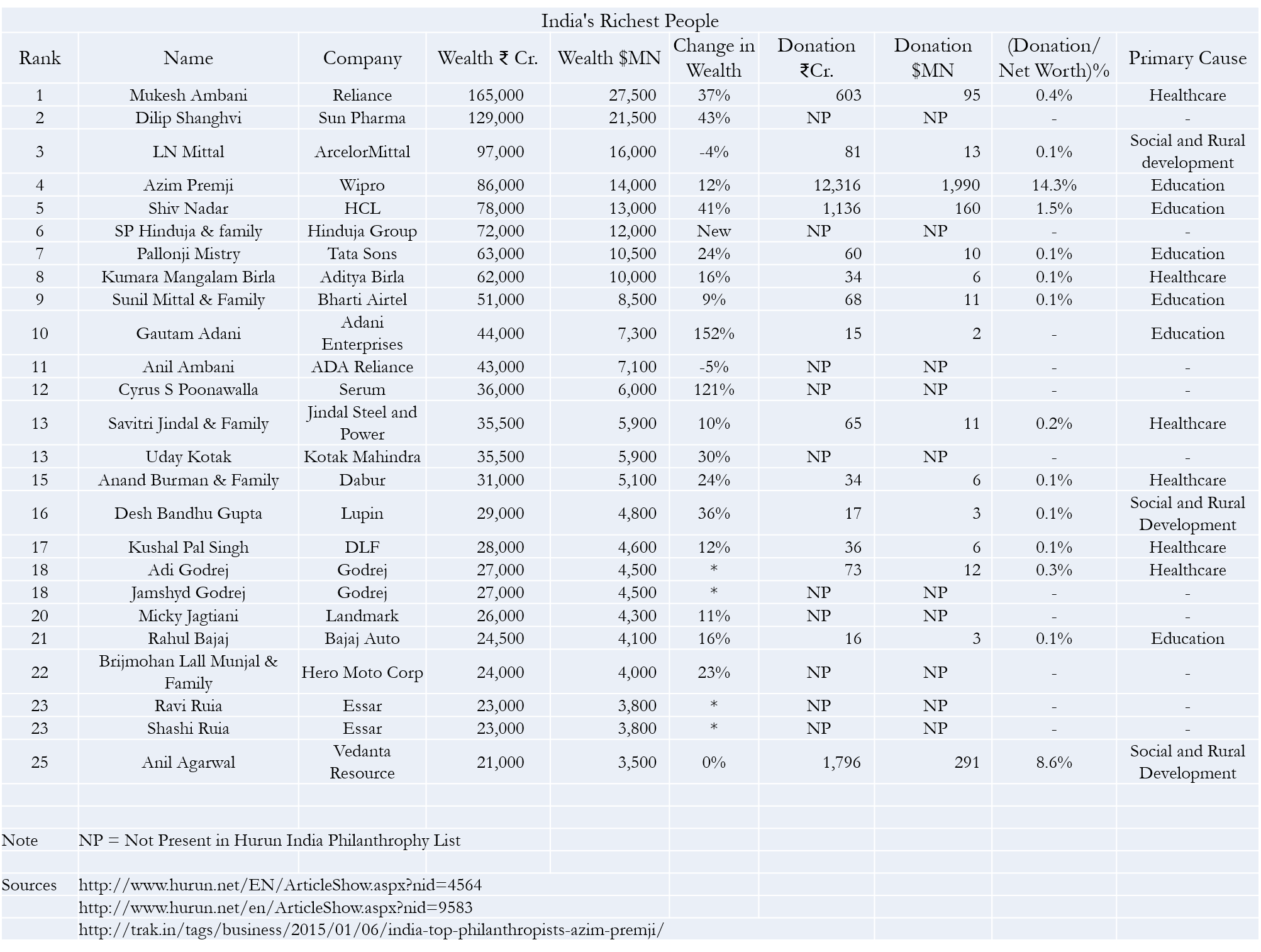
Donations by India’s Top 25 Billionaires
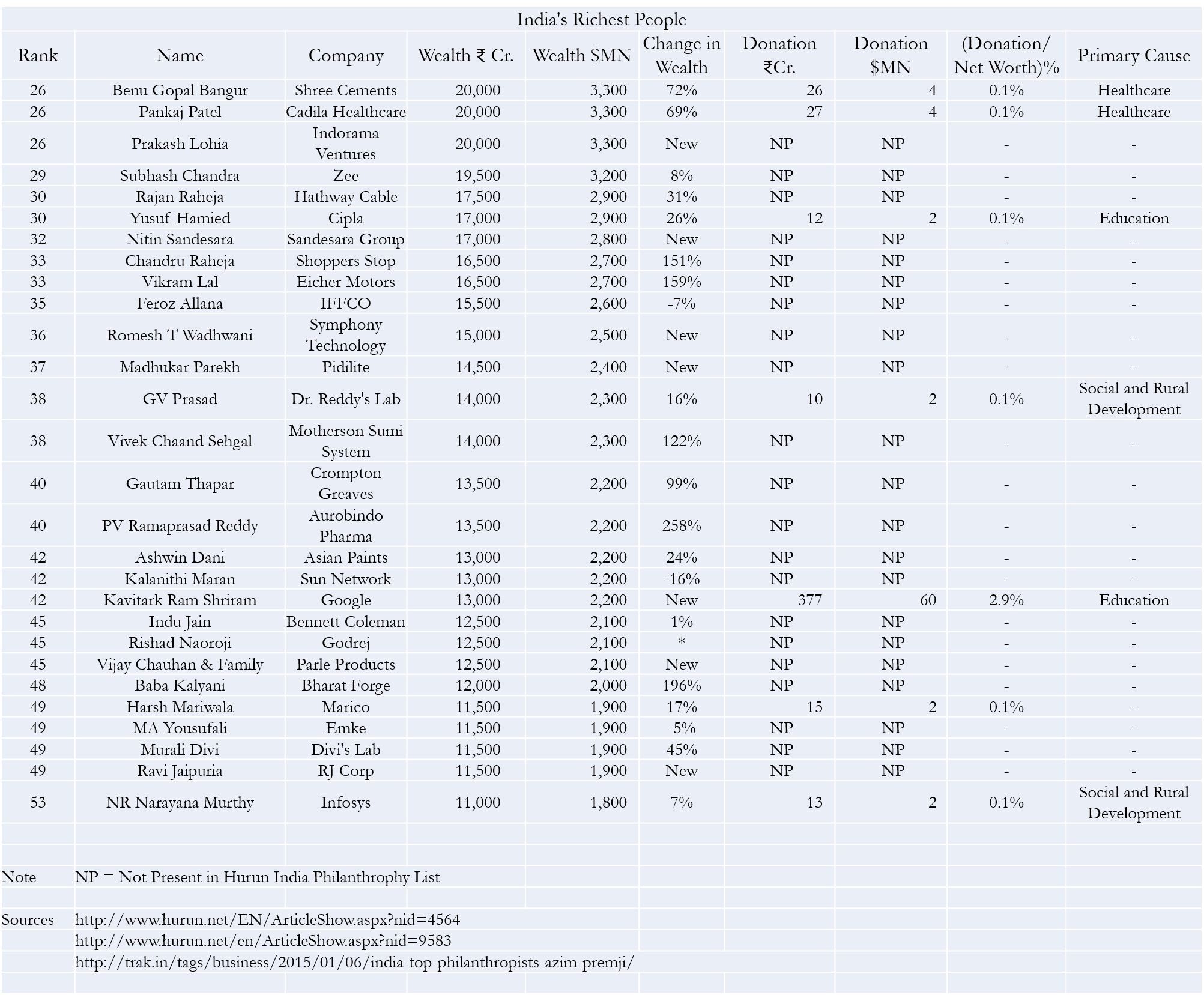
Donations by nest 28 Indian Billionaires
My findings paint a dismal picture about contributions by richest Indians towards charitable causes. Out of the top 53 richest Indians, 32 are not present in the ‘Hurun India Philanthropy List 2014,’ a whopping 60%. Of the remaining only 4 of them have made contributions above 1% of their wealth, an uninspiring 8%. Azim Premji of Wipro Technologies tops the Hurun India Philanthropy List 2014 with donations of $1,990 MN, which amounts to very generous 14.3% of his wealth. Anil Agarwal of Vedanta Resource comes in at a distant second with a contribution of $291 MN, which however translates to an impressive 8.6% of his wealth. Kavitark Ram Shriram, a board member of Google and Shiv Nadar of HCL Technologies come in at number three and number four with contributions of 2.9% and 1.5% of their wealth respectively.
India’s richest man Mukesh Ambani of Reliance Industries has only donated 0.4% of his wealth to charitable causes in the assessment period. This is in stark contrast with China where the country’s richest man Jack Ma of Alibaba has donated an impressive 9.6% of his wealth towards charitable causes and the U.S. where the world’s richest man Bill Gates of Microsoft has (been estimated to have) contributed (life time contribution) of about 38% of wealth (as per 2013 article by Forbes).
While researching for this blog post I came across other interesting articles on India’s Ultra-rich. According to a Credit Suisse report, ‘India is home to 11th largest population of Ultra High Net Worth Individuals, but also figures among countries with “very high wealth inequality” with a large number of its residents being in the lower wealth strata.’
In his October 2012 blog post in The New York Times, Vivek Dehejia has made some interesting observations quoting a study economists Aditi Gandhi and Michael Walton: ‘The other important finding emerging from Ms. Gandhi and Mr. Walton’s research is that 43 percent of India’s billionaires came from sectors that the researchers classify as “rent-thick,” that is, those enjoying what economists would consider above-normal profits because the companies possess certain privileges. The Forbes list of richest Indians, released last week (in 2012), is full of businessmen and women from “rent-thick” sectors: real estate, construction, infrastructure, media, cement and mining. These are sectors in which the government continues to play a large role, in the form of licenses and other forms of control, and in which there’s a presumption of a government-business nexus – or collusion, to use a less flattering term, according to Ms. Gandhi and Mr. Walton.
There is some heartening news, though, in the study by Ms. Gandhi and Mr. Walton. According to their analysis, the majority of Indian billionaires are “self-made,” and around 40 percent represent wealth that is “inherited and growing,” like the Ambani brothers, Mukesh and Anil, sons of the late Dhirubhai Ambani, founder of the family business empire. According to research, there is a positive correlation between economic growth and the wealth of self-made billionaires, while there is a negative correlation between growth and inherited wealth. It’s impossible to establish a conclusive cause-and-effect relationship, but the finding is at least suggestive of the fact that economies populated by those whose wealth is self-made are more dynamic than those that rely on the perpetuation of existing economic elites and their descendants.’
An October 2014 article in Forbes notes that only four Indians had thus far signed The Giving Pledge, a campaign (initiated by Warren Buffett and Bill Gates in 2010) to encourage the wealthiest people in the world to make a commitment to give most of their wealth to philanthropic causes. Out of the four only Azim Premji is based in India. The other three (Vinod Khosla, Manoj Bhargava and Romesh Wadhwani) are Indian-Americans. A study by economists from the University of Southampton who performed an analysis of the pledgers’ letters to The Giving Pledge has found that billionaires who have built their own fortunes are more likely to pledge to donate a large portion of their wealth to charities, than those who are heirs to family fortunes. This doesn’t augur well for Indian Philanthropic scene since some of the most well-known ultra-rich in India have inherited their wealth. To close this blog I will leave with a video of an interview by Warren Buffet and Bill Gates on Philanthropy. To quote Warren Buffet from the video: ‘A Philanthropic family on balance is going to feel better about themselves and their progeny than the family who has been hanging on to every single penny.’
Note:
Hurun India Rich List 2014: ‘A list of the richest people in India with a cut-off of INR 1,800 Crores. Wealth calculations are a snapshot of 3 September 2014 when the rate of exchange to the US dollar was INR 60.33.’
Hurun India Philanthropy List 2014: ‘Donations were measured by the value of the cash or cash equivalent from 1 April 2013 to 31 October 2014.’
About a couple of days ago I came across a news article and a blog post that serve as the inspiration for this post. The news article is by non-profit organization Oxfam and it says that the richest 1% of the world is most likely to control 50% of global wealth by 2016. The report is interestingly titled: ‘WEALTH: HAVING IT ALL AND WANTING MORE.’ The executive summary of the report reads:
‘Global wealth is increasingly being concentrated in the hands of a small wealthy elite. These wealthy individuals have generated and sustained their vast riches through their interests and activities in a few important economic sectors, including finance and pharmaceuticals/healthcare. Companies from these sectors spend millions of dollars every year on lobbying to create a policy environment that protects and enhances their interests further. The most prolific lobbying activities in the US are on budget and tax issues; public resources that should be directed to benefit the whole population, rather than reflect the interests of powerful lobbyists.’
One key finding of the report caught my eye: ‘The very richest of the top 1%, the billionaires on the Forbes list, have seen their wealth accumulate even faster over this period. In 2010, the richest 80 people in the world had a net wealth of $1.3tn. By 2014, the 80 people who top the Forbes rich list had a collective wealth of $1.9tn; an increase of $600bn in just 4 years, or 50% in nominal terms. Meanwhile, between 2002 and 2010 the total wealth of the poorest half of the world in current US$ had been increasing more or less at the same rate as that of billionaires; however since 2010, it has been decreasing over this time.’ It seems to me that the global recession and country specific recessions since 2008 have not had much impact on the wealth of the global superrich. Another interesting information from the report: ‘In 2010, it took 388 billionaires to equal the wealth of the bottom half of the world’s population; by 2014, the figure had fallen to just 80 billionaires.’ The wealthy are getting wealthier by the day.
The report also finds that, ‘Companies from the finance and pharmaceutical sectors spent millions of dollars in 2013 on lobbying.’ All these lobbying has resulted in favorable results for the companies in these sectors at the expense of tax payers. Again to quote from the report: ‘While the financial sector has recovered well as a result of this bailout, median income levels in the USA are yet to return to their pre-crisis levels. The ongoing cost to the tax payer for “systematically important financial institutions‟ – in other words those that are too big to fail – has been estimated by the IMF to be $83bn every year.’ The report goes on to say, ‘In the US, the two issues which most lobbying is reported against are the federal budget and appropriations and taxes. These are the public’s resources, which companies are aiming to directly influence for their own benefit, using their substantial cash resources. Lobbying on tax issues in particular can directly undermine public interests, where a reduction in the tax burden to companies results in less money for delivering essential public services.’
Another interesting observation from the report: ‘The three pharmaceutical companies (GSK, Johnson & Johnson and Novartis) that are members of the International Federation of Pharmaceutical Manufacturers & Associations (IFPMA) have made the largest contribution to the Ebola relief effort, have collectively donated more than $3m in cash and medical products. But the amount of money that has been spent on Ebola and other activities that have a broader benefit to society needs to be looked at in the context of their expenditure on corporate lobbying to influence for their own interests. These three companies together spent more than $18m on lobbying activities in the US during 2013.’ Did I read that right: $18 MN for lobbying in U.S. but only $3MN to fight Ebola, a disease that was killing roughly 1 in 2 of the infected people in the current outbreak?
Some of the remedies suggested by Oxfam to alleviate such extreme inequality include:
I was interested in looking at examples of difference in tax rates between the wealthy and the rest when I ran into a videos in which none other than Warren Buffett, one of richest men in the world, had claimed in 2007 (if I’m not wrong) that he is taxed at a lower rate than people who work for him!!!
Looks like things have not changed since then, a proof for which I came in the blog post ‘The Taxman Cometh’ by ‘I Pledge a Fallegiance’. He quotes the Institute on Taxation and Economic Policy study on taxation in the United States that finds that: ‘in 2015 the poorest fifth of Americans will pay on average 10.9 percent of their income in state and local taxes, the middle fifth will pay 9.4 percent and the top 1 percent will average 5.4 percent.’ The author concludes that: ‘It seems that States and localities have regressive tax systems because they tend to rely more on sales and excise taxes (fees tacked onto items like gas, liquor and cigarettes), which are the same rate for rich and poor alike. Even property taxes, which account for much of local tax revenue, hit working- and middle-class families harder than the wealthy because their homes often represent their largest asset.’ All this makes the author conclude: ‘poverty is a waste product of wealth.’
Years ago when I was chatting with some of MBA batch mates, one of them said that USA has made an important contribution to mankind by introducing the concept of wealth creation to the world. He said that because of this contribution by USA, accumulation of wealth is no more a zero-sum game and one person does not have to plunder another person to increase his wealth. He claimed that this concept of ‘wealth creation’ is the fairest system possible. Looking at the findings of Oxfam and the Institute on Taxation and Economic Policy, it doesn’t look the current world’s approach to wealth creation is fair by any yardstick.
I have always found it interesting that the government would let corporations to deduct their expenses first and then levy income tax on what is left of their revenue but would not follow the same taxation approach when it comes to individual tax payers. Clearly just like in a corporation, some of the expenses for an individual are also mandatory/ inevitable. So shouldn’t they be deducted first before levying any income tax? I am starting to wonder if transaction taxes would be a fairer taxation system (on the common man) than income taxes.
Everything made Art.
The goal of this blog is to create a list of super facts. Important facts that are true with very high certainty and yet surprising, misunderstood, or disputed by many. This blog aims to be challenging, educational, and fun, without it being clickbait. I determine veracity using evidence, data from reputable sources and longstanding scientific consensus. Prepare to be challenged (I am). Intentionally seek the truth not confirmation of your belief.
The musings and ramblings of a young poet.
Rhymes and Reasons for Every Season
words. hearts. humidity.
The Life & Ramblings Of A Zillennial
welcome to my paradoxes
where wellness meets authenticity.
Just Inked Thoughts- Poems, Quotes, and Reflections
Here's To Express.. :)
THIS SITE IS ABOUT ME, MY CREATIVITY, MY IMAGINATION AND MY FEELINGS.
Hi! my name is Sebastian (You can call me Seb!) ...welcome to my Blog. I'm a photographer from Worcester, Worcestershire, England. Thanks for dropping by! I hope you enjoy my work.
Open Your Mind
Epic fantasy & military sci-fi author.
An Independent Nondiscriminatory Platform With No Religious, Political, Financial, or Social Affiliations - FOUNDED 2014
Living slowly, adventuring often ✨️
Connecting Inner voice to External World
Gray clouds trail across the sky. In the pale winter sun a flock of geese (Ben Grafström--Akita, Japan)
This is Your Quest - Your Mission to Find Happiness
Tip Shack generates inspiring, positive, informative, entertaining and useful tips & guide, covering fast and fun gastronomy, movies, entertainment, sports, beauty, news, relationships and technology.
Climbing, Outdoors, Life!
Challenging and Supporting People to do the Most Important Work of their Lives
A Journey Through the Looking Glass - Views Expressed Are My Own





 Yogi's Blogosmos