Seeing in Others What They Can’t See in Themselves

Very Inspiring Post by Lynne Strang (https://wordpress.com/read/blog/id/18642940/). Read it and also watch the YouTube video in the post. Feel inspired and Have a Great Day.

Lynne Strang's avatarLate Blooming Entrepreneurs

If you’ve been reading this blog for a while, you might remember this post about entrepreneur Len Forkas’ experience as a solo competitor in the 2012 Race Across America — a grueling, 3,000-mile bicycle race that starts in California and ends in Maryland. At age 52, Len finished in less than 12 days, placing first in his age group and tenth overall. Best of all, he raised over $300,000 for Hopecam, his nonprofit that uses technology to connect young cancer patients with their friends at school.

Earlier this year, Len published What Spins the Wheel, a book that describes his journey and lists ten lessons he learned during the race. Lesson #8 is to “See in Others What They Can’t See in Themselves.” By doing so, “we can inspire people to achieve more than they ever thought possible,” he wrote.

That lesson came to mind when I watched Dananjaya Hettiarachchi’s winning performance in Toastmasters International’s 2014 World Championship of Public Speaking. Over six months, Hettiarachchi…

View original post 36 more words

Two different worlds on either side of the light house

On 7th November by chance I landed up (10th floor of the building) at the light house in Chennai. I started with the intention of taking my wife and daughter to visit the grand banyan tree inside the Theosophical society garden at Adyar, Chennai. We reached there at 4.30 PM only to be told that entry is closed at 4 PM. I wanted to visit a place that all three of us have not visited so far and decided to visit the light house. Chennai’s light house was reopened to public after 22 years on November 14, 2013. There is a light house museum at the ground floor, where I learned that this one is the fourth light house in Chennai and Chennai has had a light house since 1976. On display were a few photographs of Chennai Beach and Harbor from the by-gone eras. Also on display were vintage lighting equipment.

We reached the 10th floor viewing bay through a lift (A pleasant surprise for me as I was thinking we will have to climb by staircase). It was quite windy at the viewing bay. People were very busy taking snaps and selfies rather viewing below. The view from the top was nice. Somehow everything below looked beautiful from the viewing bay (even areas that looked otherwise from the ground).

While we enjoyed the trip to the light house, as I recollect what I saw from the viewing bay, the light house almost served as a dividing line for two social strata. To the left of the light house were splendid government buildings, government colleges, the beach front that serves as a recreational area for the city and Chennai’s harbor. When one looks at this side, one gets the picture of vibrant, progressive and affluent city. The traffic through the beach road was moving both swiftly and in an orderly fashion. As you look towards the right side of the light house you get a completely different picture. On this side you see multi-storey buildings housing some of the poorest in Chennai and the buildings were badly in need of repair. There were boats of fishermen on the beachside. The traffic on the road adjoining the buildings on this side was moving rather chaotically.

As I think about this contrasting picture both residing within a radius of a few kilometers, I am reminded of the comment made by one my professors in our MBA class. He said “We can’t afford to have islets of prosperity in an ocean of poverty. Soon the ocean of poverty will start engulfing these islets of prosperity through social unrest.” I am sure my professor was not talking about socialism. He was referring social progress. True social progress for the masses is only possible through good education followed by employment. Unfortunately in the last few years, the short term mentality of the voting public and vote-bank politics by politicians has ensured that government money is spent in doling out freebies rather than being invested in education and employment generation.

Worth a Watch: Life finds a Way

I came across this TED talk by Ramanan Laxminarayan (Center for Disease Dynamics, Economics & Policy) titled, ‘The coming crisis in antibiotics.’ Definitely worth a watch. The Issue: Bacteria are becoming resistant to Antibiotics. The Key Message: Life find a way. It’s not only a problem in Antibiotics, but we are seeing this issue in multiple areas: including drug resistant tuberculosis, resistance developed by viruses and agricultural pests, etc. There are number of ideas discussed on how to handle the issue with ideas drawn from the energy sector. Definitely a relevant topic for this year and a very important topic that everyone including government, doctors, pharmaceutical companies and the general public should plan and execute for the long term well being on the human race.

Lousy Customer Service and Laudable Customer Response

4

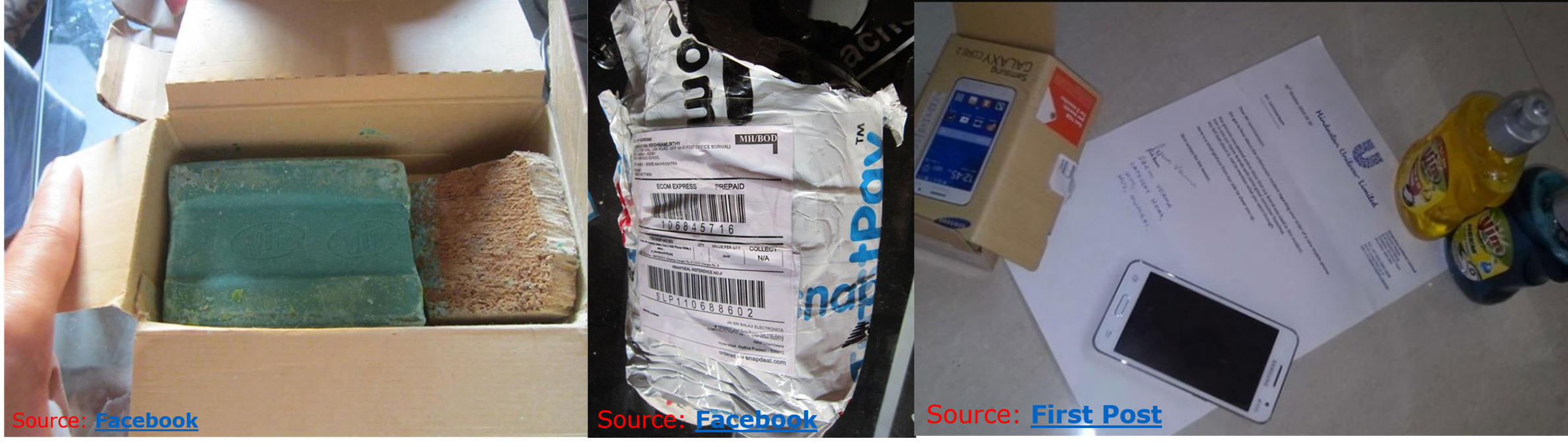
Laxminarayan Krishnamurthy from Mumbai (India) ordered a Samsung Core Duo mobile on Snapdeal to gift it to his wife for Diwali during the Snapdeal Diwali bumper sale this year. He got shocker when he received the courier. Instead of brand new Samsung Core Duo, the box contained a Vim dish wash bar and brick. Mr. Murthy in addition to complaining with Snapdeal posted about his experience on Facebook. His story got nearly 19,000 shares. It so happened that one of the executives at Hindustan Unilever (HUL) which owns the Vim brand saw Mr.Murthy’s post and decided to delight Mr. Murthy with a surprise. HUL sent Mr. Murthy a Samsung mobile phone along with two bottles of Vim Liquid and letter with the following message, “The pictures you posted online show that our brand was used in this incident. Vim is one of our iconic brands with some great consumer franchise. We felt bad about it, not to mention what you went through. Here is a small gesture from our side to cheer you up.” Snapdeal on its part, to avoid further bad publicity apologized to Mr. Murthy and returned his money. They also told him that the courier service that they used was at fault. While Snapdeal missed an opportunity to provide a good customer experience, HUL, though there was not fault on its part decided to step in and delight Mr. Murthy with its kind gesture.

Talking of customer response to lousy customer service, I am reminded of the singer/ songwriter Dave Carroll based in Halifax, Nova Scotia, Canada. In 2008 Dave was flying by United Airlines from Halifax, Nova Scotia to Omaha, Nebraska, with a layover at Chicago’s O’Hare airport. Dave’s $3500 Taylor guitar was damaged due to poor handling by United Airline’s baggage handlers at Chicago’s O’Hare airport. However Dave’s complaints to United Airlines fell in deaf ears and they were unapologetic. Dave tried for nine months running from pillar to post to get the refund for at least the cost of the repair ($1800). Having been fed up with United Airlines, he decided to write a song and produce a music video and aptly named it, ‘United Breaks Guitars.’ He posted the song on YouTube (on July 6, 2009) and it became an instant YouTube hit garnering about 5 million hits by mid-august 2009. What a PR disaster for United Airlines for ignoring one customer on one flight journey. United Breaks Guitars won the 2009 Music Nova Scotia Video of the Year Award and Dave Carroll was awarded the 2009 Music Nova Scotia Digital Artist of the Year. Dave did not stop with that. He produced two more videos, “United Breaks Guitars Song 2” and “United Breaks Guitars Song 3.” The three songs together have received around 17 million views on YouTube (as of today). That’s 17 million bad publicity instances for United Airlines. In May 2012, Dave also went on to publish a book, “United Breaks Guitars: The Power of One Voice in the Age of Social Media.”

When I personally had bad experiences (twice) with Airtel Digital TV, I wrote mails directly to Airtel Digital TV’s CEOs. I had to struggle for about an hour (each time) on the internet to find out the email addresses of the CEOs but got the issue resolved. In the both the instances I received calls from the head of their service department the very next day but for some strange reasons they took more than a week to actually resolve the issue. Guess I should have posted my complaint on Social Media.

The Story of Arjun Santhosh Kumar

Today I came across the story of Arjun Santhosh Kumar, Founder and CEO of LateraLogics, a tech startup based out of Chennai, India. How is Arjun’s story unique? Arjun is just fourteen years of age and is class nine (ninth standard) student of Velammal Vidhyashram, Chennai. On Children’s Day (November 14th) this year he will become one of the recipient of the National Child Award for Exceptional Achievement in New Delhi instituted by the Ministry of Women and Child Development (WCD), Government of India. The motto of his company is ‘Great Solutions come from Small Problems‘.

The first Android app that he developed ‘Ez School Bus Locator’ won the first prize (K-8 Category) in the Massachusetts Institute of Technology (MIT)’s App Inventor App Contest (2013). Arjun then went on to develop another Android phone ‘iSafeGuard’, a women & teen safety app. As quoted in ‘The Hindu’, Arjun recollects that he got the idea for developing the ‘Ez School Bus Locator’ after his parents got worried when it took him time to return home on a rainy evening. Arjun developed both his apps using MIT’s App Inventor tool, an open source blocks-based programming tool used to program and build fully functional apps for Android devices. So far his story has been covered by several newspapers and magazines including ‘The Hindu’, India Today, NDTV, The Times of India, etc.

Arjun’s very first post on LinkedIn is interestingly titled, ‘Why Can’t Entrepreneurship be Part of School Curriculum?’. An even better question to ask would be ‘Why can’t Indian Schools develop many such Entrepreneurs?’ In response to the comment for his article Arjun has responded, “Couldn’t agree more that our schooling system should foster innovation and creativity among students in place of ‘uniformity’ (am a big follower of Sir Ken Robinson).” Congratulations to our young innovator and entrepreneur Arjun and best wishes for his entrepreneurial journey.

How a working professional in her med-twenties continues to remain a 14 year old school girl in social media

Yesterday (November 4, 2014) as I was going through my LinkedIn page looking for updates from my connections, I came across a post that was liked by one of my connections. It read “Remya Jose a 14 year old girl from India invented this pedal operated washing machine. It requires no electricity and using it also gives you exercise. She won a national award for this.” Without even thinking further, I too pressed the like button (The post had around 1900 likes at that time). But the update did not have any working link to take me to a website/ newspaper article featuring Remya’s story. So I went to Google to look for newspaper coverage of Remya’s innovation. I got a list of links featuring Remya’s story; the one that interested me was Google Book’s link to “India: Land of a Billion Entrepreneurs by Upendra Kachru.’ I checked the details of the book to figure out that the book has been published in 2011. On seeing this publication year I get the natural suspicion that Remya’s story is 3 years old. Or is it just three years old story?

I started reading through the page that featured Remya’s story. Almost the entire page 46 chronicles Remya’s innovation. But one sentence towards the end of the page caught my attention: “Her innovation was featured in Oulook magazine in 2005.” Oh My God! This story is nine years old. Remya, who is by now in her mid-twenties still continues to remain a 14 year old school girl in our social media. I was curious about what happened to Remya and what happened to her innovation. I was also curious to figure out why a story which is probably nine years old is currently making rounds in LinkedIn and other social media sites. As I could not remember seeing any pedal operated washing machines in stores, I decided look on the World Wide Web to figure out what had actually happened.

A little bit of background on Remya and her story: Remya’s family hails from Keezhattur Village in Malappuram district of Kerala, India. In 2002/ 2003 timeframe when Remya was a fourteen year old school student she developed the ‘pedal operated washing machine.’ The tough family circumstances under which Remya designed and developed the pedal operated washing machine (with the help of her father and other well-wishers) is truly inspiring. The benefits of the washing machine are it does not require electricity and cycling would help the person to stay fit. Remya’s innovation was found out by SRISTI (Honey Bee Network), a non-governmental organization set up to strengthen the creativity of grassroots inventors, innovators and ecopreneurs. Eventually through National Innovation Foundation (NIF), Remya’s work got coverage in Outlook magazine, Discovery channel and NDTV. In 2003, with support from NIF, she acquired the national patent for her machine. In 2005 she won the award for the best innovation among 25,000 entries at the NIF’s Third National Grassroots Technological Innovations and Traditional Knowledge competition. The 2005 article in Outlook goes on to state that, “if the washing machine patent is accepted, she hopes she will have enough funds to pursue an electronics engineering degree in a reputed college.

So far so good. I was still not coming across articles about whether Remya was able to successfully commercialize her innovation. As I kept searching, I ran into a blog post by Rahul Brown on ‘India’s National Innovation Foundation and Honeybee Network’, dated May 23 2008. Rahul Brown states that though NIF helped Remya patent her intellectual property, the redesigned washing machine by NIF went on to cost Rs. 3,000 compared to the original Rs. 1,500 for Remya’s initial design thus making it unattractive against low end electric washing machines available in India at that time. Also NIF’s licensing agreement with Remya introduced another layer of cost into the final price of the washing machine. Rahul goes on to argue that NIF’s processes might in a way be detrimental to the wide spread commercialization of the very grass-root innovations that they are trying to promote. By Rahul’s account, looks like the ‘Pedal Operated Washing Machine’ did not have huge commercial success.

So what happened to the young innovator Remya Jose? Remya eventually went on to be an engineering graduate. An April 16, 2010 article from India Today provides a very grim picture. Quoted from India Today, ‘Though she received much acclaim for her invention, there weren’t many takers for it as it wasn’t considered commercially viable. She has gone to the UAE now with her uncle to look for a job. Showing the bundle of certificates and prizes Jose has won during her student days for various innovations, her father Joseph laments; “What’s the use of all this if she cannot find a decent job in her country?” India needs to answer this disappointed father.’ I felt very sad on reading this: Is this a story of a teenage innovator whose hopes were dashed?

I continued my search on the web to find out what Remya is currently doing. I landed on Remya Jose’s page on INKtalks where she is listed as a fellow and serial innovator (hurray!!!). The page stated that, ‘Remya works at National Innovation Foundation, Ahmedabad, and is responsible for many other innovations.’ I checked NIF’s site but could not find Remya’s profile as an employee, though I was able to see details of her innovation. I once again started searching on the internet on where Remya is currently working and landed on this LinkedIn profile of Remya Jose. Remya works in UAE as a project coordinator with Petrofac. The profile does not list her roots from Kerala, India (School or College). So, is this Remya Jose of that I was looking for? I could not figure out from the photograph. I am assuming this is our teenage innovator based on these three facts from the LinkedIn profile page: 1. Remya is working in UAE (her father said she went to UAE to look for jobs), 2. Between 2010 and 2012, a stint with National Innovation Foundation (NIF) as research engineer (INKtalks profile stated that she worked with NIF) and 3. Most important of all, a mention about her ‘Washing Cum Exercise Machine’ on the profile page.

I am not sure whether to be happy that Remya is working in a reputed company abroad or be sad about the fact that a young innovator from India who could have gone on to become a successful entrepreneur in India itself, is working in another country. So much has happened in Remya’s life and to her innovation (listen to what she wants to become and what her father wanted to do with the money from commercializing this product) since 2005 when her story stated appearing in Indian media and yet only in November 2014, a lot of Urban Indians (through social media) are feeling happy about a 14 year old girl who invented a pedal operated washing machine and won a national award for it. Incidentally the washing machine on this Facebook page is slightly different from the one featured on NIF Page. And so, the young innovator from Kerala who is currently working as Project Coordinator in UAE still continues to remain (in our social media) a 14 year old girl who invented this pedal operated washing machine.

Why do people send their kids to school? (Part 2)

This is a follow-up post to one of my earlier posts “Why do people send their kids to school? (Part 1).”

Why do people send their kids to school? To me the most important reason why people send their kids to school is to understand the dynamics of the society and learn to survive/ thrive in them. Whether one realizes this fact or not, whether one accepts it or not, schools are the closest possible and the safest simulator of societies available to kids.

One might ask, ‘Wouldn’t a family serve as simulator of the society?’ The answer is no. One’s family might be the biggest influence in his/her life. But it does a poor job of simulating a society. A society consists of vast number of individuals with infinite shades of multiple characteristics interacting billions of times in a day in real time. Most of these interactions happen between people on equal terms and most of the rules of these interactions are set by the interacting people themselves. In a society we are influenced by the actions of people whom we might not even know.

Number of Individuals: A family at best consists of few individuals. In the case of a nuclear family with just one kid, there is no one in the kid’s age group with whom the kid can interact on a day to day basis. Even a decent sized school would have a fair bunch of kids in every age group in the neighborhood of the kid’s age group.

Infinite shades of Characteristics: Most families are homogenous groups (Ethnicity, Language, Religion, Economic Strata, etc.). Most kids for the first time in their lives, would interact with kids from different ethnic and religious background in their schools. If we were to include other intrinsic characteristics like (extroversion vs. introversion, assertiveness vs. timidity, aggression vs. compassion, multiple intelligences, etc.), it’s virtually impossible to meet people across the entire spectrum of these characteristics in one’s own family.

Number of Interactions: With only a few members in the family, the number of interactions will be fairly limited. Add to this the fact that we are dealing only with people with whom we are related or whom we like (at a broad level). But in a society we will have to interact with people whom we like/ don’t like, know/ don’t know, with whom we don’t share the same ideology, with whom we agree on a few things but don’t agree on a lot of issues, our neighbors whom we don’t like, etc. Only a school will provide such a variety of situations and variety of interactions for kid.

Rules of the Transactions/ Interactions: In a family setting except for a few rules all others are pretty much relaxed. But in a society rules are rigid and there are consequences for breaking rules. In school just like in a society every child will have to abide by a broad set of rules set by the school authorities. Similar to the society in schools there are groups of people in charge of enforcing these rules (teachers). In interactions with their own classmates/ friends the rules are set by the interacting kids themselves.

Influence of Others’ Actions: In a society we are often influenced by the consequence of other people’s actions (sometimes we might not even be aware of what those actions are or who that person is). E.g. a few days back just before Diwali when tropical storm was in full swing in Chennai, a group of six boys from my neighborhood ventured into Marina Beach to take bath in the sea. Unfortunately three of them drowned. As a result there is an increased police patrol in the beaches in Chennai and in some cases people are prevented from entering the waters. Most people who head to these beaches would not even know who these boys were, but will face the consequence of the bad judgment of these six boys. In a family setting such kind of anonymity is impossible. We can easily trace back the consequences to actions of individual members in the family. Only schools replicate this aspect of the society very well.

Dynamics of the Society: In a society not everyone is equal; some people are more equal than others. There are some sources of power/ visibility (wealth, connections, knowledge, etc.). Only in schools kids will come to terms with this aspect of the society. In schools certain kids will have higher visibility due to the fact that they are studious, athletic, able win awards for the class/ school, good looking, kids of influential people, know the teacher or the principal at a personal level. The existence of such dynamics in schools might not be desirable but their mere existence ensures that the kids grow up into adults with an understanding of this aspect of the society.

Also in schools kids experience firsthand something similar to social progression: Kids who meet the requirements of the current class (standard) will qualify to move to the next class (standard). In addition they also get to know the concept of people’s representative through the class representatives and school people leader (however the process followed to choose people’s representatives in a real society is completely different).

The reason why we choose a particular school is because we expect the school to train our kids to gain entry into the best colleges and subsequently into best workplaces (A school is the first step in a lengthy ladder that would eventually lead to financial independence). But we completely lose sight of the fact that schools serve as simulators of the society and help to inculcate the habits and skillsets required by kids (to thrive in the society) when they grow up into adults. Put simply the role that schools play in teaching skills related to curricular and co-curricular activities is broadly appreciated, but the role that schools play or should play in teaching life skills is not properly understood (especially by parents) much less appreciated. Understanding this contribution of schools would help the government and school authorities to redesign the school curriculum/ school experience for the better and will help the parents to choose schools that are better suited to teach life skills to their kids.

Mind is like a Parachute

I did my MBA from Department of Management Studies (DMS), IIT Delhi from 2002 to 2004. It’s been ten years since I graduated from B-School….One whole decade. When I try to remember what I had learned in B-School, a lot which was taught there but was not reinforced at my workplace (through work) have all long been forgotten. I was then trying to recollect what would be the number one quote or comment that I had heard at B-School. I didn’t have to think too long as I quickly recollected the quote given below made by one of our Assistant Professors during our Operations Management Class:

Mind is like a Parachute. It works only when it is Open

It is strange that I am recollecting this quote as my number one quote from my B-School days because this saying was ‘ridiculed/ made fun of’ a lot in our hostels in the days following the session in which our Assistant Professor made this comment. Strange life though, what gets ridiculed in one stage of our life gets praised in a subsequent stage. When I read this quote again and again it strikes me that these few words sound simple and generic at first but then it dawns on me that this quote is profound, almost magical. If the wisdom contained in these few words are understood and implemented by every single human being through every one of their actions then this world would be safer and better place.

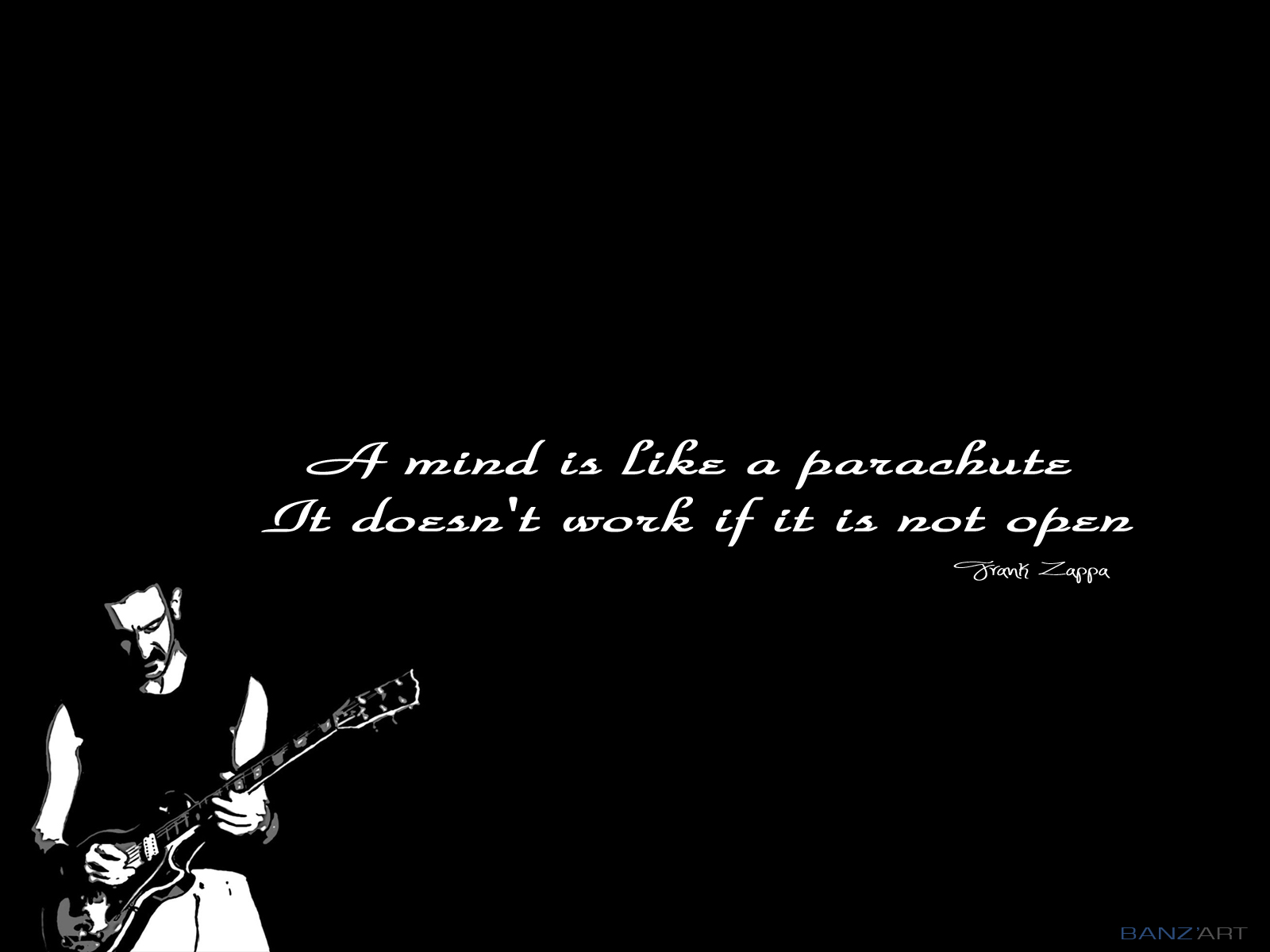
As I was planning to write this blog, I searched in Google for the origin of this quote. This quote is attributed to Author Anthony J. D’Angelo and is taken from his book The College Blue Book: A Few Thoughts, Reflections & Reminders on How to Get the Most Out of College & Life published by Arkad Press in 1995. There is slight variation of this quote attributed to American musician Frank Zappa:

A mind is like a parachute. It doesn’t work if it is not open.

Based on the timeline (Frank Zappa was born in 1940 and died in 1993 whereas Anthnoy J. D’Angelo was a graduate student in the early nineties and published the ‘The College Blue Book’ in 1995), I am assuming that Anthnoy J. D’Angelo was inspired by Frank Zappa’s ‘A mind is like a parachute’ quote and came up with his own modified version of the quote for his book. A collection of Frank Zappa’s quotes can be found at Good Reads. A collection of quotes by Anthnoy J. D’Angelo can be found here.

Note: The photo (by BANZ’ART) for this blog post is used under the creative commons license and was downloaded from Flickr.Mind_Parachute

The Two Best Insurance Products

The two best insurance products in this world are not sold by insurance companies. No, they are not sold by multinational banks either. The government is in no way related to these insurance products. Some of the best minds in economics or finance have got nothing to do with these insurance products.

These two insurance products give the best possible protection in the long term, not only for ourselves but also for our families. So, where can we buy these insurance products? None of us can buy these insurance products anywhere. But we can invest in them. We can invest in these two insurance products at our very own home.

The Two Best Insurance Products are:

  1. Our own (life-long) education
  2. Our Children with the right outlook towards life and right skillsets required for life

So, how much money do we need to invest in them? When it comes to these two insurance products, the primary investment required is not money but our time and effort. We need to invest our time and effort in our continuing education as well as in bringing up our children the right way. Keep in mind these are not one time investment plans but systematic involvement plans (SIP).

Are you investing enough in these two?

True Alchemist

I came across the following quote given under ‘Inspiration Point’ from the blog ‘A Writer’s Path’ attributed to William H. Gass:

The True Alchemists do not change lead into gold; they change the world into words

I guess William H. Gates was referring to writers when he made this comment. As I was reflecting on this sentence it struck me that it would have been better had the comment been:

True Alchemists do not change lead into gold; they change the world with their words

And this comment would also be applicable to Writers.